16 Sun and Moon Matching Tattoos for Couples: A Real Guide Before You Book
Thinking about getting sun and moon matching tattoos with your partner but nervous about picking a design you’ll actually love in ten years? I’ve spent a lot of time talking to tattoo artists, sitting in studio waiting rooms, and watching healed work age on real skin — not just scrolling Pinterest boards. This guide skips the fluff and gets into what actually matters: technique, placement, pain, cost, and how these designs hold up over time.
So what are the best sun and moon matching tattoos for couples? Fine-line, blackwork, and dotwork sun-and-moon pairs work best because they balance symbolism with clean technique — one partner gets the sun, the other the moon, often linked by shared line weight or a matching placement. Simple linework ages more predictably than heavy shading or color.
Below, you’ll find 16 specific design directions, plus placement advice, pain level context, realistic healing timelines, and the exact questions to ask your artist before you sit in the chair.
Why Sun and Moon Designs Work So Well for Couples
Sun and moon tattoos have stuck around for a reason that goes deeper than trend cycles. The imagery naturally splits into two complementary halves — light and dark, day and night, warmth and cool — which makes it one of the easiest concepts to turn into a matching set without both people getting the exact same tattoo. That’s a real advantage over identical matching designs, which can feel less personal once the novelty wears off.
Technically, the sun-and-moon motif also translates well across nearly every tattoo style. A crescent moon or basic sun burst holds up in fine line, blackwork (solid black shapes with no shading, similar to a silhouette), dotwork (shading built from tiny dots instead of solid lines), or bold traditional work. That flexibility means you and your partner can pick different techniques that still feel connected — which matters if one of you wants something subtle and the other wants something bolder.
1. Fine-Line Sun and Moon Wrist Tattoos

Fine-line work uses a thin, consistent needle line — usually a single needle or a small liner — to create delicate outlines without heavy shading. For a couple’s sun and moon set, this usually means a small sun (about 1 to 1.5 inches) on one wrist and a crescent moon of similar scale on the other person’s wrist. Skin texture matters here: fine lines can blur slightly on very oily or textured skin over time, so ask your artist if a slightly thicker line (0.3mm instead of 0.25mm) would hold up better for you specifically. Wrist skin heals in about 2 to 3 weeks but the area sees a lot of friction from clothing and washing, so expect some initial fading.
Pain-wise, the wrist sits over bone and tendon, so it tends to be more sensitive than fleshier spots. This is a solid first-tattoo option since it’s low-commitment and easy to keep hidden at work if needed. From here, some couples want more shading depth, which brings us to dotwork.
2. Dotwork Shaded Celestial Sun and Moon Tattoos

Dotwork builds shading and texture entirely from small dots instead of solid shaded fills, giving the sun and moon a soft, almost stippled glow instead of flat black. This works especially well for a moon with subtle craters or a sun with a gradient burst radiating outward. Because dotwork requires more precise, repeated needle contact, sessions run a bit longer than simple linework, and healing takes closer to 3 weeks as the skin sheds the fine texture. Best placements are flatter areas with less movement — the upper arm, shoulder, or upper back — since dotwork can distort slightly on high-flex areas like the inner wrist. Booking tip: bring reference images showing dot density you like, not just the shape, since “light dotwork” and “dense dotwork” look very different once healed. Pain is moderate to high on fleshier areas because of the repetitive puncturing pattern, though many people find it more tolerable than continuous shading. This style ages well if kept out of direct sun. Next, let’s look at a bolder, simpler alternative.
3. Blackwork Sun and Moon Silhouettes

Blackwork means solid black ink filled in completely, with no shading gradient — think a crisp black crescent moon or a sun with defined triangular rays, like a silhouette cut from black paper. This is one of the most durable styles because solid black holds its saturation longer than fine gray-wash shading, which can look patchy as it fades. A blackwork sun and moon pair looks striking on the forearm, calf, or shoulder blade, ideally sized at 2 to 4 inches so the shapes stay bold rather than becoming a black blob over time. Healing runs about 2 to 4 weeks, and because the needle passes over the same area repeatedly to pack in solid ink, pain tends to run higher than fine line, especially on bony areas.
This style suits people who want something visible and confident rather than subtle — not ideal if you need to keep ink hidden for work. It also photographs cleanly, which matters if you’re documenting the matching set. If solid black feels too heavy, negative space offers a clever workaround.
4. Negative Space Moon with Sun Tattoo

Negative space tattooing uses the untouched, natural skin tone to form part of the image, rather than ink. A common approach here: a solid black circle with an unshaded crescent shape left bare inside it to represent the moon phase, paired with a sun made of black rays radiating around a blank (skin-toned) center. This technique looks especially crisp on lighter skin tones where the contrast between ink and skin reads clearly; on deeper skin tones, an experienced blackwork artist can adjust ray thickness and spacing to keep the negative space visible and legible. Best placement is a flat, larger canvas — outer forearm or upper thigh — since tight negative space details can blur on smaller, curved spots like fingers. Ask your artist for a stencil preview specifically checking the negative space against your actual skin tone before the appointment. Healing takes about 2 to 3 weeks, and touch-ups are common since negative space is more prone to visible fading than solid fills.
Pain is comparable to standard blackwork. This is a striking, less-common choice for couples who want something conversation-starting rather than blending in. Traditional style takes a completely different, more classic route.
5. Bold Traditional Sun and Moon Tattoos

Traditional American tattoo style uses thick black outlines, a limited bold color palette (often red, yellow, and green), and minimal shading gradients. A traditional sun might have a smiling face with thick pointed rays; a traditional moon often gets a similar face with a star nearby. This style was built to last — thick lines and saturated color hold up better over decades than fine detail, which is why old-school flash designs from the 1950s still look readable today. Best placement is the upper arm, calf, or shoulder, sized around 3 to 5 inches to give the linework room to breathe. Healing takes 2 to 3 weeks, with color settling in fully around week 4. Pain is moderate, similar to blackwork, since color passes require extra needle time.
This is a strong long-term choice if you want a design that photographs well and stays legible even after 20 years, though it’s less subtle for workplace settings. For couples wanting more detail without color, geometric styling is worth considering next.
6. Geometric Sun and Moon Tattoos

Geometric tattoos build the sun and moon from clean lines, triangles, and precise angles instead of organic curves — think a moon phase built from overlapping circles or a sun made from a mandala-like radial pattern. This requires very steady linework, so portfolio-checking matters more here than with simpler styles; look specifically for straight lines and symmetrical spacing in an artist’s past geometric work. Good placement options include the forearm, sternum, or upper back, at a size of at least 2.5 inches so the geometric details don’t merge together as the tattoo settles. Healing runs 2 to 3 weeks. Pain level depends on placement, but the sternum and ribs (thin skin over bone) rate higher than the arm. This style suits people who like symbolism paired with a more modern, structured look rather than something soft or whimsical. It’s also a strong option if you want a matching set that still feels distinct — one partner’s geometry can differ slightly from the other’s while still reading as a pair. Moving to smaller scale, let’s talk finger placement.
7. Sun and Moon Finger Tattoos

Finger tattoos place a tiny sun or moon on the side or top of a finger, usually under half an inch. This is one of the trickiest spots for tattoo longevity — skin on the fingers turns over (sheds and regenerates) faster than most other body areas, according to general dermatological consensus, which means finger tattoos fade and blur faster and often need touch-ups within a year or two. If you go this route, ask your artist about using a slightly heavier line than you’d use elsewhere, since finger tattoos can’t hold fine detail long-term. Healing also takes longer to feel “settled” — often 3 to 4 weeks — because fingers flex constantly and are hard to keep bandaged. Pain is notably higher here since it’s bone-close skin with little cushioning.
This is a fun, visible option for couples who want something noticeable, but it’s not the best pick for a first tattoo or for anyone who dislikes the idea of a touch-up appointment down the road. For something with more staying power, consider the ribs instead.
8. Sun and Moon Rib Tattoos
The rib cage offers a larger, more private canvas, which makes it a favorite for couples who want a more detailed sun and moon composition — maybe with added stars, clouds, or a small mountain line beneath the moon. Skin here is thinner and closer to bone, so this consistently ranks as one of the more painful placements, especially for anyone sensitive around the sides. Give yourself 2 to 4 weeks of healing, and expect some discomfort from clothing rubbing the area in the first week. Because it’s easily hidden, it works well if you want a meaningful design without workplace visibility concerns. Booking tip: bring a photo of your torso’s natural curve so your artist can size and angle the stencil to actually fit your body rather than a flat design that distorts once placed. This is a strong pick for a more custom, detailed piece rather than a simple flash design. Next, let’s cover a spot that’s nearly painless by comparison.
9. Sun and Moon Ankle Tattoos

The ankle is a gentler pain option for people nervous about their first tattoo, since it’s away from major nerve clusters, though it still sits close to bone, so it’s not entirely pain-free. A small sun (inner ankle) and moon (outer ankle, or on the partner’s matching ankle) works well at 1.5 to 2 inches. One real tradeoff: ankle tattoos see constant friction from socks and shoes, which can accelerate fading compared to less-exposed areas, so touch-ups every few years are common. Healing takes about 2 to 3 weeks, and swelling in the first few days is normal here due to lower circulation in the lower leg. This placement is easy to hide or show depending on footwear, making it flexible for work settings. It’s also a great matching option since both partners can choose the same visible spot without much size variation. If you’d rather go bigger and bolder, the shoulder blade is worth a look.
10. Sun and Moon Shoulder Blade Tattoos

The shoulder blade gives you a flatter, larger surface, which is ideal for more detailed dotwork or blackwork sun and moon scenes — think a moon with visible phases next to a detailed sun with layered rays. This placement handles detail well because it doesn’t flex or stretch much day to day, so linework holds its shape better over the years compared to joints or high-movement areas. Pain here is moderate; it’s fleshier than the ribs but still has some bony ridges to watch for. Healing typically runs 2 to 3 weeks. This spot is easy to conceal for work with normal clothing, which makes it a popular “best of both worlds” choice — visible when you want it to be, hidden when you don’t. Ask your artist about stencil placement symmetry if you and your partner are getting mirrored designs on the same side of your bodies for photos. From bigger canvases, let’s shrink things down again with minimalist single-needle work.
11. Minimalist Single-Needle Sun and Moon Outlines

Single-needle tattooing is a specific fine-line technique using one very thin needle to create extremely delicate, almost thread-like lines. For sun and moon designs, this usually means a simple outlined crescent and a basic sun circle with a few short rays — no shading, no fill, just clean outline work. This is one of the most subtle options on this list, ideal for someone who wants symbolism without a bold visual statement. Because the lines are so thin, they’re more prone to fading into a soft gray blur after 5 to 10 years, so ask your artist directly how they expect this specific line weight to age on your skin tone before committing. Best placement is a smooth, low-flex area like the outer forearm or collarbone, sized under 2 inches. Healing takes about 2 weeks. Pain is generally lower than bolder styles since the needle isn’t packing in heavy ink. This is a great low-commitment option for a first tattoo or for couples who want something that reads as delicate and private. Behind-the-ear placement takes subtlety even further.
12. Matching Sun and Moon Behind-the-Ear Tattoos

Behind-the-ear placements are tiny by necessity — usually under an inch — which means the design has to be extremely simple: a basic sun dot-and-rays or a plain crescent outline. Detail gets lost fast at this scale, so this isn’t the place for shading or intricate linework. Skin here is thin and the area is bony, so pain tends to run higher than people expect for such a small tattoo. Healing takes about 2 weeks, though hair and glasses can irritate the area during recovery, so ask your artist for specific aftercare notes for this spot. This placement is easy to hide with hair down and easy to show by pulling it back, giving you real control over visibility. It’s a popular choice for couples who want a quiet, personal symbol rather than a statement piece. If pain tolerance is a concern, the outer forearm offers a gentler alternative with more room for detail.
13. Sun and Moon Forearm Tattoos

The outer forearm is one of the most forgiving placements for beginners — fleshier than the wrist, flatter than the shoulder, and easy to see for aftercare monitoring. This makes it a good spot for combining fine line and dotwork in one piece, like a linework sun paired with a dot-shaded moon for contrast between the two symbols. Sizing between 2 and 3.5 inches gives enough room for that contrast to actually show once healed. Healing runs about 2 to 3 weeks. Pain is generally moderate and tolerable for most first-timers. This placement is fully visible in short sleeves, so it’s worth discussing workplace dress codes before booking if that’s a concern. It also ages reasonably well since the skin here doesn’t stretch dramatically over time for most body types. Couples often pick mirrored forearm spots so the two tattoos face each other when holding hands. Let’s look at a option that leans into color next.
14. Colored Sun and Moon Tattoos with Warm and Cool Palettes

Adding color gives you a natural way to visually split the pair — warm oranges and yellows for the sun, cool blues and purples for the moon. Color saturation depends heavily on skin tone and the artist’s color-mixing experience, so review portfolio work specifically on skin tones similar to yours before booking. Color tattoos also fade differently than black ink; lighter colors like yellow tend to soften faster under UV exposure, so consistent sunscreen use on the area is something most artists will recommend once healed. Best placement is a flatter, larger area — forearm, calf, or shoulder — at 3 inches or larger so color has room to sit without muddying into surrounding lines. Healing takes 2 to 4 weeks, with color settling fully by week 4. Pain is moderate to higher than black-ink-only work due to extra passes. This is a good option for couples who want their tattoos to feel more vibrant and less “matching gray outline.” A mandala-inspired approach offers another way to add visual complexity.
15. Mandala-Style Sun and Moon Tattoos
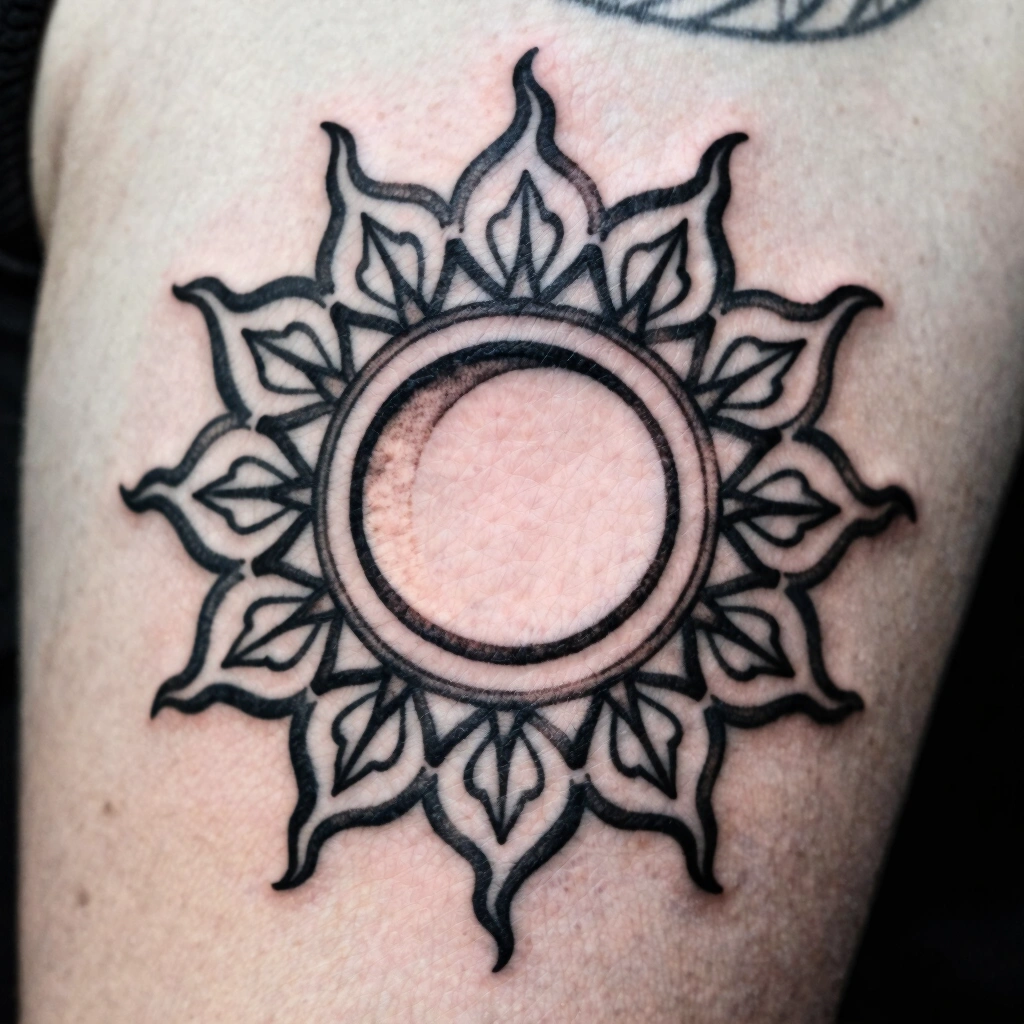
Mandala work incorporates repeating symmetrical patterns radiating from a center point — here, that center becomes the sun or moon shape, surrounded by lace-like linework or geometric borders. This requires a lot of precise, small-scale linework, so healing can look a little uneven in the first week as the skin flakes over dense detail; this is normal and not a sign of a bad tattoo. Best placement is the upper arm, thigh, or upper back, sized at 3 inches minimum since mandala detail disappears fast at smaller scale. Pain is moderate to high depending on placement and session length, since mandala pieces often take longer in the chair. This is a strong pick for couples who want a more ornate, detailed matching set rather than something simple. Ask to see healed (not just fresh) mandala photos in your artist’s portfolio, since fresh tattoos always look sharper than they will in six months. For something with a totally different mood, a simple sun/moon face brings a softer, whimsical option.
16. Sun and Moon Face Tattoos
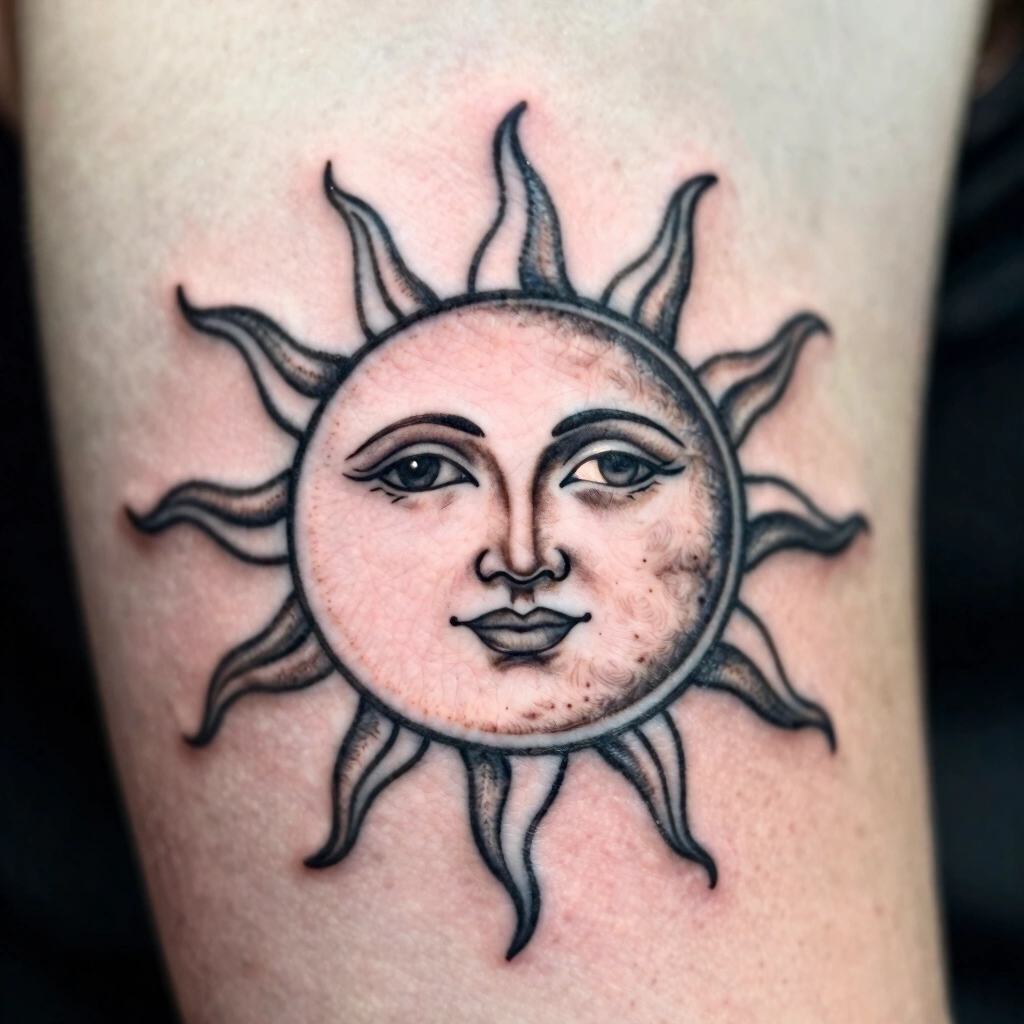
This design gives the sun and moon simple human-like expressions — a small smiling or peaceful face inside the sun’s rays or the moon’s crescent, similar to old folklore illustrations. It works well in fine line or bold traditional style, and it tends to feel more playful and less symbolic-heavy than other options on this list. Best placement is the upper arm or calf at around 2 to 3 inches, giving the facial details enough room to stay clear as the tattoo settles. Healing takes about 2 to 3 weeks. Pain is generally moderate, depending on exact placement. This design suits couples who want something a little more lighthearted and personality-driven rather than strictly symbolic. It’s also a flexible option for matching sets since each partner’s face expression can differ slightly while still clearly belonging to the same set.
Fine Line vs. Blackwork vs. Dotwork: Quick Definitions
- Fine line: Thin, single-needle outlines with no shading or fill; delicate look, ages toward a soft gray over many years.
- Blackwork: Solid black ink filled completely with no gradient; high contrast, holds saturation longer than fine detail.
- Dotwork: Shading and texture built from small individual dots instead of solid lines; creates a soft, textured gradient effect.
- Traditional (American traditional): Thick black outlines with bold, limited color palette; built for long-term legibility.
- Negative space: Uses bare, uninked skin as part of the design, usually framed by surrounding black ink.
Best Placement Ideas
- Wrist — highly visible, moderate pain, faster fading from friction and washing
- Forearm — good detail retention, moderate pain, easy to show or cover
- Ribs — private, higher pain, good for detailed custom pieces
- Ankle — lower pain, but faster fading from shoes and socks
- Shoulder blade — low movement, holds detail well, easy to conceal for work
- Behind the ear — very private, higher pain for the size, size-limited
- Fingers — highly visible, higher pain, fastest fading, frequent touch-ups likely
Tips for Success
Before booking, look through at least 20–30 healed photos (not just fresh ink) in an artist’s portfolio — healed work tells you how their line weight and shading actually hold up. Look specifically for consistency: even line thickness, clean symmetry, and smooth shading transitions. If you want a fine-line specialist, check that their portfolio is mostly fine line, not someone who dabbles in it occasionally. Bring reference images that show the specific line weight, size, and shading density you want, not just the general concept — artists can’t read your mind about how bold or subtle you want the final piece. Ask directly about their experience tattooing your skin tone, especially for color or negative-space designs. And always confirm whether it’s a walk-in flash design (pre-drawn, faster, usually cheaper) or a fully custom booking (more planning time, usually pricier, but tailored to your idea).
Common Mistakes and How to Avoid Them
- Sizing too small for the detail level — mandala or dotwork designs need more space than fine line to stay legible over time.
- Choosing a high-flex placement for delicate linework — joints and high-movement areas distort fine detail faster.
- Skipping the artist’s aftercare sheet — general internet advice doesn’t account for your specific ink, technique, or skin.
- Copying a design exactly without personalizing it — small tweaks (different ray count, a personal date hidden in the design, slightly different phase of the moon) keep a matching couple’s tattoo from feeling generic.
- Not asking about touch-ups upfront — some styles (negative space, fine line, finger placements) predictably need a refresh sooner than others.
Similar Variations
Nearly every idea on this list can be resized up for more detail or down for subtlety. A blackwork sun and moon can drop the solid fill and become a negative-space version instead. A colored traditional design can be redone in black-and-gray for a more muted, workplace-friendly look. Couples wanting more personalization often combine two techniques — like a fine-line moon paired with a dotwork-shaded sun — so the set feels connected but not identical.
Aftercare Basics
Aftercare instructions vary by artist and by studio, so always follow the specific sheet you’re given rather than generic advice online. In general, most artists recommend keeping the area clean, avoiding direct sun and swimming during initial healing, and avoiding tight clothing over fresh placements like the ribs or ankle. Healing timelines in this article are general estimates — individual healing speed depends on your skin, immune response, and how well you follow aftercare, so check in with your artist or a dermatologist if anything looks unusual.
Quick FAQ
How much do sun and moon matching tattoos cost?
Small, simple fine-line designs often start around $80–150 per person at many studios, while larger custom or color pieces can run $200–500 or more, depending on size, detail, and the artist’s experience level. Always ask for a direct quote during consultation.
Do sun and moon tattoos hurt a lot?
Pain depends heavily on placement and personal tolerance. Fleshier areas like the forearm or calf tend to feel more tolerable, while bony spots like the ribs, wrist, or fingers tend to rate higher on most people’s pain scale.
How long does healing take?
Most placements heal visibly within 2 to 3 weeks, though full settling under the skin can take up to 6 weeks. Fingers and high-movement areas often take a bit longer.
Will the design fade or need touch-ups?
Yes, especially fine line, negative space, and high-friction placements like fingers or ankles. Solid blackwork and traditional color tend to hold saturation longer, but touch-ups after several years are common across nearly every style.
Final Thoughts
Sun and moon matching tattoos for couples work because the imagery naturally divides into two connected halves without forcing you both into an identical design. The real decision isn’t just “sun or moon” — it’s picking the right technique, placement, and size for how you actually want it to look in ten years, not just tomorrow. Take the time to find an artist whose healed portfolio matches the style you want, ask direct questions about your skin and pain tolerance, and remember that a little personalization goes a long way toward making a shared design feel like yours. Pain tolerance and healing vary from person to person, so talk to a licensed, professional tattoo artist — and a dermatologist if you have skin concerns — before booking anything permanent. With the right prep, sun and moon matching tattoos for couples can turn into one of the most meaningful, well-aged pieces either of you ever get.