23 Bluebell Flower Tattoo Ideas For Women (With Placement, Pain, and Booking Advice)
Nervous about picking a bluebell flower tattoo you’ll actually still love in ten years? You’re not alone — flower tattoos are some of the most requested designs at studios, and bluebells specifically have a quiet, romantic quality that a lot of women want, but a lot of them also worry about getting the details wrong. This guide was built by looking closely at what actually matters before you sit in the chair: technique, placement, pain, healing, and how to talk to your artist so you get a design that ages well, not just one that looks good in a photo.
So what are the best bluebell flower tattoo ideas for women? The strongest options are fine-line single stems, dotwork clusters, blackwork silhouettes, and small botanical wrist or ankle pieces, because bluebells have delicate, bell-shaped petals that read clearly in simple linework and hold up over years better than heavily shaded or oversized designs. Color versions work too, but they need more upkeep and a longer touch-up conversation with your artist.
Below, you’ll get 23 specific bluebell design directions, plus the practical stuff most articles skip — pain levels by placement, realistic healing windows, how to brief your artist so the stencil actually matches your vision, and the mistakes that make people regret a design a few years down the line.
Why Bluebell Flower Tattoos Work So Well on Skin

Bluebells have a naturally graceful shape — a curved stem with several drooping, bell-like flowers along one side. That asymmetry is actually a gift for tattoo artists, because it gives a design natural movement without needing heavy shading or color to look dynamic. A single line can carry the whole composition. That’s why bluebells translate so well into fine-line work, the delicate style using a thin, consistent line (often done with a single needle) that mimics pen-and-ink botanical drawings. They also carry meaning many women connect with — humility, gratitude, and lasting love in flower symbolism — which matters if you want a tattoo that means something beyond decoration.
Before we get into the 23 designs, it helps to know how the main techniques differ, since your choice affects healing time, longevity, and how the piece ages on your skin.
Fine line — Thin, precise strokes made with a single needle or small needle grouping. Reads as delicate and drawing-like. Ages well in small sizes but can blur slightly after 10+ years, especially on thinner skin.
Blackwork — Bold, solid black shapes or silhouettes with heavier ink saturation. High contrast, holds up longer without touch-ups, but less delicate-looking.
Dotwork — Shading and texture built from tiny individual dots instead of solid fill or line shading. Creates soft gradients and a stippled texture; takes longer to tattoo than linework.
Watercolor-style — Color applied in soft, blended washes without hard outlines, mimicking a painted look. Visually striking fresh but historically fades faster and may need more frequent touch-ups since there’s no bold linework to anchor the color.
Negative space — Design relies on untattooed skin to form part of the image, using surrounding black or shaded areas to define shape instead of outlines.
Keep these distinctions in mind as you go through the ideas below — I’ll flag which technique fits each one best.
1. Fine-Line Single Bluebell Stem
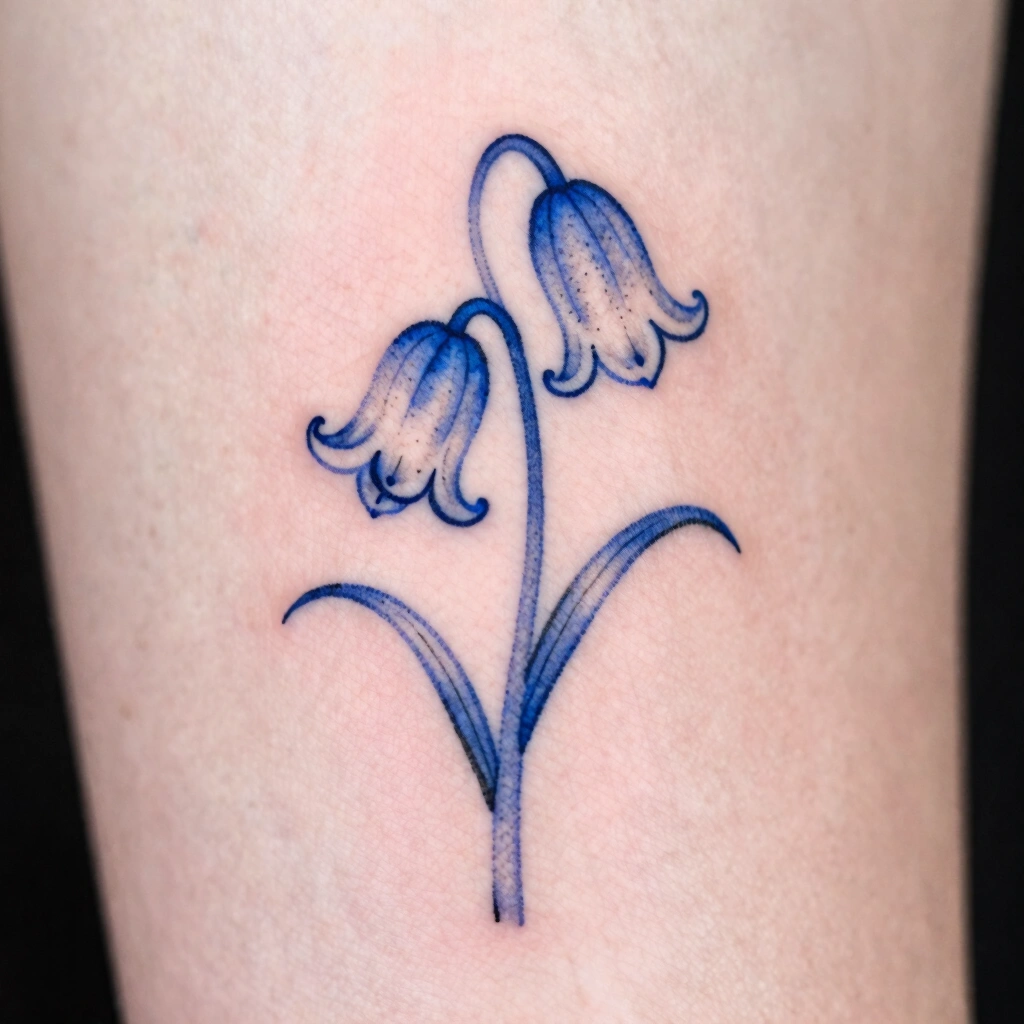
This is the classic starting point: one bluebell stem, rendered in a thin, consistent line with no shading. The line weight stays uniform throughout, which is what gives it that clean, botanical-illustration look. It’s a strong first-tattoo option because it’s small, quick to complete (often under an hour), and doesn’t require complex color matching down the line. Best placement is the inner forearm, wrist, or ankle, where a 2–3 inch vertical design has room to breathe. Skin with visible texture or lots of freckling can slightly obscure very thin lines, so ask your artist if a marginally heavier line weight suits your skin. Pain is generally mild to moderate on fleshier areas, more noticeable directly over wrist bone. Bring a botanically accurate reference photo, not just a cartoon version, so the stem curve looks natural. This simplicity makes a great base before we look at bolder variations next.
2. Watercolor Bluebell Cluster

A watercolor-style cluster uses soft blended blues and purples without hard black outlines, giving the flowers a painted, almost dreamy appearance. This works well on the upper arm, shoulder, or shoulder blade, where there’s enough flat space for the color to blend smoothly. Expect a longer session than linework, since color layering takes more passes. Healing typically runs 2–3 weeks, and because there’s no bold outline anchoring the pigment, fading is more noticeable over 5+ years — plan for touch-ups sooner than you would with blackwork. This style suits people who want something visually bold but are comfortable with more maintenance. Ask your artist to see healed (not fresh) photos of their watercolor work in their portfolio, since fresh color always looks more saturated than it will after healing. This leads naturally into a bolder, longer-lasting alternative: blackwork.
3. Blackwork Bluebell Silhouette

Instead of individual petal detail, a blackwork silhouette renders the whole bluebell cluster as a solid, deep-black shape — essentially a botanical outline filled completely in. This technique holds ink density better over time than fine line or watercolor, meaning less noticeable fading at the 10-year mark. It reads well from a distance, so it suits visible spots like the forearm or calf if you want something that still looks sharp on faded old ink years later. Sizing should be at least 3 inches to keep the bell shapes distinguishable rather than blobby. Pain level is similar to standard linework since it’s mostly outline and fill, not repeated needle passes. A good tip: ask your artist about “line boldness” specifically — bluebell stems are thin, and a good blackwork artist will vary thickness to keep the flower shape recognizable rather than one solid blob. Next, let’s look at a texture-driven option using dotwork.
4. Dotwork Shaded Bluebell

Dotwork replaces smooth shading with thousands of tiny dots that build up gradual light-to-dark gradients, giving the bluebell a soft, almost velvety texture instead of flat color. This suits the upper back, ribs, or thigh, where there’s enough space for the dot pattern to read clearly — dotwork shrunk too small just looks like smudges. Sessions run longer than basic linework because of the density of dots required. Healing takes about 2–3 weeks, and dotwork ages reasonably well if the original saturation was strong. Rib and sternum placements tend to rank higher on the pain scale due to thin skin and less padding, so mentally prepare for that if you choose this spot. Bring reference images showing dot density you like — tight dots for darker shading, sparse dots for a lighter gradient — since “shading” alone isn’t specific enough direction for an artist. From here, let’s combine bluebells with another popular motif: the butterfly.
5. Bluebell and Butterfly Combination

Pairing a bluebell stem with a small butterfly creates visual balance — the flower’s downward curve contrasts with the butterfly’s upward wing lines. This combo works especially well in fine line or light blackwork, keeping both elements from competing for attention. Placement on the collarbone, shoulder, or upper back gives enough horizontal space for both elements without cramming. Keep the overall design under 4 inches wide so neither motif gets lost in shading. Healing runs standard, about 2 weeks for surface peeling, longer for full ink settling. This design suits people wanting a bit more symbolic complexity — bluebells for humility or remembrance, butterflies for transformation — without going into a full sleeve piece. Ask your artist to sketch the composition first so the two elements are proportionally balanced instead of one overpowering the other. Next up is a design built for absolute minimalists.
6. Minimalist Single-Needle Bluebell Outline

If subtlety is your priority, a single-needle outline strips the bluebell down to its simplest recognizable shape — no shading, no fill, just a thin continuous line. This is the least painful and quickest option on this list, often finished in 20–30 minutes, making it a low-commitment way to test whether you like having tattoos before going bigger. Best placements are the wrist, finger side, behind the ear, or ankle — spots where a tiny design won’t get visually lost. One honest tradeoff: single-needle work is more prone to blurring over the long term than slightly bolder linework, especially in areas with more movement and friction, like the inner wrist. Ask your artist about needle gauge and whether they recommend sizing it up slightly for longevity’s sake. This is a great workplace-safe option since it’s easy to keep discreet. Let’s look at a more elaborate composition next — the wreath.
7. Bluebell Wreath (Circular Composition)

A wreath arranges multiple bluebell stems in a circular pattern, often with the stems overlapping slightly at the base. This composition is naturally suited to rounded body areas — the upper arm, the space between shoulder blades, or even wrapping partially around the ankle. Fine line or light blackwork both work, but the circular symmetry needs a confident, steady hand, so review portfolio work specifically showing circular botanical pieces before booking. Expect a longer sitting, often 1.5–3 hours depending on detail level and size (ideally no smaller than 4 inches across to keep individual flowers distinguishable). Pain varies by exact placement — upper arm is generally more tolerable than the ankle bone. This design works nicely as a meaningful milestone piece since wreaths often symbolize completion or a full cycle. From a full circle, let’s shrink things down to a tied bouquet instead.
8. Bluebell Bouquet With Ribbon Detail

A bouquet composition bundles several bluebell stems together with a ribbon wrapped around the base, adding a decorative line element that also helps frame the piece. This works well in fine line with a slightly bolder line for the ribbon to create subtle contrast in weight. Good placement options include the forearm, thigh, or upper back. Because there’s more going on visually — multiple stems plus a ribbon — give this design at least 3–4 inches of space so the linework doesn’t blur together as it settles into skin over the following weeks. Healing typically takes 2 weeks for the surface, though full color or shading settles closer to a month. This piece suits people wanting something that feels a little more “finished” and gift-like in composition, often chosen to mark an occasion or relationship. Next, let’s look at pairing botanical accuracy with text.
9. Botanical Bluebell With Latin Name Script

Combining a scientifically accurate bluebell illustration (Hyacinthoides non-scripta is the common English bluebell) with its Latin name in small script gives the tattoo an academic, herbarium-page feel. This works best in fine line, keeping the script small and legible — script that’s too tiny tends to blur within a few years, so don’t go below roughly 0.25 inches in letter height. Forearm and ribcage placements give enough length for both the illustration and the text line. Bring a real botanical illustration reference, not a stylized cartoon flower, since accuracy is the whole point of this design. Healing follows standard timelines, roughly 2–3 weeks. This suits people who want their tattoo to read as thoughtful and precise rather than purely decorative. From here, we move into a very different visual approach: negative space.
10. Negative Space Bluebell

Negative space designs use the surrounding tattooed area (usually solid black or heavy shading) to define the bluebell’s shape, leaving the flower itself as untouched skin. This creates a striking, almost glowing effect where the flower appears to “pop” out of a dark background. It requires a highly skilled blackwork artist, since precision around the flower’s outline determines whether it looks intentional or just unfinished. Best suited to the upper arm or calf, where there’s enough surrounding space for the black background to make sense compositionally. This is a longer, often multi-session tattoo and ranks higher on the pain scale due to the amount of solid black fill involved. It’s a strong option if you already have surrounding blackwork and want to incorporate a botanical element without adding more color. Next, let’s look at wrap-around designs for limbs.
11. Bluebell Vine Wrap

A vine wrap follows a curved line around the wrist, ankle, or forearm, with bluebell flowers branching off at intervals along the main stem. This uses the body’s natural curve as part of the composition, which is why measuring the area carefully before finalizing stencil size matters — a design drawn flat on paper doesn’t always wrap evenly once transferred. Fine line keeps this delicate; a slightly bolder line adds durability on higher-friction areas like the wrist. Expect moderate pain on the ankle and wrist due to thinner skin and less muscle padding underneath. This design is popular for matching or semi-matching tattoos among friends, since each person’s wrap can vary slightly in flower count while keeping the same visual theme. Ask your artist to do a paper or henna trial-wrap on your skin before the actual stencil session if you’re unsure about placement. Let’s pair botanical elements with a celestial motif next.
12. Bluebell and Moon Combination

Pairing a small crescent moon with a bluebell stem creates a quiet, symbolic composition — often read as growth happening even in darker or quieter periods. Fine line or light dotwork shading both suit this pairing well. Placement options include the upper back, behind the shoulder, or the outer forearm. Keep the moon smaller than the flower or vice versa to establish a clear visual hierarchy — two equally-sized elements can look cluttered rather than composed. Pain is generally mild to moderate depending on placement, with fleshier areas being more comfortable. This design works for people wanting personal symbolism without spelling it out literally through text. It also ages fairly well since the moon shape holds solid linework nicely over time. Now let’s go even smaller with a micro placement idea.
13. Bluebell Behind-the-Ear Micro Tattoo

A tiny single bluebell tucked behind the ear is about as discreet as tattoos get — usually under an inch, done in fine line with minimal to no shading. This spot suits people who want something meaningful but easy to hide with hair, useful for workplaces with strict visible-tattoo policies. Healing here can be slightly trickier since the skin folds and touches hair and phones frequently, so ask your artist for specific care instructions for this exact spot. Pain tends to run moderate to high here due to the thin skin and proximity to cartilage, so mentally prepare for a sharper sensation than on the arm. Because of the small size, fine detail (like individual petal lines) may blur within several years — a simplified two- or three-line version tends to age better here than something intricate. From this tiny scale, let’s go the opposite direction with a spine-length trail.
14. Bluebell Spine Trail

A spine trail runs a chain of small bluebell flowers vertically down the upper-to-mid back, following the spine’s natural line. This is a striking placement precisely because the body’s shape does most of the compositional work — you don’t need much embellishment beyond the flowers themselves. Fine line or light blackwork both work, though blackwork holds up better on this frequently-clothed, friction-prone area over the years. Sizing should scale gradually, larger flowers near the top, smaller toward the lower back, to keep the trail visually balanced. Pain here ranks higher than most placements on this list, since the spine has thin skin directly over bone with little cushioning. Sessions may need to be split into two sittings if the trail is long. This is a striking option for special-occasion or milestone tattoos rather than a casual first piece. Let’s shift to a more painterly, realistic rendering next.
15. Realistic Colored Bluebell in Botanical Style

A fully realistic, colored bluebell rendered almost like a botanical painting uses gradient shading and color blending (blues, violets, greens) to mimic how the flower actually looks in person. This is one of the more advanced and time-intensive options on this list, often requiring an artist who specializes specifically in colored realism rather than a generalist. Best placement is the upper arm, thigh, or shoulder, where there’s flat, ample space for gradient shading to read properly. Expect multiple hours in the chair and possibly a follow-up session. Color-heavy realism needs more diligent aftercare and is more prone to fading unevenly if exposed to prolonged sun without protection over the years, so factor future touch-ups into your budget expectations. This suits someone who wants their tattoo to look closer to fine art than symbolic linework. Next, let’s connect bluebells to another common personalization trend: birth flowers.
16. Bluebell as a Birth Flower Piece

Bluebell is associated with certain birth months in flower folklore, and some women pair it with a small birthstone-shaped gem outline or the month written in small script. This gives the tattoo built-in personal meaning beyond aesthetics. Fine line suits this combination well, keeping both the flower and the accompanying symbol delicate and proportionate. Wrist, collarbone, or ankle placements work nicely for a piece meant to stay small and personal. Because this design often includes tiny secondary details (a gem outline, a date, a month name), ask your artist about minimum legible sizing before finalizing — text or shapes under roughly a quarter inch risk blurring into illegibility over time. This works well as a solo meaningful piece or as part of a larger personalized collection across your body. From personal symbolism, let’s look at a nature-pairing option with birds.
17. Bluebell and Small Bird Combination

Pairing a bluebell with a small bird — often a wren or sparrow silhouette — creates a nature-scene feel rather than a purely botanical one. Fine line or light blackwork both work here, with the bird typically rendered as a simple silhouette to avoid overcomplicating the composition. Good placement options are the shoulder, upper arm, or ribs. Keep the bird smaller in visual weight than the flower cluster so the piece doesn’t read as two competing subjects. Rib placement ranks higher in pain due to thin skin over bone and limited padding, so budget extra recovery time mentally if you pick that spot. This combination suits people drawn to freedom or resilience symbolism alongside the softer meaning bluebells carry. It’s also a solid option for a first larger tattoo if you’ve already got a small piece and are ready to size up. Let’s move to a bolder, larger-scale placement next.
18. Bluebell Cluster on the Ribcage

A fuller cluster of bluebells across the ribcage makes a bold but still feminine statement, especially in fine line with light dotwork shading for depth. This placement is known for ranking among the more painful spots on the body due to thin skin directly over bone and cartilage with little muscle cushioning — many people describe it as more intense than the arm or leg. Sessions may need breaks or splitting into two visits for larger designs. Healing also takes a bit more care here since clothing friction against the ribs can irritate the area during the first couple of weeks. This spot suits people comfortable with a more private placement, since it’s easily covered by clothing but visible in swimwear. Because ribs sit close together, keep individual flower spacing generous so the linework doesn’t crowd once swelling goes down. Next, a design built specifically for shared tattoos.
19. Matching Bluebell Tattoos for Friends or Sisters

Matching tattoos work best when they’re simple enough to look intentional on different body types and skin tones, which is exactly why a small fine-line bluebell stem is such a common matching choice. Each person can vary size slightly, or one stem can face the opposite direction from the other, giving a “mirrored” effect that still reads as a set. Good shared placement options include the wrist, ankle, or behind the ear. Since matching tattoos are often done same-day, book appointments back-to-back with the same artist if possible for visual consistency in line weight. Pain will vary between each person regardless of identical placement, since individual tolerance differs — a fact worth setting expectations around beforehand. This works well as a milestone tattoo for friendships, siblings, or even a parent-and-child pairing. Let’s look at name integration next.
20. Bluebell With Name or Initial Script

Wrapping a bluebell stem around a small initial or name in cursive script personalizes the design further, often chosen as a quiet tribute. Keep the script size proportionate — cursive letters under roughly 0.3 inches tend to blur together over the years, especially at higher-friction placements like the wrist. Fine line suits both the flower and script uniformly, keeping visual consistency. Forearm, collarbone, and ankle are common placements for this style. Bring your exact spelling and preferred font style to your consultation, since script tattoos are one of the hardest to fix later if there’s a spacing or spelling error in the stencil. This design suits meaningful, personal tattoos more than casual decorative ones. From personalized script, let’s look at a more abstract geometric take.
21. Bluebell Mandala-Style Design

Blending bluebell motifs into a mandala — a symmetrical, radiating geometric pattern — combines botanical softness with structured geometry. This typically uses fine line or blackwork with dotwork shading filling in gaps between petals for texture. Because symmetry is central to mandala designs, this style demands a steady-handed artist experienced specifically in geometric work; review their portfolio for evenness across radiating lines. Best placement is the upper back, chest, or thigh, where there’s enough flat space for the full radial pattern to sit without distortion from body curves. Expect a longer session, often multiple hours, due to the detail density. This design suits people wanting something visually complex and less obviously “just a flower tattoo,” blending nature with pattern work. Let’s look at a hyper-realistic hanging branch design next.
22. Bluebell Hanging From a Branch (Realistic Style)

This design mimics how bluebells naturally droop from a stem in a woodland setting, rendered with soft, realistic shading rather than flat linework. Grey-wash shading (black ink diluted to create grey tones) or light color work both suit this style, giving the piece depth without needing full saturation. Best placement is the upper arm, shoulder, or thigh, where the vertical drooping shape has room to sit naturally. This style requires more shading time than simple outline pieces, so budget for a longer sit. Pain is fairly standard for shading work — moderate, manageable in short breaks. This suits people who want something that looks more like a nature illustration than a symbolic icon. Finally, let’s close the list with a more reflective, memorial-style option.
23. Bluebell Memorial Tattoo With Dates

Many women choose bluebells specifically for memorial tattoos, pairing a single stem with small text — initials, a date, or a short phrase. Fine line keeps this understated and personal rather than decorative. Common placements include the inner forearm, ribcage, or behind the ear, depending on how private or visible you want the tribute to feel. Because this design carries personal weight, take time during your consultation to get the wording and stencil exactly right before the needle touches skin — memorial pieces are the ones people most regret rushing. Pain will vary by chosen placement, following the same general patterns as other designs on this list. This is a design many people keep small and quiet rather than large and bold, letting the meaning carry the piece rather than the size.
Best Placement Ideas

Choosing where to put your bluebell tattoo affects visibility, pain, and how much upkeep it’ll need over the years:
- Wrist — Highly visible, moderate pain due to thin skin over bone, easy to show off or cover with a watch/sleeve.
- Ankle — Similar visibility tradeoffs to the wrist; footwear friction can affect healing, so loose socks and shoes matter early on.
- Behind the ear — Very easy to conceal with hair, moderate-to-higher pain due to cartilage proximity, smaller designs age best here.
- Forearm — Good middle ground for pain (fleshier than wrist), easy to show or cover with sleeves, plenty of space for detail.
- Ribcage — Higher pain due to thin skin over bone, private placement, great for larger clusters since clothing usually covers it.
- Upper back/shoulder blade — Lower pain, lots of space for larger or wreath-style compositions, easy to conceal for work.
- Spine — Higher pain, striking visual effect, best for symbolic or milestone pieces rather than first tattoos.
- Collarbone — Moderate pain, great visibility for smaller pieces, works well with script or bouquet designs.
Tips for Success

Start by looking specifically for a fine-line specialist or an experienced blackwork artist depending on which style you’ve chosen — not every talented tattooer works comfortably in every technique. Look through their portfolio for healed photos, not just fresh ink, since healed results tell you how their linework and shading actually hold up. Bring multiple reference images to your consultation, including at least one accurate botanical photo of a real bluebell, so your artist understands proportion and petal structure rather than guessing from a rough sketch. Ask directly about their approach to line weight and needle size for your chosen placement, and don’t hesitate to request a custom design rather than a generic flash tattoo pulled straight from a wall display — custom stencils fit your specific body curve better. Confirm the shop follows standard sterilization and licensing practices, and always get a written aftercare sheet before you leave.
Common Mistakes and How to Avoid Them

- Sizing too small for the detail level chosen — Intricate shading or script needs more room to stay legible over the years; simplify the design or size it up.
- Choosing a placement that fights the linework — Wrap-around designs need a curved body area; flat compositions need flat skin. Match the design shape to the body part.
- Skipping personalized aftercare instructions — Every artist has slightly different recommendations; follow the specific sheet you’re given rather than generic internet advice.
- Copying a design exactly with no personalization — A completely unoriginal flash piece may look identical to strangers’ tattoos; even small tweaks (flower count, stem curve, added initial) make it yours.
- Ignoring portfolio consistency — If an artist’s portfolio shows uneven line weight or blown-out shading in healed photos, that inconsistency will likely show up in your piece too.
Similar Variations

Nearly every idea above can shift in mood with small changes. A fine-line single stem becomes bolder simply by thickening the outline into light blackwork. A colored realistic bluebell can be muted into a soft grey-wash version for a subtler, longer-lasting look. Clusters can shrink into a single stem for a first tattoo, then later expand into a fuller wreath or bouquet as an anniversary piece. Matching friend tattoos can incorporate individual differences — one person’s stem facing left, another’s right — while keeping the shared meaning intact. Mixing techniques, like fine-line flowers with dotwork shading in the background, is also a common way to add depth without going fully into bold blackwork territory.
Aftercare Basics

Aftercare directly affects how a tattoo looks years down the line, so treat it seriously rather than as an afterthought. In general, keep the area clean, avoid direct sun exposure while it’s healing, don’t pick at any peeling skin, and avoid soaking it in pools or baths until it’s fully healed. Wear loose clothing over the tattooed area for the first week or two to reduce friction. These are general points only — your artist’s specific aftercare sheet should always take priority, and any unusual redness, swelling, or irritation should be checked by a licensed dermatologist or medical professional rather than self-diagnosed online.
Quick FAQ

How much does a bluebell flower tattoo usually cost?
Small fine-line designs often start in the range of $80–$200 depending on studio location and artist experience, while larger clusters, wreaths, or color realism pieces can run several hundred dollars or more due to added session time. Always ask for a quote during your consultation rather than assuming a flat rate.
Does a bluebell tattoo hurt a lot?
Pain depends heavily on placement and individual tolerance. Fleshier areas like the upper arm or thigh tend to be more comfortable, while bony areas like the ribs, spine, and ankle are generally reported as more sensitive.
How long does healing take?
Surface healing typically takes about 2–3 weeks, though full settling under the skin can take up to a month or more. Healing time varies by individual and by placement, so treat any timeline as a general estimate, not a guarantee.
Will a small bluebell tattoo blur over time?
Very fine, thin lines can soften slightly over many years, especially on high-friction areas like the wrist or fingers. Slightly bolder linework or blackwork tends to hold its shape longer, which is worth discussing with your artist if longevity matters more to you than extreme delicacy.
Final Thoughts

A bluebell flower tattoo works because the flower’s natural shape does most of the visual heavy lifting, whether you go tiny and delicate or bold and clustered across your ribs. What actually determines whether you’ll love it in ten years isn’t the flower itself — it’s the placement choice, the technique match, and whether you picked an artist whose healed work backs up their claims. Take the time to ask questions, bring real references, and be honest with yourself about pain tolerance and upkeep before booking. Do that, and a bluebell flower tattoo can end up being one of the most quietly meaningful pieces you own.