21 Beauty and the Beast Rose Tattoo Ideas That Actually Hold Up on Skin
Thinking about getting a Beauty and the Beast rose tattoo but worried you’ll end up with something that looks like clip art in five years? I get it. This design theme is everywhere right now, and a lot of the inspiration floating around online is pretty images with zero practical advice attached. I’ve spent a good amount of time talking to tattoo artists and watching how these designs actually age, heal, and fit into real lives — not just Pinterest boards. This guide is built from that.
So what are the best Beauty and the Beast rose tattoo ideas? The strongest options use fine-line detailing, dotwork shading, or bold blackwork to capture the enchanted rose’s fragility and drama — think wilting petals, bell jars, or negative-space outlines. These styles hold detail well over time and work at almost any size, from a coin-sized wrist piece to a full forearm design.
Before you scroll through the list, stick around for the parts most articles skip: where these designs age well, what they’ll actually cost, how painful each placement tends to be, and exactly how to brief your artist so you don’t end up with a muddy blob of ink in three years.
Why the Enchanted Rose Works So Well as a Tattoo Theme

The rose from Beauty and the Beast isn’t just a pretty flower — it’s a countdown clock, a symbol of a curse, and a stand-in for fragile beauty under pressure. That built-in tension is exactly what makes it translate so well into ink. A rose with a single falling petal or a crack in its glass dome carries a story without needing any text. It also happens to be a genuinely versatile shape: roses can be rendered tiny and minimal or large and painterly, in solid blackwork or soft watercolor washes, and they read clearly on almost every skin tone. That flexibility is why this theme keeps showing up in tattoo portfolios years after the movie’s initial wave of popularity.
Fine-Line Enchanted Rose in a Bell Jar
This is probably the most requested version, and for good reason. A fine-line artist uses a thin, consistent needle line — usually a single needle or a small liner — to draw the rose and glass dome without heavy shading, letting the linework itself do the visual work. The glass is suggested through subtle outline breaks rather than solid shading, which keeps the piece looking light and airy. This works beautifully on the forearm, upper arm, or ribs at 3 to 5 inches tall; going smaller than 2 inches risks the glass lines blurring together after a few years. Healing typically runs 10 to 14 days for line work this fine. Bring a clean reference sketch, not just a screenshot, so the artist can adjust the linework specifically for your skin’s texture. Pain is generally moderate on the forearm and higher on the ribs, since thin skin over bone tends to be more sensitive. It’s a solid first-tattoo option because it’s not overly bold, which makes it easier to keep low-key for work settings. From here, a lot of people add subtle shading to the next version for extra depth.
Blackwork Rose with Thorned Stem

Blackwork relies on solid black ink and heavy saturation rather than fine gradients, and a thorned rose stem is a natural fit for this style. The stem gets rendered with sharp, angular thorns and deep, even fill, while the rose head itself might use negative space — meaning the artist leaves small unbinked patches of skin to imply petal folds instead of drawing every line. This creates high contrast that photographs well and stays crisp even after a decade, since solid black holds up better over time than fine gradients. Best placed on the calf, upper arm, or shoulder blade where there’s room for the stem to trail naturally. Aim for at least 4 inches in length so the thorn detail doesn’t clump together as it settles. Healing takes about two weeks, with some scabbing expected over the denser black areas. Ask your artist about their preferred liner needle size before booking, since thorn tips need crisp points. Pain runs moderate to high on fleshy areas but noticeably sharper over the shoulder blade. This design ages exceptionally well and suits both first-timers wanting something bold and collectors adding to an existing blackwork sleeve.
Watercolor Rose with Wilting Petals

Watercolor-style tattooing uses soft color blending and blurred edges to mimic paint bleeding on paper, and a wilting rose is one of the more emotionally resonant ways to use it. The petals fade from a saturated red or violet at the base to a faded pink or grey at the tips, suggesting decay in a way that feels painterly rather than gory. This style needs real space to breathe — a minimum of 4 to 6 inches, placed on the thigh, upper back, or outer forearm. Smaller sizes cause the color blending to muddy within a couple of years as pigment settles. Healing runs slightly longer, around 2 to 3 weeks, because color saturation techniques can irritate skin more than pure linework. Bring color swatches, not just black-and-white sketches, so your artist can plan pigment layering correctly. Pain is moderate on the thigh and upper back, both fairly forgiving placements for beginners. This design leans toward statement-piece territory rather than subtle office wear, and it’s a favorite for people wanting one striking centerpiece rather than several small tattoos.
Dotwork Shaded Rose Portrait

Dotwork builds shading entirely out of tiny dots instead of solid lines or shaded fill, creating a soft, almost stippled texture that gives a rose real dimension without looking heavy. The technique is slower to tattoo and requires a steady-handed, experienced dotwork artist, since uneven dot spacing shows up clearly once healed. This style shines at a medium size, roughly 3 to 4 inches, placed on the upper arm, shoulder, or sternum. It tends to hold its texture well over time, though very fine dot gradients can soften slightly after 8 to 10 years, similar to how any fine detail mellows with age and sun exposure. Healing takes about two weeks. Ask to see healed dotwork photos in the artist’s portfolio specifically, not just fresh ink, since dotwork can look different once it settles. Pain is moderate almost everywhere, though the sternum tends to be more sensitive due to thin skin and nerve density. This design suits people wanting texture and depth without full color, and it photographs beautifully in black-and-grey.
Negative Space Rose Outline

Negative space designs rely on what’s not inked as much as what is — the artist tattoos the background or surrounding petals in solid black and leaves the rose shape itself as untouched skin, creating a striking silhouette effect. This is a more advanced technique and works best on lighter skin tones for maximum contrast, though experienced artists can adapt it for darker tones using different framing. Ideal placement is the forearm or calf, at 3 to 5 inches, giving the negative shape enough room to read clearly from a distance. Healing takes roughly two weeks, similar to standard blackwork. Ask your artist to sketch the design directly on your skin before tattooing so you can check the proportions in person. Pain is comparable to other blackwork pieces — moderate on fleshy areas, sharper near bone. This isn’t the best first-tattoo choice since it requires more skin real estate and a very steady hand, but it’s a striking option for someone adding a bold second or third piece.
Single-Needle Micro Rose
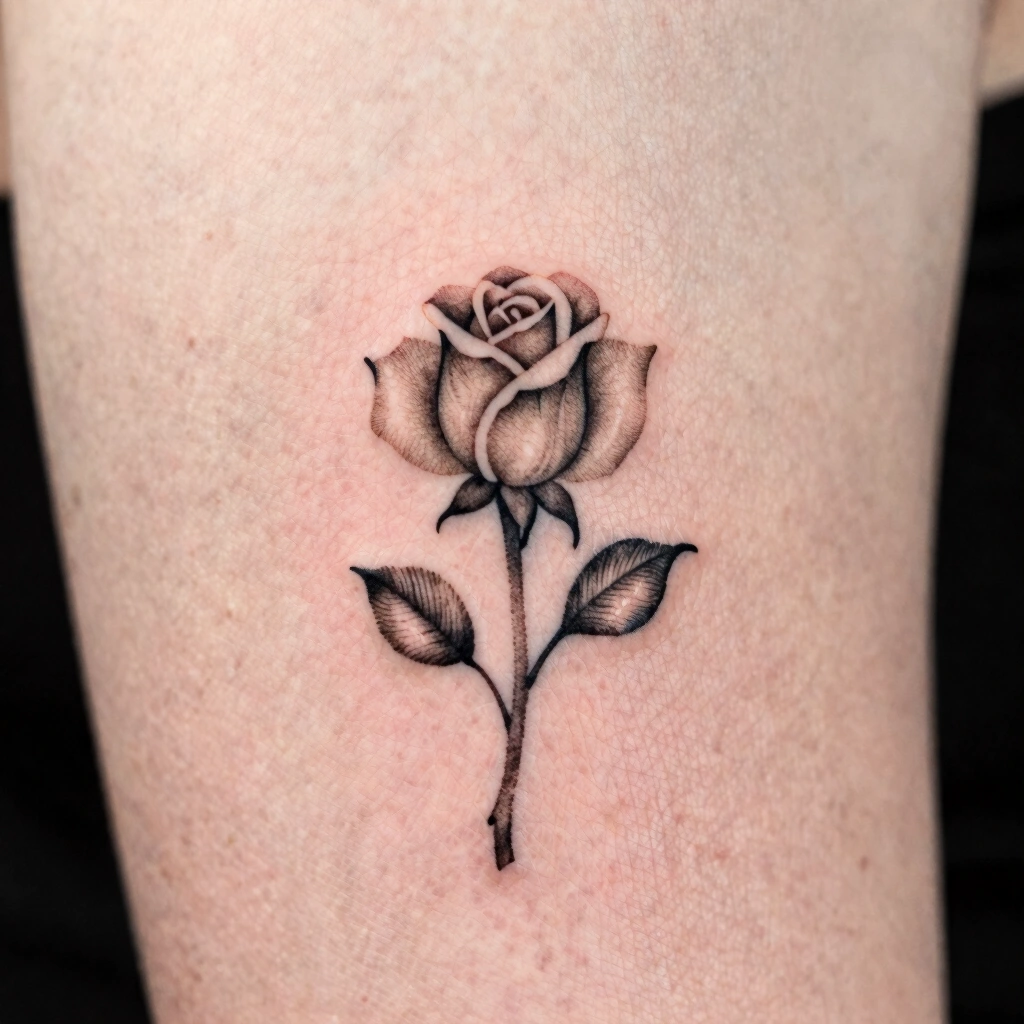
A single-needle rose is about as minimal as this theme gets — a tiny, delicate outline usually under 1.5 inches, often tucked behind the ear, on the wrist, or along the ankle. The single needle creates an extremely thin, precise line, which is what allows the design to stay legible at such a small scale. The tradeoff is longevity: fine details this small can blur slightly faster than bolder work, sometimes within 5 to 7 years, especially in areas that get a lot of friction like the wrist. Healing is usually quick, about a week to 10 days. Bring a simplified version of your reference image and ask the artist to strip out any unnecessary detail, since overcomplicating a tiny design is one of the most common mistakes. Pain on the wrist and ankle tends to run higher due to bone proximity and thin skin. This is a great low-commitment option for a first tattoo or a matching design with a friend or partner.
Rose and Beast Silhouette Combo

Pairing the rose with a small silhouette — a paw print, a castle spire, or the Beast’s profile — adds narrative without needing extra text. Most artists render this combo in fine line or light blackwork so the two elements don’t visually compete. Placement on the inner forearm or upper back gives enough length for both elements to sit comfortably, ideally 4 to 6 inches total. Healing runs about two weeks. A practical tip: ask your artist to draw a stencil and place it on your skin dry (no water) so you can walk around for a few minutes and check how it moves with your body before committing. Pain is moderate on the forearm, slightly higher on the upper back near the spine. This combo works well for meaningful, story-driven tattoos and tends to age gracefully since the two elements are usually kept in solid, simple linework rather than delicate gradients.
Traditional Bold Rose with Banner

American traditional style uses thick, bold outlines and a limited, saturated color palette — usually red, black, yellow, and green — giving the rose a graphic, timeless look. Adding a banner underneath is a classic way to personalize the piece with initials, a date, or a short phrase. This style is genuinely one of the most durable options long-term, since thick lines and solid color fill resist blurring far better than fine detail. Best placed on the upper arm, calf, or chest at 4 inches or larger. Healing takes about two weeks, with noticeable scabbing over the bold black outlines. Ask your artist about their color saturation process, since traditional work depends on solid, even fill rather than blending. Pain is moderate on the upper arm and calf. This is an excellent choice for someone who wants a design that still looks sharp decades later, and it suits visible placements well since the style reads as clearly intentional rather than delicate or easily smudged-looking.
Rose Under Glass with Falling Petals

This color-realism take aims for a near-photographic look, using smooth gradients and careful highlight placement to mimic actual glass reflections and petal texture. It’s one of the more technically demanding designs on this list, requiring an artist who specifically works in color realism rather than general flash tattooing. Expect to need real space — 5 inches minimum — on the thigh, upper arm, or back. Healing runs closer to 3 weeks given the heavier shading work involved. A useful tip: ask to see at least three healed (not just fresh) examples of glass or reflective surfaces in the artist’s portfolio, since glass highlights are notoriously tricky to render convincingly. Pain is moderate to high depending on shading density and placement. This isn’t a great first-tattoo pick due to complexity and cost, but it’s a striking centerpiece for someone already comfortable with longer sessions.
Geometric Rose with Fine Line Detailing

This design overlays the rose with clean geometric shapes — a triangle, hexagon, or simple frame — using consistent fine-line work throughout so the organic and geometric elements feel unified rather than clashing. It suits smaller placements well, around 2 to 4 inches, on the forearm, shoulder, or collarbone. Healing takes about 10 to 14 days. Ask your artist to keep line weight consistent across both the rose and the geometric frame, since mismatched thickness is a common reason these designs look unbalanced once healed. Pain is generally moderate, with the collarbone running slightly sharper due to thin skin over bone. This style works well in professional settings since it reads as more abstract and modern, and it’s a solid choice for a first tattoo thanks to its manageable size and lower long-term maintenance needs.
Rose and Chandelier Matching Set

For couples or friend groups, splitting a design — one person gets the rose, the other gets a chandelier or candlestick motif — creates a matching set that still tells a shared story. These work best kept simple, in fine line or light dotwork, at a small to medium size around 2 to 3 inches, placed on the wrist, ankle, or behind the ear for easy comparison. Healing takes about 10 days to two weeks. A practical booking tip: get both pieces done by the same artist in the same sitting if possible, so the line weight and proportions match exactly. Pain varies by placement but tends to run higher on the wrist and ankle. This is a fun, lower-commitment option for a first tattoo done with someone else, and it ages well since simple line work holds its shape longer than heavily shaded pieces.
Realistic Rose with Paw Print Accent

Combining a softly shaded, realistic rose with a small paw print pays tribute to the Beast’s transformation without needing an obvious character illustration. The rose uses gradual black-and-grey shading for dimension, while the paw print stays simple and solid for contrast. This pairing suits the shoulder, upper back, or outer thigh, at around 3 to 5 inches. Healing runs roughly two weeks. Ask your artist whether they’re using a rotary or coil machine for the shading work, since this affects how smooth the gradient looks once healed. Pain is moderate on the shoulder and upper back. This design suits people who want subtle symbolism over a literal character portrait, and it tends to age well thanks to its balance of solid black and soft grey shading rather than delicate fine lines alone.
Best Placement Ideas

Placement affects pain, visibility, and how well a design ages, so it’s worth thinking through before you book.
- Wrist or ankle — highly visible, easy to show off, but bonier areas tend to hurt more and see faster fading due to friction and sun exposure
- Behind the ear — great for small, discreet designs, though tight skin here can make fine-line work slightly more uncomfortable
- Forearm — a good all-around choice for medium designs; fairly low pain, easy to keep visible or cover with sleeves
- Ribs — better for people with some tattoo experience already, since this area is generally more sensitive
- Upper back or shoulder blade — plenty of room for larger, detailed pieces; moderate pain and easy to keep hidden for work
- Thigh or calf — good for bigger color or watercolor work, with generally moderate pain and easy aftercare access
Tips for Success

Start by looking for an artist whose portfolio actually includes the style you want — fine line, blackwork, dotwork, or color realism — rather than someone who does a little of everything. Ask specifically to see healed photos, not just fresh ink straight off the machine, since healed results tell you far more about how lines and shading actually settle. During your consultation, bring reference images, discuss sizing honestly, and ask about their stencil process so you know what the outline will look like before the needle touches your skin. It’s also worth asking whether your design is a walk-in flash option or needs a fully custom booking, since custom work usually takes longer to schedule but gives you more control over final details.
Common Mistakes and How to Avoid Them

A lot of tattoo regret comes down to a handful of avoidable errors. Sizing a highly detailed design too small is probably the biggest one — fine details need enough space to stay legible for years, not just look good on day one. Choosing a placement that doesn’t suit the design’s linework is another common issue; a long, trailing thorned stem needs a long placement like the calf or spine, not a cramped spot like the wrist. Skipping aftercare instructions, even for a few days, can affect how the final healed tattoo looks. And copying a design exactly from a photo without personalizing it even slightly often leads to seeing the same tattoo on someone else later — small tweaks in size, color, or added elements go a long way.
Similar Variations

Nearly every design above can be resized or recombined for a different feel. A fine-line bell jar rose can shrink to a wrist-sized micro version or scale up into a back piece with added candlesticks and mirror shards. Blackwork thorn stems can be recolored with a single accent shade — deep red or gold — for a hybrid neo-traditional look. Watercolor pieces can be simplified into black-and-grey dotwork for people who want the texture without the maintenance color sometimes requires. Mixing two or three of these elements — a wilting petal, a thorn stem, a small silhouette — is genuinely how most of these 21-plus variations get created in real studios, since artists rarely tattoo a design exactly as shown in reference photos.
Aftercare Basics

General aftercare guidance from most licensed studios includes keeping the tattoo clean, avoiding direct sun exposure while healing, and not picking at scabs or peeling skin. Avoid soaking the area in pools, baths, or open water until it’s fully healed, and stick to breathable clothing over the area to reduce friction. Always follow the specific aftercare sheet your artist gives you, since products and timelines can vary by studio, and check in with a licensed professional or dermatologist if you notice unusual redness, swelling, or irritation that doesn’t improve within a few days.
Quick FAQ

How much does a Beauty and the Beast rose tattoo cost?
Prices vary widely by size, detail, and artist experience, but small single-needle designs often start around $80–$150, while larger color or realism pieces can run $300–$800 or more, especially if multiple sessions are needed.
How painful is a rose tattoo?
Pain tolerance is individual, but generally bony or thin-skin areas like the wrist, ankle, and ribs feel more intense than fleshier spots like the upper arm, calf, or thigh.
How long does healing take?
Most rose tattoos heal within 10 days to 3 weeks depending on size, shading complexity, and placement, though full pigment settling can take a bit longer.
Will the design fade or blur over time?
Some fading is normal with any tattoo over the years, especially with sun exposure; bold linework and solid color tend to hold their shape longer than very fine or delicate detailing.
Fine Line vs. Blackwork vs. Dotwork vs. Watercolor

- Fine line — thin, consistent needle lines with little to no shading; best for delicate, minimal designs
- Blackwork — solid black fill and bold outlines, high contrast, ages well over time
- Dotwork — shading built from small dots instead of solid fill, creating soft texture and gradual depth
- Watercolor — soft, blended color meant to mimic paint, needs more space and tends to require more upkeep than solid ink work
Final Thoughts

Choosing a Beauty and the Beast rose tattoo really comes down to matching the story you want to tell with a technique that will actually hold up on your skin for years. Whether you lean toward a tiny single-needle outline behind your ear or a full color-realism piece on your thigh, take the time to find an artist whose portfolio proves they can execute that specific style well, and always ask questions before you sit in the chair. Pain, healing, and long-term results vary from person to person, so a quick consultation with a licensed professional is worth more than any online guide — including this one. Get that part right, and your Beauty and the Beast rose tattoo will still look intentional and well-made a decade from now.