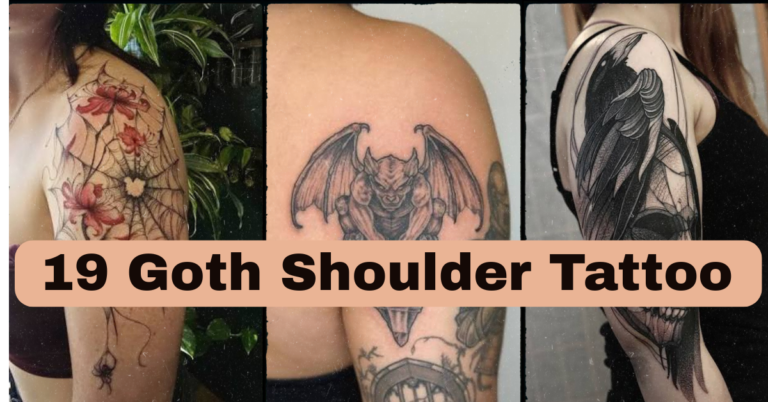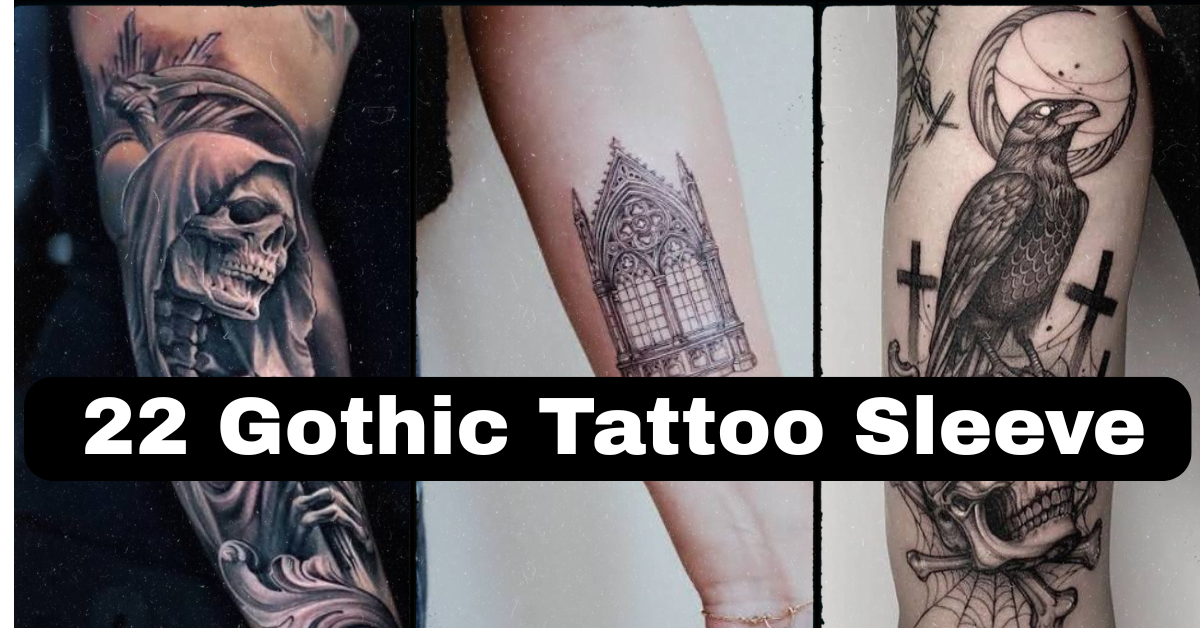
22 Gothic Tattoo Sleeve Ideas: A Practical Guide to Style, Placement, and Booking
Nervous about committing to a gothic tattoo sleeve you might regret in five years? That hesitation makes sense. A sleeve is a real commitment, and it deserves real planning before you sit down in the chair.
So what are the best gothic tattoo sleeve ideas? Blackwork skulls, bold traditional roses with thorns, and dotwork raven or moon motifs work best as sleeve anchors, since they hold contrast and detail well across multiple sessions and age predictably over decades. Smaller fine-line elements like script banners or ivy work best as connective filler between larger pieces.
Stick with me and I’ll walk you through 22 specific gothic sleeve elements, how to sequence them into a full sleeve, what each one costs in pain and time, and exactly how to brief your artist so the whole arm reads as one composition instead of a scattered collection.
Why Gothic Tattoo Sleeves Hold Together So Well
Gothic tattoo art pulls from centuries of architecture, folklore, and memento mori imagery (art built around the idea of remembering death), which gives it a naturally dark, cohesive visual language. Because so many gothic elements share the same emotional register, skulls, roses, ravens, cathedral arches, they combine into a full sleeve more easily than mixing unrelated styles. That’s part of why gothic sleeves tend to age well: the linework and shading approach usually stays consistent across the whole arm instead of clashing piece to piece. Below, each design names the specific technique, so you can plan how the pieces will connect before your first session.
Blackwork Skull and Rose Sleeve Base
A solid black skull paired with a single rose in bold outline makes a strong anchor piece for the upper arm, since it establishes both the dark, graphic tone and the shading style the rest of the sleeve will follow. The skull is filled mostly solid black with negative space carving out eye sockets and cheekbone highlights, while the rose petals get soft bokashi-style gradient shading (a gradual black-to-skin fade) for contrast. This works at 5 to 7 inches on the bicep or shoulder. Ask your artist to plan this piece first if it’s meant to anchor the rest of your sleeve, since later elements will need to match its saturation level. Bicep placement is generally more tolerable than the inner elbow. It’s not a first-tattoo-sized piece, but it’s a smart starting point for anyone committing to a full sleeve. Next, a bolder figure for the forearm.
Bold Traditional Grim Reaper
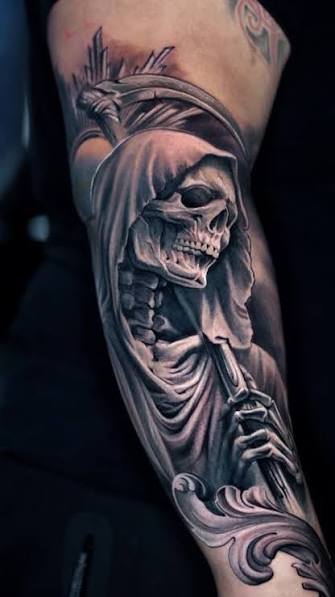
The grim reaper, rendered in bold traditional style, uses thick black outlines for the robe and scythe with heavy gray-black shading to suggest folds of fabric and a shadowed hood. This is one of the more visually dominant gothic sleeve pieces, so it usually anchors the forearm or the sleeve’s largest open section at 7 to 9 inches. Ask your artist to keep the hood’s interior mostly dark rather than detailing a full face, since a suggested shadow reads more ominous than an overly detailed skull underneath. Forearm sessions run moderate on discomfort compared to bonier wrist areas. It’s a bold, less office-discreet piece best suited for someone already comfortable with longer sits. Let’s move to something more delicate for the connective spaces.
Fine-Line Gothic Cathedral Window
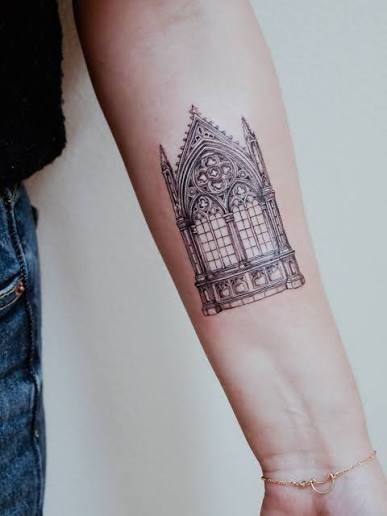
A cathedral’s arched window, or rose window, translated into fine line uses thin, precise geometric linework to capture the tracery pattern without any shading at all. This works well as a background or connective element between bolder pieces, at 4 to 6 inches, typically placed on the inner or outer forearm. Ask your artist to keep line spacing even across the window’s radial pattern, since gothic tracery relies on symmetry to read correctly. Forearm placement here is generally more comfortable than the elbow crease. It’s a smart way to add architectural detail to a sleeve without adding visual weight, and it works well even for someone earlier in their sleeve-building process. Now, a darker bird motif.
Dotwork Raven and Skull

A raven perched on or near a skull, built through dotwork, replaces traditional outlines with thousands of individually placed dots that create a textured, engraved look and a natural gradient in the feathers. This piece suits the shoulder or upper forearm at 5 to 6 inches, where the dot density has room to shift gradually from dense black to sparse gray. Ask to see healed dotwork examples specifically, since dot spacing that’s too loose tends to look patchy once the skin settles. Shoulder placement tends to be more tolerable than wrist or ankle areas. It’s a striking mid-sleeve piece and pairs naturally with both the skull-and-rose base and the cathedral window filler. Let’s cover the elbow next with something structural.
Blackwork Spider Web Elbow Piece

A spider web in solid blackwork, with clean negative space defining each web strand against a dark background, is a classic choice for the elbow specifically, since the web’s radial shape naturally follows the joint’s curve. Lines stay thick and confident here rather than fine, since fine linework tends to blur faster over a joint that bends constantly. Keep this piece to roughly the elbow’s natural size, 3 to 4 inches. Ask your artist directly how joint placement affects linework longevity, since elbows see more stretching and friction than flatter areas of the arm. Elbow placement is one of the more sensitive spots on the whole arm due to thin skin over bone. It’s a functional connector piece rather than a standalone focal point, and it’s a common addition once someone is a few sessions into a sleeve. Now, a bolder combination with real punch.
Bold Traditional Snake and Dagger
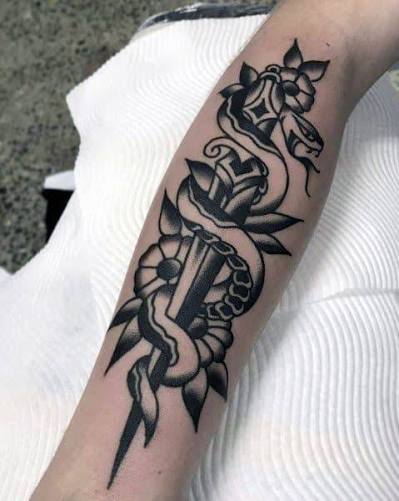
A coiled snake wrapped around a dagger, done in bold traditional style, uses thick black outlines, warm gray-black shading on the snake’s scales, and a sharply defined blade with subtle highlight lines. This piece works well on the inner or outer forearm at 5 to 7 inches, where the snake’s coil has room to wind naturally around the dagger’s length. Ask your artist to plan the snake’s head position facing outward from the arm rather than inward, since outward-facing details read more clearly at a glance. Outer forearm placement tends to be more comfortable than the inner arm. It’s a bold mid-sleeve piece with real visual energy, well suited to someone building a traditional-leaning gothic sleeve rather than a softer aesthetic. Let’s soften things with a floral connector.
Fine-Line Thorned Rose Vine
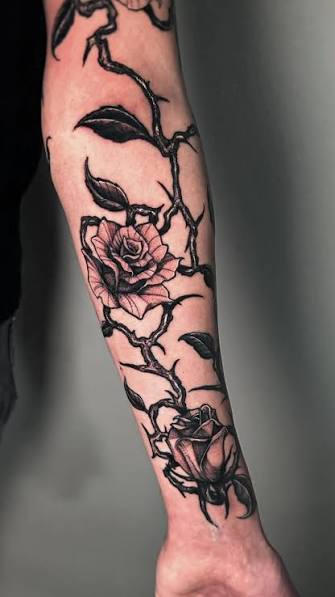
A trailing vine of small roses and thorns, done entirely in fine line with no shading, works as connective tissue that links larger, bolder pieces together along the arm’s length. Each rose stays simple, a few thin petal outlines rather than fully rendered blooms, so the vine reads as texture rather than competing for attention. This vine can run 6 to 10 inches depending on how much space it needs to bridge. Ask your artist to vary thorn spacing slightly along the vine, since perfectly even spacing can look mechanical rather than organic. Inner arm sections along this vine tend to run more sensitive than outer arm sections. It’s an essential filler piece for tying a gothic sleeve together into one cohesive composition. Now, a stone guardian figure.
Blackwork Gargoyle
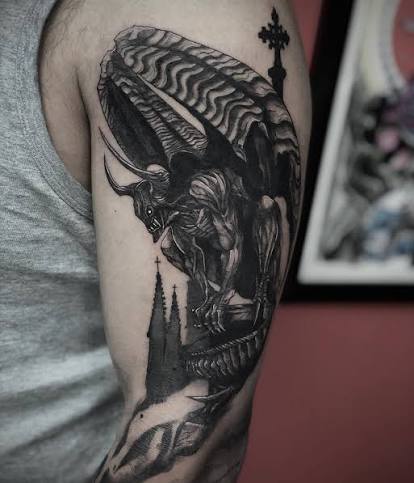
A crouched gargoyle figure, rendered in solid blackwork with sharp negative space defining wing membranes and facial features, brings a stone-carved, architectural quality to a gothic sleeve. This piece needs real space to read clearly, ideally 6 to 8 inches on the upper arm or shoulder. Ask your artist to reference actual gothic architecture photos rather than a generic gargoyle image, since real carved gargoyles have a distinct blocky, weathered quality that reads better in blackwork than a smoother cartoon version. Shoulder placement is typically more tolerable than the wrist or hand. It’s a strong standalone focal point for a sleeve and pairs well thematically with the cathedral window piece. Let’s shift to a symbolic religious element.
Negative Space Gothic Cross
Here a cross shape is left as bare, untattooed skin surrounded by dense blackwork or fine crosshatching, so the cross itself is defined entirely by what’s left blank. This negative space technique demands real skill and works best on a flatter section of the forearm or upper arm at 4 to 6 inches. Ask to see the artist’s negative space portfolio specifically, since this is a harder technique than standard linework and uneven surrounding fill can make the cross shape look muddy. Expect more pressure sensation given the amount of surrounding solid fill. It’s a striking, high-contrast piece that works as a sleeve centerpiece, though its boldness makes it less discreet for conservative dress codes. Now, something built around the passage of time.
Bold Traditional Clock and Chains
A cracked or melting clock face wrapped in heavy chain links, done in bold traditional style, plays on classic memento mori themes (reminders of mortality and time passing) with thick outlines and deep gray-black shading throughout. This piece works well on the forearm or bicep at 5 to 7 inches. Ask your artist to keep the chain links consistent in thickness with the clock’s outline weight, since mismatched line weights between elements is one of the most common issues in multi-object gothic pieces. Bicep placement tends to be more comfortable than the wrist. It’s a bold, meaningful mid-sleeve piece and suits someone who wants a personal message (time, mortality, resilience) built into the visual composition. Let’s bring in some lettering.
Fine-Line Gothic Script Banner
A flowing banner with gothic blackletter script, done in fine line with thin, precise strokes, adds a personal word or phrase into the sleeve composition without heavy visual weight. This works well wrapping around the upper arm or woven between other elements at 3 to 5 inches long. Ask your artist about letter spacing and font weight before finalizing the stencil, since gothic blackletter can blur into illegibility if lines sit too close together at small sizes. Inner arm placement for a banner tends to run more sensitive than the outer arm. It’s a meaningful personal touch piece and a common addition once the sleeve’s bolder anchor pieces are already placed. Now, a cracked, weathered skull variation.
Blackwork Skull with Cracked Face
This skull design leans harder into texture than the earlier skull-and-rose base, with visible crack lines running through the solid black fill and small negative-space fragments suggesting broken bone. It works well as a secondary skull motif elsewhere on the sleeve, at 4 to 6 inches, so it doesn’t visually compete with a larger anchor skull. Ask your artist to vary crack placement so it doesn’t look symmetrical or decorative, since real cracking patterns are irregular. Upper forearm placement here is generally more tolerable than the wrist. It’s a strong secondary focal point once you already have one bolder skull piece anchoring the sleeve. Let’s move to a quieter celestial motif.
Dotwork Moon Phases
A horizontal row of moon phases, from full to crescent to new, built through dotwork shading rather than solid fill, adds a subtle celestial element that ties nicely into gothic and witchy aesthetics alike. This works well as a band across the upper forearm or wrist-to-elbow stretch at 4 to 6 inches. Ask your artist to keep dot density consistent across each moon phase so the gradient reads smoothly from one phase to the next. Wrist-adjacent placement along this band tends to be more sensitive. It’s a great connector piece between bolder gothic elements and reads as workplace-discreet if placed higher on the arm, away from the wrist. Now, back to a bold animal figure.
Bold Traditional Wolf Howling
A howling wolf head, done in bold traditional style with thick black outlines and warm gray shading through the fur, brings a wild, untamed energy into a gothic sleeve. This piece needs real space, ideally the shoulder or upper arm at 6 to 8 inches, so the fur texture and expression stay clear rather than compressed. Ask your artist for a reference showing the specific angle (profile versus head-on), since a howling wolf’s neck position changes significantly between the two. Shoulder placement is typically more comfortable than the forearm’s bonier sections. It’s a bold standalone piece and works well as a second anchor point if your sleeve already has a skull-based centerpiece elsewhere. Let’s return to something smaller and more intimate.
Fine-Line Candle and Skull
A small candle with dripping wax next to a simplified skull, done entirely in fine line with no shading, brings a quiet memento mori moment into the sleeve without heavy visual weight. This works at 3 to 4 inches, often placed near the wrist or lower forearm as a smaller connective piece. Ask your artist to keep the wax drip organic and slightly irregular rather than perfectly symmetrical, since uneven dripping reads more naturally. Wrist and lower forearm placement here run more sensitive due to thin skin over bone. It’s a solid smaller addition once the sleeve’s bolder anchor pieces are already in place, and it holds detail well at this modest size. Now, a somber resting place.
Blackwork Coffin and Roses
A closed coffin surrounded by a scattering of small roses, done in blackwork with the coffin rendered mostly solid black and the roses left in lighter linework for contrast, creates a striking light-and-dark balance within one piece. This works well on the upper arm or shoulder at 5 to 6 inches. Ask your artist to keep the roses secondary in size and detail to the coffin, since overly detailed roses can pull focus away from the main subject. Shoulder placement tends to be more tolerable than the inner elbow. It’s a bold, thematically rich mid-sleeve piece for someone drawn to memento mori symbolism specifically. Let’s shift to a nocturnal silhouette.
Negative Space Bat Silhouette
A bat in flight, rendered as a negative space silhouette against a solid black or densely dotted background, uses the surrounding fill to define the bat’s wing shape rather than outlining the bat itself. This works well on the forearm or upper arm at 3 to 5 inches. Ask your artist to keep wing membrane detail simple, since overly complex negative space shapes can lose clarity once healed. Forearm placement here runs moderate on the sensitivity scale. It’s a smaller, punchy connector piece that adds visual variety to a sleeve full of solid black and fine line elements. Now, a bold mythological figure.
Bold Traditional Medusa Head
A Medusa head, snakes coiling in place of hair, done in bold traditional style with thick outlines and deep shading throughout the serpent details, makes for a dramatic, detailed centerpiece. This piece needs significant space, ideally the shoulder or upper arm at 6 to 8 inches, so each individual snake stays distinguishable rather than blending into a tangled mass. Ask your artist how many individual snakes they plan to render clearly, since overcrowding this design is a common mistake. Shoulder placement is generally more comfortable than the wrist. It’s a bold, striking centerpiece best suited for someone with sleeve real estate to dedicate to a single detailed figure. Let’s move to a quieter graveyard scene.
Fine-Line Tombstone and Ivy
A simple tombstone with trailing ivy climbing up one side, done in fine line with no shading, adds a quiet graveyard element without heavy visual weight. This works at 3 to 5 inches, often placed in a smaller gap between bolder sleeve pieces. Ask your artist to keep the ivy leaves varied in size rather than uniform, since natural ivy growth is irregular. Placement in smaller gaps along the inner arm tends to run more sensitive than the outer arm. It’s a useful smaller connective piece and a good pick for filling awkward negative space left between larger elements. Now, a darker facial motif.
Blackwork Demon Face
A snarling demon face, rendered in solid blackwork with sharp negative space carving out horns, eyes, and bared teeth, brings high-contrast intensity to a gothic sleeve. This works well on the shoulder or upper arm at 4 to 6 inches. Ask your artist about their fill consistency approach, since uneven black saturation is the most common flaw in large blackwork faces. Shoulder placement is typically more tolerable than the elbow or wrist. It’s a bold secondary focal point, well suited to a sleeve that’s already established a dark, graphic tone through its other pieces. Let’s cover an occult-inspired detail next.
Dotwork Ouija Planchette
A small ouija board planchette (the pointer piece used to spell out messages), built through dotwork shading with the pointer’s eye left as clean negative space, adds an occult-adjacent detail without needing heavy color or bold outlines. This works well at 2 to 3 inches, tucked into a smaller gap within the sleeve. Ask your artist to keep the dot gradient subtle here given the piece’s small size, since overly dense dotwork can lose the planchette’s shape at this scale. Smaller gap placements along the inner arm run more sensitive. It’s a niche but meaningful detail piece for anyone drawn to occult symbolism specifically within their gothic sleeve. Finally, let’s look at how all of this comes together.
Full Gothic Sleeve (Combined Elements)
This is the complete picture: a full sleeve combining several of the pieces above (commonly a skull-and-rose base, a bolder figure like a reaper or wolf, connective fine-line vines or script, and smaller detail pieces like a candle or moon phases) into one cohesive composition from shoulder to wrist. Because it spans multiple large and small pieces, a full gothic sleeve is typically built across many separate sessions over a year or more. Ask your artist for a full composition sketch or digital mockup before your first session, since changing element placement mid-sleeve is far harder than planning the layout up front. Full sleeve work covers a range of sensitivity zones, with the inner elbow and wrist consistently more sensitive than the outer forearm and shoulder. This isn’t a first-tattoo or workplace-discreet choice, but for someone genuinely committed to the gothic aesthetic, it represents the fullest expression of the style across the whole arm.
Best Placement Ideas
Different spots on your arm trade off visibility, pain, and long-term maintenance differently. Here’s a quick placement guide:
- Shoulder and upper arm: Easy to cover with sleeves, moderate to lower pain on fleshier spots, ideal for bold anchor pieces like a skull, wolf, or gargoyle.
- Outer forearm: High visibility, moderate pain, holds both bold traditional and fine-line work equally well, a common spot for mid-sized focal pieces.
- Inner forearm: More sensitive due to thinner skin, better suited to smaller connective pieces like script or a single rose.
- Elbow crease: One of the most sensitive spots on the arm, best reserved for smaller, thicker-lined pieces like a spider web rather than fine detail.
- Wrist: High visibility, higher pain due to bone proximity, works best for small detail pieces like a candle or moon phase band.
- Bicep: Generally more comfortable than joint areas, a strong spot for larger anchor pieces that need room to breathe.
Tips for Success
Choosing the right artist matters even more for a full sleeve than for a single small tattoo, since you’re trusting one person’s composition sense across a long-term project. Look specifically for a portfolio with completed sleeve work, not just isolated pieces, so you can see how that artist handles flow and spacing across a whole arm. At a consultation, ask to see healed sleeve photos, not just fresh sessions, since fresh linework always looks sharper than it will after a few months. Bring reference images for each element you want, along with a rough sense of how you want them arranged, and let the artist refine the layout from there. It’s completely reasonable to ask about total session count, spacing between sessions for healing, and overall cost range before committing.
Common Mistakes and How to Avoid Them
- Sizing pieces too small for the detail level: Both fine line and dotwork need enough surface area to stay legible as skin ages, especially on a sleeve where pieces sit close together.
- Mixing wildly different line weights without a plan: A sleeve with some elements in thick bold traditional and others in delicate fine line can look disjointed unless your artist deliberately bridges the styles with connective pieces.
- Skipping aftercare between sessions: This is one of the biggest causes of blotchy healing, and it matters even more on a sleeve where you’re managing multiple healing zones over time.
- Copying a full sleeve design exactly without personalizing it: A sleeve you find online was built for someone else’s arm length, muscle shape, and skin tone. A good artist will adapt the composition to fit you specifically.
Similar Variations
Almost every design above can be resized, recolored, or recombined. A large blackwork skull anchor can be simplified into a smaller fine-line version if you’re not ready for full sleeve commitment yet. A single rose vine can be extended or shortened to bridge whatever gap your sleeve currently has. Bold traditional pieces like the wolf or Medusa head can be redone in dotwork for a more textured, less saturated alternative. Smaller detail pieces, like the candle, moon phases, or ouija planchette, can be swapped in or out depending on which symbolism resonates most with you personally.
Aftercare Basics
Aftercare details vary by studio and by how much of the sleeve is done in a single session, so always follow the specific sheet your artist gives you rather than generic internet advice. In general, most artists recommend keeping each healing section clean, avoiding direct sun and swimming during initial healing, and avoiding picking at any scabbing or peeling, which matters even more across a larger sleeve where several session areas may be healing at once. Healing timelines vary by individual and by how large each session was, with smaller fine-line additions often settling faster than large blackwork sessions. If anything seems off during healing, such as unusual redness or swelling that doesn’t improve, check in with your artist or a licensed dermatologist rather than guessing.
Fine Line vs. Bold Traditional in a Gothic Sleeve
- Fine line: Thin, consistent needle work, little to no shading, best for connective pieces like vines, script, or small detail work, tends to soften slightly over many years.
- Bold traditional: Thick black outlines, heavy gray-black shading, best for anchor pieces that need to hold visual weight across a whole sleeve, holds shape well for decades.
- Blackwork: Solid black fill with deliberate negative space, high contrast, ideal for skulls, demons, and other graphic focal points.
- Dotwork: Shapes and gradients built from individual dots rather than continuous lines or flat fill, gives a textured, engraved look well suited to ravens, moons, and occult detail pieces.
Quick FAQ
How much does a full gothic tattoo sleeve cost? Individual elements often start around $150 to $400 each, while a full sleeve combining several pieces across multiple sessions can run several thousand dollars total. Exact pricing depends heavily on your artist’s rate, region, and total sleeve complexity.
Does a gothic sleeve hurt more than other tattoo styles? Not inherently. Pain depends far more on placement (bony areas like the elbow and wrist tend to be more sensitive) and the amount of solid black fill involved than on the gothic theme itself.
How long does a full sleeve take to complete? Most full sleeves are built across several sessions spaced weeks or months apart to allow proper healing between them, often totaling a year or more from first session to final touch-up.
Will a gothic sleeve still look sharp in ten years? Bold traditional and blackwork elements tend to hold their contrast longest. Fine-line connective pieces can soften over time, especially on high-movement areas like the elbow, so occasional touch-ups help keep the whole sleeve looking crisp.
Final Thoughts
A gothic tattoo sleeve gives you a genuinely rich set of imagery to build from, whether you’re drawn to the boldness of a grim reaper, the quiet detail of a candle and skull, or the architectural weight of a cathedral window. The key is planning your anchor pieces, connective elements, and smaller details together as one composition instead of booking them one at a time with no overall plan. None of this replaces an actual consultation, and pain, healing, and pricing will always vary by individual, so talk to a licensed, professional artist before you book anything.
Whatever combination of elements pulls you in, take the time to plan the full arm before your first session. A well-planned gothic tattoo sleeve is something you’ll still be proud to wear decades from now.