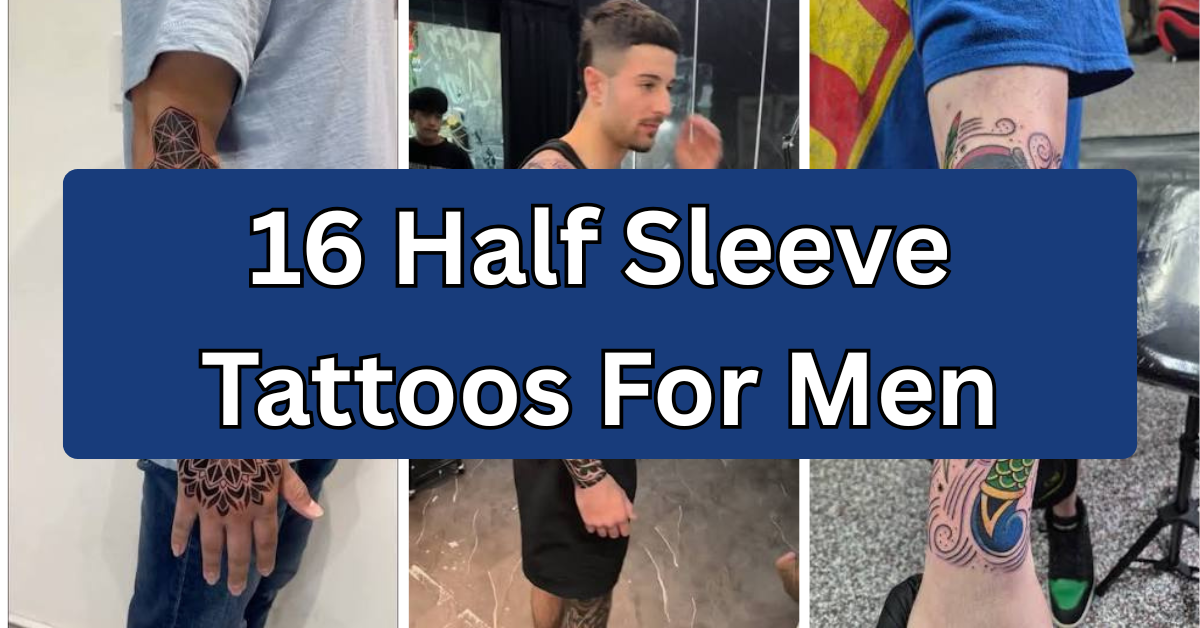
16 Half Sleeve Tattoos For Men: A Real Guide to Design, Placement, and What to Expect
Nervous about committing to something that covers half your arm for the rest of your life? That’s a fair worry, and it’s exactly why this guide exists — to give you actual technical detail, not just a scroll of pretty pictures.
So what are the best half sleeve tattoo ideas for men? Japanese dragons, blackwork geometric patterns, fine-line botanicals, and neo-traditional animal designs top the list because they scale well across the upper or lower arm, hold up over decades, and give an artist enough space to use proper shading and linework. Bold traditional pieces and dotwork mandalas also work well for men wanting strong visual impact without needing full realism.
Stick around, because I’m going to walk you through placement tradeoffs, pain levels by arm zone, realistic healing timelines, what a half sleeve actually costs, and the exact language to use when you sit down with an artist.
Why Half Sleeves Work So Well as a Canvas
Here’s the thing about the half sleeve — it’s basically the sweet spot of tattoo real estate. You get the muscle curve of the bicep, the flatter plane of the forearm, and the bend of the elbow, which means an artist can play with depth, shading direction, and negative space (the parts of skin left untouched to create shape and contrast) in ways a small tattoo just can’t do. It’s also flexible on commitment. You can start with one anchor piece and build outward over a year or two, or walk in with a full custom design and get it blocked out in one long session. Either way, you’re working with a big enough space that details won’t get lost as your skin changes over time.
Japanese Dragon Half Sleeve
A Japanese-style dragon done in the traditional Irezumi approach uses bold black outlines, graduated shading (called “wash” shading, where ink is diluted to create smooth gradients), and often incorporates wind bars or cloud filler to connect the body to the background. Line weight varies deliberately — thick on the dragon’s spine and claws, thinner on scale detail — which is what gives it that sense of motion. Best placed starting at the shoulder and flowing down to just above the elbow, since the design benefits from following the arm’s natural curve. Expect 3 to 4 sessions of 3+ hours each. Bring reference images of traditional Japanese woodblock art rather than just other tattoos, since it helps the artist nail the composition. Pain tends to spike near the inner elbow and armpit area. This is a strong first-half-sleeve choice if you want something with visual weight.
Blackwork Geometric Half Sleeve
Blackwork relies entirely on solid black ink and sharp linework — no shading gradients, no color. Geometric patterns (think interlocking triangles, sacred geometry grids, or mandalized shapes) work particularly well on the half sleeve because the flat planes of the forearm let straight lines stay crisp. Saturation is high and consistent throughout, which means touch-ups down the line are less noticeable than with soft shading work. Ideal size covers the full forearm or bicep independently rather than blending both — trying to wrap one geometric pattern around the elbow bend often distorts the symmetry. Ask your artist about a “single needle” versus “mag needle” approach for the fine grid lines; single needle gives thinner, crisper results. Healing runs about 2 to 3 weeks. This style photographs sharply and reads well even from a distance, making it workplace-visible in a bold way.
Fine-Line Botanical Half Sleeve
Fine-line work uses a thin, consistent needle line — usually a single needle or small liner — to create delicate detail without heavy shading. A botanical half sleeve built from fine-line ferns, wildflowers, or branch work looks almost like a pen illustration on skin. The lack of solid black fill means it ages differently than blackwork; fine lines can soften and spread slightly over 10+ years, so an experienced fine-line specialist will often add slightly thicker line weight than you’d expect to account for that natural fading. Best on the outer forearm where skin stays relatively flat and visible. This is a good first-half-sleeve option for guys who want something detailed without the boldness of traditional or blackwork. Bring botanical illustration references, not just other tattoo photos — it helps the artist match linework style precisely.
Bold Traditional American Half Sleeve
Bold traditional (also called “old school”) uses thick black outlines, limited but saturated color palettes — usually red, green, yellow, and black — and iconic imagery like eagles, anchors, roses, and pin-up figures. The heavy outline is intentional; it’s what keeps the design legible even after decades of natural fading. This is arguably the most “ages well” style on this list because the thick lines were designed a century ago specifically to survive skin aging. Best suited to the upper arm and shoulder where there’s enough flat space for bold color blocks. Mention specific flash-style references (classic tattoo flash sheets) when briefing your artist. Pain is moderate and consistent since there’s less fine detail work. Great for a first tattoo because it’s forgiving of minor healing imperfections.
Biomechanical Half Sleeve
Biomechanical designs blend mechanical or robotic elements with organic muscle and tissue, often creating the illusion that gears or metal plating are visible beneath torn skin. This requires advanced shading technique — soft gradients, sharp metallic highlights, and deep shadow work to create a 3D illusion. It’s one of the more technically demanding styles, so portfolio-checking matters more here than almost anywhere else on this list. Best placement follows the arm’s actual musculature, meaning the artist needs to study your specific arm shape before designing the stencil. Size should cover a continuous area rather than being broken into segments. Expect longer healing due to dense shading, sometimes 3 to 4 weeks. This isn’t a great first tattoo due to complexity, but it’s a striking second or third piece once you understand your pain tolerance.
Polynesian Tribal Half Sleeve
Tribal work rooted in Polynesian or Maori tradition uses bold blackwork patterns — repeating triangles, spearheads, and turtle or wave motifs — arranged to follow the arm’s contours rather than sit flat. Traditionally, every pattern element carries specific meaning tied to family, strength, or journey, so it’s worth researching symbolism before finalizing a design rather than picking patterns purely for looks. Line weight is thick and confident throughout, with almost no fine detail, which makes this one of the more forgiving styles as it ages. Best placement wraps from shoulder to elbow, using the natural taper of the arm as part of the composition. Tell your artist if you want custom symbolism versus a more flash-style repeating pattern. Pain is moderate to high given the density of solid black coverage.
Realism Portrait Half Sleeve
Realism uses smooth shading transitions, minimal outlining, and careful attention to light source to recreate a photo-like image — often a portrait, an animal, or a detailed object. This is the most technically difficult style to execute well, and portfolio quality varies enormously between artists, so this is one design where you should never walk in without reviewing at least 15 to 20 healed (not just fresh) photos of an artist’s past realism work. Best placed on the flatter plane of the forearm or upper arm where shading gradients read clearly. Color saturation needs to be built up gradually across multiple sessions for accurate skin tone matching if it’s a portrait. Healing takes 3 to 4 weeks due to dense shading work. This is not typically a first-tattoo recommendation.
Dotwork Mandala Half Sleeve
Dotwork builds shading and texture entirely from small individual dots rather than continuous lines or solid fill. A mandala done this way creates a soft, almost stippled gradient effect that looks distinctly different from wash shading. It requires a steady hand and patience from the artist, since density of dots controls the darkness of each area. Best suited to the outer bicep or forearm where the circular mandala shape can sit centered without distortion from the arm’s curve. Ask specifically for “dotwork” or “pointillism” style when briefing your artist — some studios specialize in this and others rarely do it. Healing tends to run slightly longer than linework, around 3 weeks. This design ages gracefully since dot density fades more evenly than solid black fill.
Neo-Traditional Animal Half Sleeve
Neo-traditional takes the bold outlines of old-school tattooing and adds richer color palettes and more illustrative detail — think a wolf or lion rendered with stylized, almost storybook shading rather than photorealism. Line weight varies more than traditional bold work, with thinner interior detail lines paired with a thick outer border. This style sits nicely on the upper arm where there’s room for both the animal figure and decorative background elements like florals or banners. A good actionable tip: ask your artist to sketch a custom stencil rather than using flash directly off the wall, since neo-traditional benefits enormously from personalization. Pain is moderate. This works well for men who want symbolism (strength, loyalty, family) without full realism’s cost and time commitment.
Sacred Geometry Half Sleeve
Sacred geometry combines precise geometric shapes — often overlapping circles, triangles, and grid patterns — with spiritual or mathematical symbolism like the Flower of Life pattern. This demands extremely precise linework, often done with a ruler or stencil grid to keep proportions exact, since even small asymmetries are visually obvious in geometric work. Best placed on the forearm where flat skin keeps lines straight and true. Size should be moderate to large, since tiny geometric detail tends to blur together as skin ages. A useful tip: bring printed geometric references with exact proportions rather than describing shapes verbally. Pain is moderate. This design ages well if line weight is kept slightly thicker than a minimalist approach would suggest.
Skull and Rose Half Sleeve
This design pairs bold blackwork or neo-traditional skull imagery with detailed rose work, using contrast between hard, angular skull linework and soft, curved petal shading to create visual tension. Shading on the roses typically uses wash technique for soft gradients, while the skull often stays more graphic with solid black and sharp highlights. Best on the upper arm where there’s enough room for both elements without cramming. This is a classic combination that reads well from a distance, making it workplace-visible depending on your dress code. Ask your artist about balancing negative space between the skull and roses so the composition doesn’t feel cluttered. Pain is moderate to high given the dense shading and blackwork combined.
Watercolor-Style Half Sleeve
Watercolor tattoos mimic the soft bleeding and color blending of actual watercolor paintings, using diluted ink and often skipping traditional black outlines altogether. This is a style where honesty matters: watercolor pieces tend to soften and fade faster than linework-based styles since there’s no bold outline anchoring the color. Many artists now recommend pairing watercolor color washes with a thin fine-line structure underneath to help the design hold its shape over the years. Best placed on the outer forearm or upper arm where flat skin shows color blending clearly. Ask specifically whether your artist uses a hybrid linework approach, since pure watercolor without any outline is the riskiest version long-term. Healing time is standard, around 2 to 3 weeks.
Nature and Landscape Half Sleeve
A landscape half sleeve — mountains, forests, or ocean scenes — uses layered shading to create depth, often moving from darker, more saturated tones near the shoulder to lighter, airier shading near the wrist-facing end of the design. This requires an artist comfortable with large-scale composition planning, since the whole arm needs to read as one continuous scene rather than disconnected images. Best placement runs the full outer arm to take advantage of the elongated canvas. A practical tip: ask to see a full stencil laid out on your actual arm before the first session, not just a flat digital mockup, since curves change how a landscape reads. Pain varies by session length given the scale. This is a strong choice for men wanting personal, meaningful imagery tied to a specific place.
Clock and Compass Half Sleeve
This combination pairs a detailed clock face with a compass rose, often rendered in neo-traditional or realism-leaning style with fine mechanical detail in the clock gears and bold directional lines in the compass. Symbolically it usually represents time, direction, or a specific meaningful date worked into the clock hands. Best placed on the forearm where the circular clock shape sits naturally within the limb’s width. Line weight needs to stay crisp on the numerals and gear teeth, so ask your artist about using a smaller liner needle for those fine details specifically. Pain is moderate. This design suits men who want a personal, story-driven piece without going fully into portrait realism.
Negative Space Half Sleeve
Negative space designs use the untouched skin itself as part of the image, rather than filling every area with ink. A common approach on the half sleeve involves a solid blackwork background with a figure or pattern “cut out” in the natural skin tone, creating strong contrast. This requires real technical skill to execute cleanly, since uneven negative space edges look obviously mistaken. Best on the upper arm where there’s a large enough flat area for bold contrast to read clearly. Ask to see healed (not fresh) examples of an artist’s negative space work specifically, since this style can shift slightly as skin heals. Pain is high given the density of solid black fill. This is a striking option for men wanting something visually unusual.
Script and Symbol Half Sleeve
This design blends meaningful script — quotes, names, dates — with symbolic imagery like religious icons, family crests, or personal symbols, usually connected through fine-line or single-needle work. Font choice matters enormously here; a good artist will show you multiple lettering style options rather than defaulting to one script. Best placed on the inner or outer forearm where lettering stays legible and doesn’t distort around the arm’s curve. A helpful tip: request a printed stencil test on paper first to check spacing and letter size before it goes on skin. Pain is moderate. This is one of the more personal, meaningful half sleeve options and works well combined with other design elements from this list.
Fine-Line vs. Bold Traditional vs. Blackwork: Know the Difference
If you’re mixing styles across a half sleeve, it helps to actually understand what separates these techniques:
Fine-line — Thin, consistent lines made with a single needle or small liner, minimal shading, ages by softening slightly over time.
Bold traditional — Thick black outlines with limited, saturated color fills, built specifically to hold up well over decades.
Blackwork — Solid black ink used for large filled areas or geometric patterns, high contrast, minimal to no color or shading gradient.
Dotwork — Shading and texture built from individual dots rather than lines or fill, creates a stippled, textured gradient effect.
Best Placement Ideas
- Upper arm/shoulder — most visible when wearing short sleeves, moderate pain, good for bold or large-scale designs
- Forearm (outer) — highly visible, flatter skin good for geometric or lettering work, moderate pain
- Forearm (inner) — easier to conceal, slightly more sensitive skin, good for personal or meaningful pieces
- Elbow area — higher pain due to bone proximity, best avoided for a reader’s first session unless connecting two larger pieces
- Bicep — moderate pain, good muscle curve for dragon or animal designs that benefit from following body shape
Tips for Success
Start by reviewing at least 20 to 30 pieces of an artist’s healed work, not just fresh photos straight off the tattoo gun, since swelling and redness can make almost anything look sharp temporarily. Ask directly about their experience with the specific style you want — a fine-line specialist and an experienced blackwork artist often have very different strengths, and a strong portfolio in one style doesn’t guarantee skill in another. Bring 3 to 5 reference images that show the exact linework, shading, or color saturation you want, and be upfront about your pain tolerance and available session time. A good consultation should include a rough cost estimate, an honest session-count projection, and a conversation about how the design might be adjusted for your specific arm shape and skin tone.
Common Mistakes and How to Avoid Them
- Sizing too small for the detail level — intricate line work needs enough space to stay legible as skin ages; don’t cram a detailed design into a small zone
- Ignoring how a design wraps around the elbow bend — straight geometric lines can distort badly across joints
- Skipping the aftercare instructions given by your specific artist — generic online advice doesn’t always match the ink or technique used
- Copying a design exactly from a photo without personalizing it — most artists prefer adapting a reference into something original, both for quality and for avoiding duplicate tattoos
- Booking a walk-in slot for a large custom piece — half sleeves generally need a proper consultation and multiple scheduled sessions, not a same-day walk-in
Similar Variations
Nearly every design above can be adjusted. A dragon can shrink from full color to pure blackwork outline. A botanical fine-line piece can be resized down to a quarter sleeve or expanded into a full sleeve later. Geometric blackwork can incorporate small color accents for a modern hybrid look, and traditional pieces can be combined with neo-traditional shading for a more contemporary feel. Talk to your artist about which combinations actually work well together stylistically before committing.
Aftercare Basics
General aftercare typically involves keeping the area clean, avoiding direct sun exposure while healing, and avoiding tight clothing that rubs against fresh ink during the first two to three weeks. Healing time and skin reaction vary by individual, so always follow the specific aftercare sheet your artist provides rather than generic advice found online. If you notice unusual redness, swelling, or irritation that doesn’t improve, consult a licensed dermatologist or your tattoo artist directly rather than self-diagnosing.
Quick FAQ
How much does a half sleeve tattoo cost?
Costs vary widely by region, artist experience, and design complexity, but most half sleeves run anywhere from $400 to $2,000+ across multiple sessions. Detailed realism or color-heavy work typically costs more than blackwork or simple linework.
How painful is a half sleeve tattoo?
Pain tolerance varies by individual, but bony areas like the elbow and inner arm tend to be more sensitive than fleshier areas like the outer bicep. Multiple long sessions can also increase overall discomfort simply due to time spent under the needle.
How long does a half sleeve take to heal?
Most half sleeves take 2 to 4 weeks for surface healing, though deeper skin layers can take a few months to fully settle. Dense shading or blackwork areas sometimes take slightly longer than simple linework.
Will my half sleeve fade over time?
All tattoos fade gradually with sun exposure and natural skin aging, though bold linework and blackwork tend to hold up better long-term than fine, delicate detail. Occasional touch-ups from your original artist can help maintain sharpness after several years.
Choosing from these 16 half sleeve tattoos for men really comes down to being honest with yourself about pain tolerance, budget, and how much detail you actually want carrying on your skin for decades. Take your time picking an artist whose healed work matches the style you’re after, and don’t be afraid to ask blunt questions during your consultation — a good artist expects that. Whatever direction you go, the right half sleeve tattoo idea is one that still feels like you ten years from now.