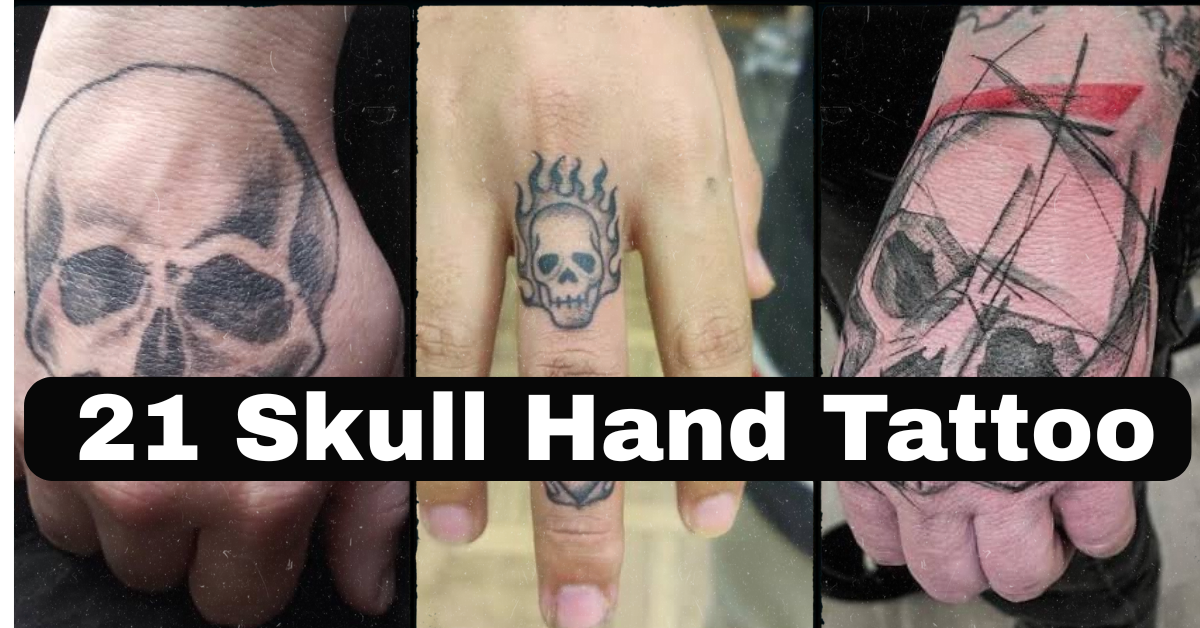
21 Skull Hand Tattoo Ideas That Are Worth the Extra Commitment
Nervous about picking a skull hand tattoo you’ll regret in five years? That’s actually the right instinct to have before booking this specific placement, because hands are genuinely different from the rest of the body when it comes to how a tattoo holds up. I’ve spent enough time around studios watching hand tattoo consultations happen to know this is one placement where the design choice and the honesty about tradeoffs matter more than almost anywhere else.
So what are the best skull hand tattoo ideas? Bold blackwork skulls, simplified single-needle outlines, and dotwork designs work best on the hand, since the skin here fades and stretches more than most other placements, and simple, high-contrast designs hold their shape better over the years than fine, detailed shading does.
Keep reading, because I’m covering 21 specific skull designs, along with honest pain expectations for this placement specifically, real cost ranges, why hand tattoos age differently than the rest of your skin, and exactly how to brief an artist so the design survives years of handwashing and sun exposure.
Why the Hand Is a Different Kind of Placement Entirely
Before getting into specific designs, it’s worth being straightforward about something a lot of articles gloss over: hands are not like other tattoo placements. The skin on your hands is thinner, stretches and moves constantly, and gets washed and exposed to sun far more than almost anywhere else on your body, all of which affects how ink settles and holds over time. That doesn’t mean hand tattoos are a bad idea, it just means the design has to account for that reality. Bold, simplified designs with strong linework and solid black fill tend to hold their shape noticeably better here than fine detail or soft shading gradients, which is exactly why skull motifs, often already graphic and high-contrast by nature, translate so well to this placement.
Fine Line vs. Bold Blackwork: Which Actually Works on Hands
Before getting into individual designs, it helps to understand the core technique tradeoff for this specific placement. Fine line work uses a single thin needle line with no shading, and while it looks delicate and precise fresh out of the chair, it’s genuinely more prone to blurring and softening on hand skin given how much this area moves and stretches over the years. Bold blackwork, using thick, solid black fills, holds its shape and contrast far more reliably on hands over time. That doesn’t mean fine line is off the table entirely for a hand skull design, it just means bolder linework and simplified detail are usually the safer long-term choice for this placement specifically, and it’s worth discussing that tradeoff directly with your artist before finalizing a design.
1. Bold Blackwork Skull Knuckle Tattoo
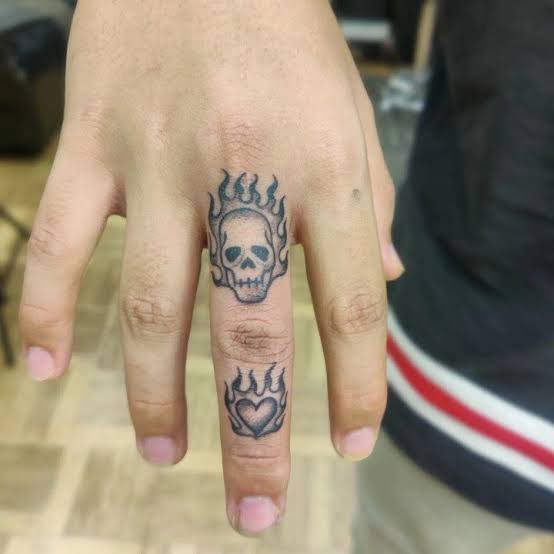
A simplified skull, solid black with clean, bold outlines, placed directly over one or two knuckles, is one of the most classic hand tattoo designs for a reason. The solid black fill holds up better on hand skin than fine detail, and the graphic simplicity reads clearly even at a small scale. Best kept to 1 to 2 inches per knuckle. Pain here runs on the higher end since knuckles sit directly over bone with almost no padding. Tip: ask your artist to simplify the skull’s features, eye sockets, nose bridge, rather than trying to include fine detail like teeth texture, since that detail is most likely to blur first on this placement. This is a bold, highly visible design, not typically a first tattoo, and worth thinking through carefully for workplace visibility since hand tattoos are hard to cover. Let’s look at a smaller, single-point version next.
2. Single Small Skull on the Back of the Hand
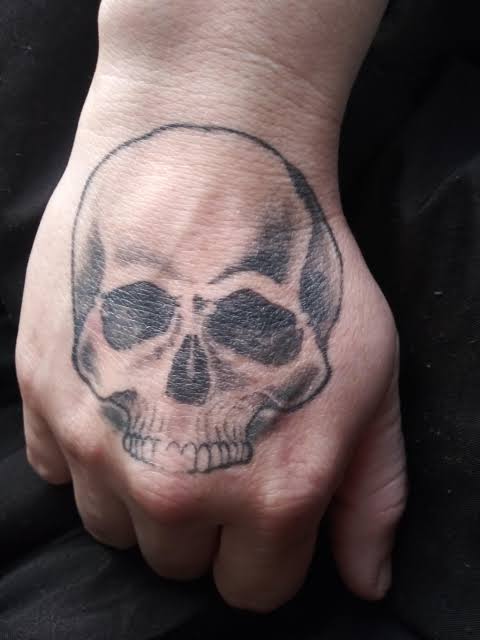
A compact skull, kept simple and solid rather than heavily detailed, placed on the back of the hand between the wrist and knuckles, gives more flexibility in sizing than knuckle placement while still reading clearly as a bold statement. Best sized 2 to 3 inches. Pain runs moderate to higher here, though slightly more tolerable than directly over knuckle bone. Tip: ask your artist to keep the linework thick enough that it won’t visually thin out as the tattoo settles over the following weeks, hand skin tends to spread ink slightly more than other placements. This design is visible in most everyday settings, so think honestly about your workplace and how often you’d want to explain or cover it. It’s a strong choice for someone who already has some ink experience elsewhere. Now, a dotwork alternative for a different texture.
3. Dotwork Skull with Shading Gradient
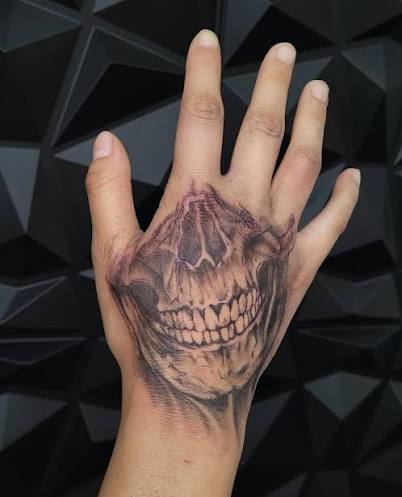
Dotwork builds an image from thousands of small individual dots rather than solid lines, creating a soft, stippled gradient across the skull’s surface instead of flat black fill. This gives more visual depth than a pure blackwork piece, though it’s worth knowing that dotwork gradients can soften a bit faster on hand skin than solid black fill does. Best sized 2 to 4 inches on the back of the hand. Dotwork tends to take longer in the chair given the individual dot placement, and pain runs moderate to higher for this placement. Tip: ask to see healed dotwork specifically on hands in your artist’s portfolio, not just other body placements, since this area behaves differently and you want proof the gradient holds up here specifically. This is a bold, visible design suited to someone ready for the visibility tradeoff. Let’s move to a smaller, single-needle version next.
4. Tiny Single-Needle Skull Outline
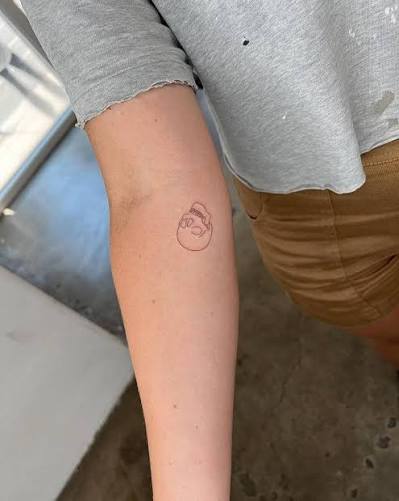
A very small skull outline, done entirely in single-needle linework with no shading or fill, is the most understated skull option for the hand, though it’s worth being upfront that fine, thin linework is the style most likely to blur or soften over the years on this specific placement. Best kept under 1.5 inches, positioned on the side of the hand or a finger. Pain runs high on fingers specifically given how little padding exists there. Tip: ask your artist directly about their experience with fine line work specifically on hands, and ask how they expect this design to age here compared to a bolder alternative, since this is one placement where that conversation genuinely changes the outcome. This is a lower-commitment design in terms of size, but the placement itself still carries real pain and touch-up considerations. Now, a bolder traditional-style option.
5. Bold Traditional Skull and Rose Tattoo
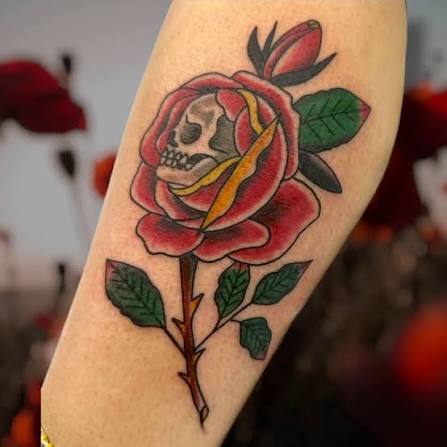
American traditional style uses thick outlines and a limited, saturated color palette, prioritizing longevity over fine detail, which makes it a genuinely strong technique choice for hand placement specifically. A skull paired with a rose in this style trades photorealism for graphic punch and holds up notably well over time given the bold linework. Best sized 3 to 5 inches on the back of the hand. Pain runs moderate to higher given the outline weight and any color fill involved. Tip: trust your traditional artist’s proportion suggestions over your own reference photo, thick linework at hand scale needs specific spacing to avoid blending together as the design settles. This is a strong choice for someone who wants a hand tattoo that ages reliably rather than one that needs frequent touch-ups. Let’s contrast that with a much simpler geometric take.
6. Geometric Skull Outline Tattoo
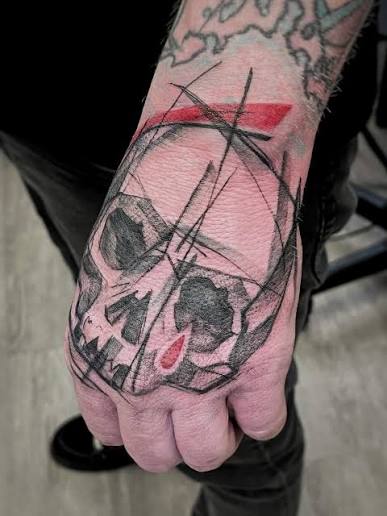
A skull simplified into clean geometric shapes and straight panel lines rather than a naturalistic illustration gives a modern, graphic look that holds its structure well on hand skin given the bold, deliberate linework involved. Best sized 2 to 4 inches on the back of the hand. Pain is moderate to higher for this placement. Tip: ask if your artist uses a straightedge or ruler-guided stencil for the geometric panels, precision matters even more on a placement this visible and detail-sensitive. This design ages relatively well compared to fine detail work, since there’s no shading gradient to soften, just clean structural lines. It’s a bold, visible choice better suited to someone ready for the commitment than a first tattoo. Now, let’s look at a design incorporating flames.
7. Blackwork Skull with Flames Tattoo
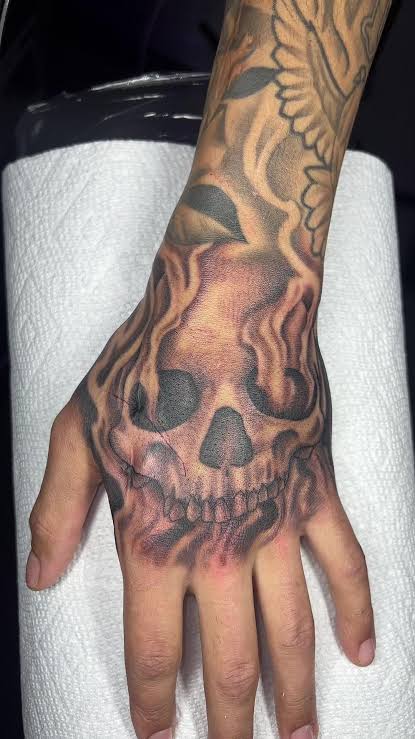
A skull with simplified flame shapes rising from the top or sides, done in solid blackwork, is a bolder, more dramatic take that leans into classic skull-and-fire imagery. The solid black fill in both the skull and flames holds shape well on hand skin over time. Best sized 3 to 5 inches on the back of the hand. Pain runs higher given the amount of solid black saturation across a larger area. Tip: ask your artist to keep the flame shapes simplified and graphic rather than trying to add fine texture within them, texture at this scale on hand skin is genuinely one of the first details to blur. This is a bold, high-visibility piece, not a first-tattoo pick, and worth serious thought about workplace visibility before booking. Let’s shift toward a smaller, symbolic pairing next.
8. Small Skull and Crossbones Finger Tattoo
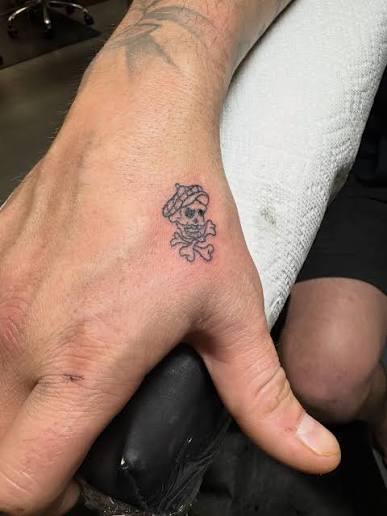
A classic skull and crossbones, simplified and kept small, works on the side or back of a single finger for guys and women alike who want something compact and instantly recognizable. Best kept under 1.5 inches given the limited space fingers offer. Finger placements run especially high on the pain scale given minimal padding and constant movement. Tip: ask your artist directly how finger tattoos specifically tend to fade in their experience, since this is one of the areas most prone to needing a touch-up within the first couple of years due to constant hand washing and friction. This is a bold, low-size but high-visibility and high-maintenance choice, best for someone who’s already comfortable with the touch-up conversation. Now, a design pulling in floral elements more heavily.
9. Blackwork Skull Wrapped in Vines
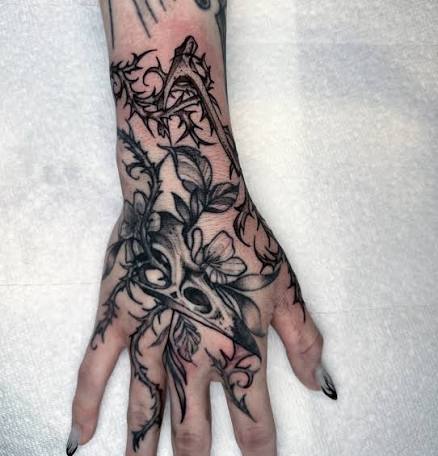
A skull with a simplified vine wrapping around part of it, done in solid blackwork with the vine kept thick enough to hold its shape over time, softens the skull’s harder edge with a bit of organic detail. Best sized 3 to 5 inches on the back of the hand. Pain runs moderate to higher given the black saturation involved. Tip: keep the vine’s leaves simplified and larger rather than trying to include a lot of thin detail, since thin vine tendrils are exactly the kind of fine linework that struggles on hand skin over the years. This design carries a mix of mortality and growth symbolism for a lot of people and works as a bold, visible statement piece. Let’s move to a design built around negative space instead.
10. Negative Space Skull Tattoo
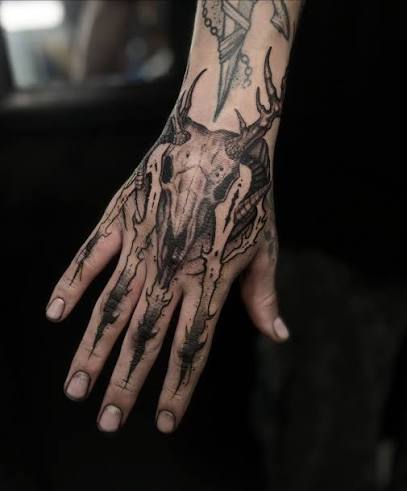
Negative space tattooing uses untouched skin as part of the image itself, typically a solid black background with the skull’s features left bare rather than inked. It’s a striking, high-contrast technique, but genuinely one of the harder ones to execute cleanly, and it’s worth knowing that thin negative space lines are more likely to blur on hand skin than on flatter, less-used placements. Best on the back of the hand at 2 to 4 inches. Pain runs high given the solid black fill required. Tip: ask specifically how your artist plans to keep the negative space channels wide enough to survive years of hand movement and washing, thin negative space lines are the first thing to lose definition here. This is a bold, advanced design best suited to someone with prior ink experience. Now, a simpler traditional flash-style option.
11. Flash-Style Skull Tattoo
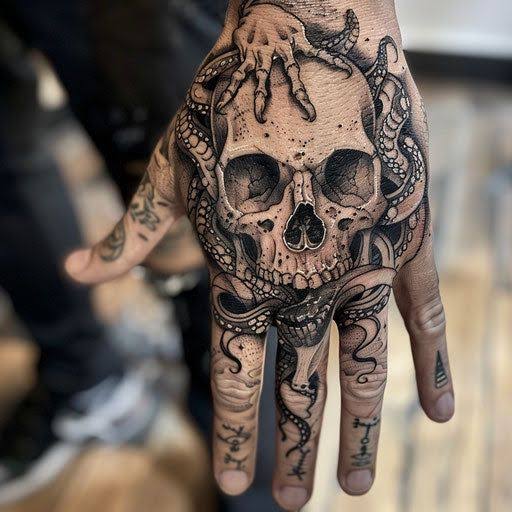
Flash tattoos are pre-drawn, ready-to-go designs rather than fully custom pieces, and a classic flash-style skull, bold outlines, minimal shading, straightforward composition, is a strong walk-in option if you want something quick without a lengthy custom design process. Best sized 2 to 4 inches on the back of the hand. Pain runs moderate to higher for this placement regardless of design origin. Tip: even with a flash design, ask if small personal tweaks are possible, a different eye shape, an added small detail, so the piece still feels a little more yours than a completely generic template. This is a solid, faster-turnaround option for someone who wants a hand skull piece without a long custom booking process, though it’s still a bold, visible commitment either way. Let’s look at a much bolder cover-spanning option next.
12. Large Skull Spanning the Full Back of the Hand
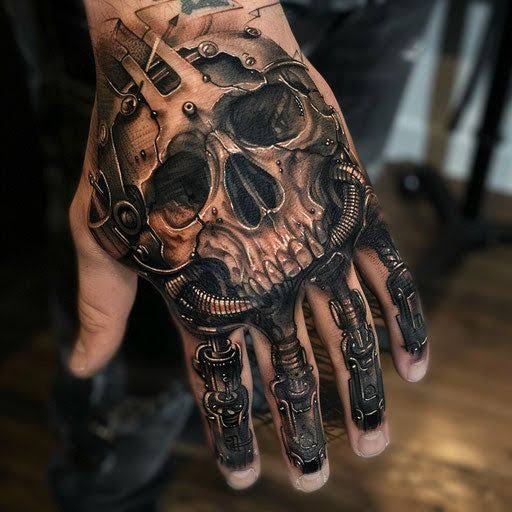
For guys and women wanting maximum visual impact, a larger skull design spanning most of the back of the hand, done in bold blackwork or bold traditional style, is about as committed as this placement gets. Sized 4 to 6 inches, this design fills most of the available flat space on the hand. Pain runs high given both the size and the amount of solid black or heavy shading involved. Tip: plan the composition around your hand’s specific proportions with your artist in person rather than relying purely on a flat reference photo, since hand shape varies enough from person to person that a stencil fitting session matters more here than almost anywhere else. This is a serious, high-visibility commitment, not a first tattoo, and one that will affect professional and social interactions daily, so think it through thoroughly. Now, a quieter, single-line alternative.
13. Single Continuous Line Skull Tattoo
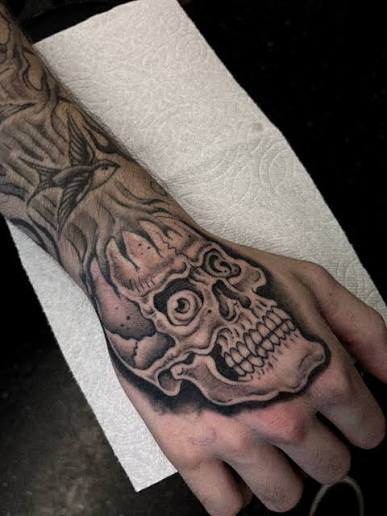
A skull illustrated in one single, unbroken line, done in bold enough linework to hold up on hand skin, creates a minimalist, almost abstract version of the design that still reads clearly as a skull from a normal viewing distance. Best sized 2 to 3 inches. Pain is moderate to higher for this placement. Tip: ask your artist to keep the line thickness consistent and slightly bolder than a typical single-line design elsewhere on the body, since overly thin single-line work is one of the styles most prone to fading unevenly on hands. This design is bold in concept but visually lighter than a fully shaded skull, making it a middle-ground option for someone who wants the hand placement but not maximum visual weight. Let’s look at a design incorporating a crown next.
14. Blackwork Skull with Crown Tattoo
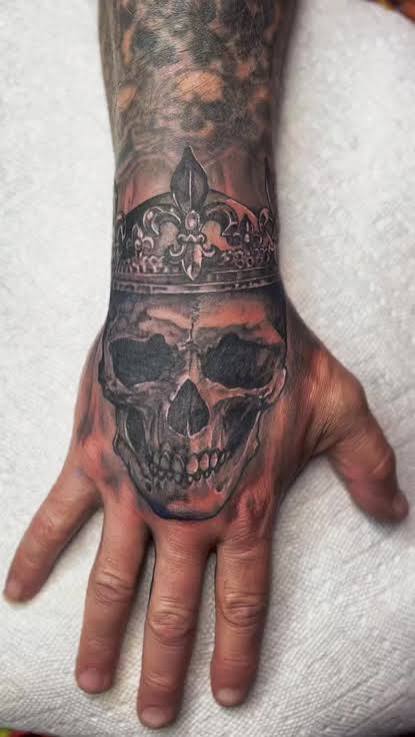
A skull topped with a simplified crown, done in solid blackwork, carries a specific symbolic meaning around legacy, mortality, or personal achievement that a lot of people connect with. Best sized 3 to 5 inches on the back of the hand. Pain runs moderate to higher given the solid black saturation across both elements. Tip: keep the crown’s points simplified and evenly spaced rather than overly ornate, fine crown detail is exactly the kind of small linework that tends to blur first on hand placements. This is a bold, meaningful statement piece, worth being ready to explain if asked, and best suited to someone comfortable with a highly visible design. Now, a lighter option using dotwork shading.
15. Dotwork Skull Profile Tattoo
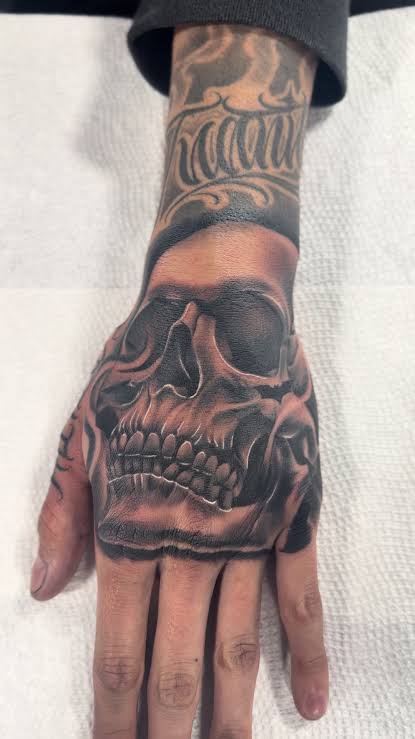
A skull shown in side profile rather than facing forward, rendered in dotwork for a soft, textured gradient across the visible bone structure, offers a slightly different composition than the more common front-facing skull designs on this list. Best sized 2 to 4 inches. Pain runs moderate to higher for this placement given the shading involved. Tip: ask your artist to keep dot density higher in this piece specifically compared to how they might approach dotwork elsewhere on the body, denser dot placement holds up better against the fading hand skin tends to experience over time. This is a bold, distinctive design that works well for someone wanting a skull tattoo that looks a bit different from the standard front-facing options. Let’s move to a design that combines a skull with a simple banner.
16. Bold Traditional Skull and Banner Tattoo
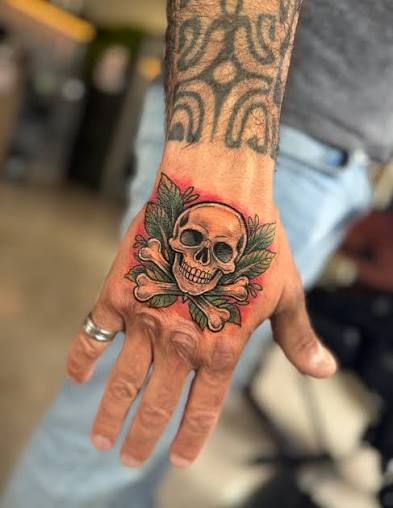
Pairing a skull with a simple banner beneath it, ready for a short word or name, is a classic traditional-style combination that adds a personal, specific layer to the design. Keep any banner text brief, a single word rather than a phrase, since longer script is one of the details most likely to blur on hand skin over time. Best sized 3 to 5 inches. Pain runs moderate to higher given the outline weight and any lettering involved. Tip: ask your artist to bold up the banner lettering specifically more than they might elsewhere on the body, thin script fades disproportionately fast on hands compared to bolder illustration work. This design is personal and bold at once, and it’s worth thinking through how visible you want that personal detail to be day to day. Now, a design built entirely from thick, sharp linework.
17. Bold Angular Skull Tattoo
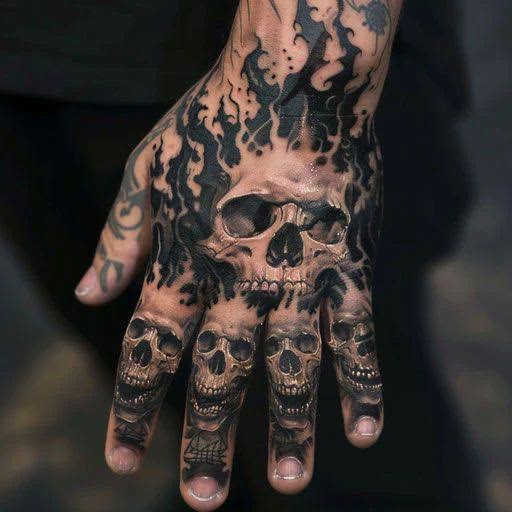
A skull rendered with sharp, angular linework rather than rounded, naturalistic curves gives a more aggressive, graphic look that holds up well on hand skin given the thick, deliberate lines involved. Best sized 3 to 5 inches on the back of the hand. Pain runs moderate to higher for this placement. Tip: ask your artist to keep the angular lines thick and well-spaced rather than tightly packed, since tightly spaced sharp linework is more prone to blurring together on hands than on flatter, less-exposed skin. This is a bold, distinctive design well suited to someone who wants something visually different from a more classic rounded skull shape. Let’s look at a much smaller wrist-adjacent option next.
18. Small Skull Tattoo on the Side of the Hand
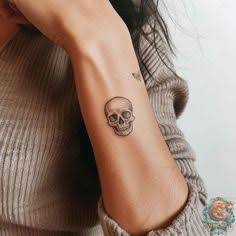
Placed along the outer edge of the hand between the wrist and pinky finger, a small, simplified skull here offers slightly more coverage flexibility than the back of the hand, since this area is a bit easier to hide with certain wrist positions or accessories. Best kept to 1.5 to 2.5 inches. Pain runs moderate to higher given the proximity to bone in this area. Tip: ask your artist about placement specifically relative to how your hand naturally rests, since this spot can be more visible than expected depending on how you hold your hands day to day. This is a slightly more discreet hand placement option, though still a visible, high-commitment choice overall. Now, a bolder design incorporating a serpent.
19. Blackwork Skull and Serpent Tattoo
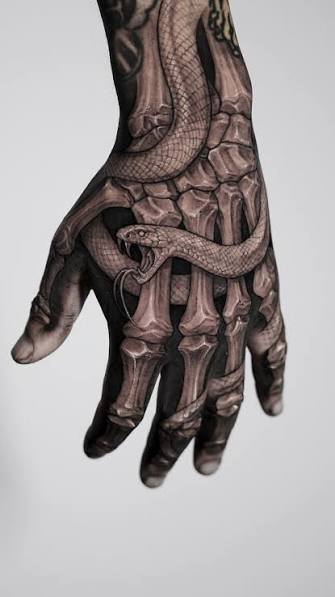
A skull with a simplified serpent wrapping through the eye sockets or jaw, done in solid blackwork, is a bolder, more elaborate composition that works best at a slightly larger size to keep both elements legible. Best sized 4 to 6 inches on the back of the hand. Pain runs high given the size and black saturation involved. Tip: ask your artist to keep the serpent’s body thick enough to read clearly at this scale rather than thin and winding, thin winding details are exactly the kind of linework that tends to blur first on hand skin. This is a bold, advanced design best suited to someone with prior ink experience and a clear understanding of the visibility tradeoffs involved. Let’s move toward a simpler, more universally wearable design.
20. Minimalist Skull Silhouette Tattoo
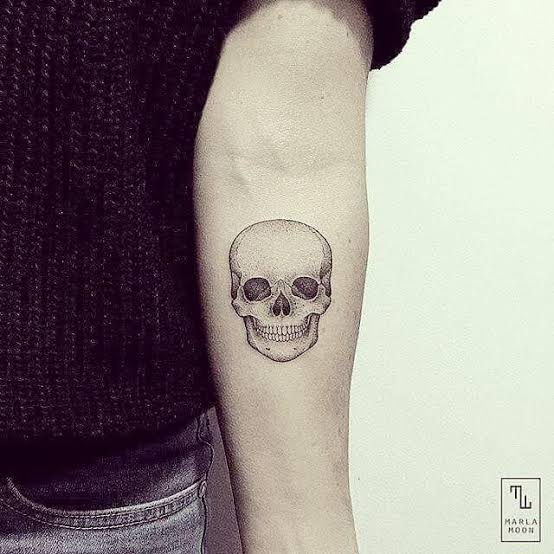
A clean, solid skull silhouette with no internal detail at all relies entirely on shape and proportion, and this simplicity happens to be one of the more forgiving approaches for hand placement specifically, since there’s no fine detail to blur or fade unevenly over time. Best sized 2 to 3 inches on the back of the hand. Pain runs moderate to higher for this placement. Tip: ask your artist to slightly exaggerate the eye socket and jaw proportions when sketching, an overly simplified silhouette can start to look more like a generic icon than an intentional design if the proportions are too flat. This is one of the more durable long-term choices on this entire list given how well solid black silhouettes hold their shape on hands. Last on the list, let’s close with the boldest option here.
21. Full Blackwork Skull and Dagger Hand Piece
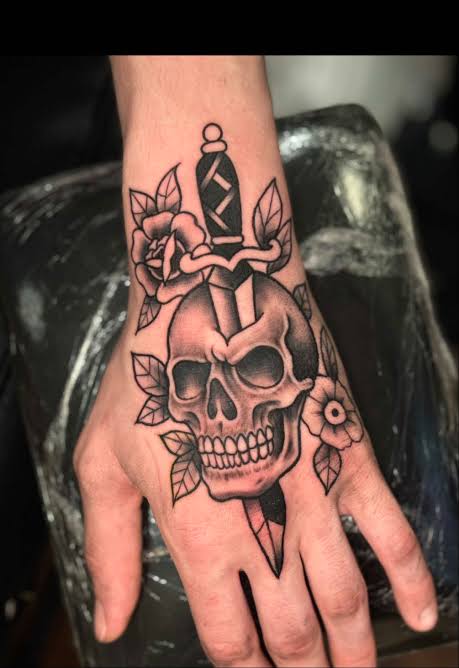
Closing out the list with one of the most committed designs: a skull paired with a dagger, both rendered in solid blackwork, spanning a significant portion of the back of the hand. Sized 4 to 6 inches, this design uses the dagger’s straight lines to balance the skull’s rounder shape. Pain runs high given the size and solid black saturation throughout. Tip: plan this design in a stencil fitting session in person rather than relying purely on a digital mockup, hand proportions vary enough between people that seeing the actual stencil on your specific hand matters here more than almost anywhere else on this list. This is a serious, high-visibility commitment, not a first tattoo, best suited to someone confident in both the design and the artist relationship, and done well, it’s a striking, graphic piece that holds up for years.
Best Placement Ideas
- Back of the hand — the most flexible spot for larger or bolder skull designs; higher pain, high visibility, harder to cover for work.
- Knuckles — bold, classic placement for smaller skull designs; among the more painful spots given minimal padding over bone.
- Fingers — best for very small, simplified designs; high pain and higher touch-up frequency given constant movement and washing.
- Side of the hand — slightly more coverage flexibility than the back of the hand; still a visible, high-commitment placement overall.
- Wrist-adjacent edge — a bit more discreet depending on how you naturally hold your hands, though still not a fully hidden placement.
Tips for Success
Choosing an experienced artist matters more for hand tattoos than for almost any other placement, since this skin behaves differently and not every artist has extensive hand-specific experience. Start by looking through portfolios specifically for hand placement work, not just general skull designs elsewhere on the body, since technique that ages well on the ribs or thigh doesn’t always hold up the same way here. Look for healed photos of hand tattoos at the one and two year mark if possible, since that’s the real test of how a design settles on this particular skin. Bring a clear reference photo and be upfront about wanting a bold, simplified version if fine detail is a concern, and ask direct questions in your consultation: how many hand pieces has this artist done, how do they typically expect a design like yours to age here, and what’s their honest touch-up recommendation timeline for this specific placement.
Common Mistakes and How to Avoid Them
- Choosing fine, detailed linework for a placement that doesn’t hold it well. Hand skin moves and fades more than most other areas, so bold, simplified designs generally outperform delicate detail here over time.
- Underestimating visibility and workplace impact. Hands are one of the hardest placements to cover consistently, so think through your specific job and daily life before booking, not just the design itself.
- Skipping the aftercare instructions your specific artist gives you. Hands get washed and exposed to sun constantly, which makes proper aftercare even more important here than on most other placements.
- Copying a reference design exactly without personalizing it. Small adjustments, a specific symbol pairing, a resized element, make the piece genuinely yours instead of a direct copy of someone else’s tattoo.
Similar Variations
Most designs on this list can be adjusted for size and boldness depending on your comfort level. A larger back-of-hand piece can be simplified into a smaller knuckle or finger version for lower commitment, keeping in mind that smaller, more detailed hand placements tend to need more frequent touch-ups. A fully shaded design can be simplified into a bold outline or silhouette version, which generally holds up better on this specific skin over time. Multiple smaller skull elements from this list, like the crossbones or a small silhouette, can also be combined across several fingers for a cohesive themed set rather than one larger single piece.
Aftercare Basics
Aftercare depends on your specific ink type, technique, and individual skin, so always follow the exact sheet your artist provides rather than generic internet advice. Hand tattoos in particular require extra attention during healing since this skin gets washed and exposed to friction constantly, so expect your artist to give more detailed guidance around handwashing, sun protection, and moisturizing than they might for a less-exposed placement. Healing timelines and reactions vary from person to person, so if anything seems unusual, it’s worth checking in with your artist or a licensed dermatologist rather than guessing.
Quick FAQ
How much does a skull hand tattoo cost? Cost depends heavily on size, technique, and your artist’s experience level, but expect a wide range, roughly $100 for a small finger piece up to $500 or more for a larger design spanning the back of the hand. Always get a direct quote during your consultation.
Does a skull hand tattoo hurt a lot? Pain tolerance varies a lot by individual, but the hand is generally considered one of the more sensitive placements on the entire body given the minimal padding over bone and joints, especially on the knuckles and fingers specifically.
How long does a skull hand tattoo take to heal, and does it fade faster than other placements? Surface healing typically takes a couple of weeks, though full healing underneath the skin can take longer, and hand tattoos in general tend to need touch-ups sooner than tattoos on less-exposed placements given constant washing, movement, and sun exposure. Follow your artist’s specific aftercare guidance closely.
Should I choose bold blackwork or fine line for a skull hand tattoo? Generally, bold blackwork and simplified linework hold their shape better on hand skin over time than fine, delicate detail does, which is worth discussing directly with your artist before finalizing a design for this specific placement.
Final Thoughts
Whichever version speaks to you, bold blackwork, a simplified silhouette, or a more elaborate skull and dagger piece, a skull hand tattoo works best when the design is honest about what this specific placement can and can’t hold onto over the years.
Take your time picking both the design and the artist, ask the questions covered here, and don’t be afraid to personalize any of these 21 skull hand tattoo ideas until it actually feels like yours. This is one of the most visible, high-commitment placements on the body, so it’s worth getting the plan right before you sit down in the chair.
This article is for inspiration and general informational purposes only. Pain tolerance, healing time, and individual results vary. Always consult a licensed, professional tattoo artist, and a dermatologist if you have any skin concerns, before booking.