24 Japanese Tattoo Art Ideas: A Practical Guide to Style, Placement, and Booking
Nervous about picking a Japanese tattoo design you’ll regret in five years? That worry is normal, and it’s actually a good sign. It means you’re thinking past the picture and into how the piece will actually live on your skin.
So what are the best Japanese tattoo art ideas? Fine-line koi, blackwork hannya masks, and traditional dragon or wave motifs work best for most people, since they draw on a centuries-old visual language with clear rules for line weight, shading, and composition. Smaller single-motif pieces heal faster and age more predictably than dense, multi-figure back work.
Stick around and I’ll walk you through 24 specific designs, where to put them on your body, how much pain to expect, roughly what they cost, and exactly how to brief an artist so you don’t end up with a watered-down version of what you actually wanted.
Why Japanese Tattoo Art Holds Up So Well Over Time
Japanese tattooing, often called irezumi, isn’t just a style of pictures. It’s a full system of composition: bold outlines, controlled shading (called bokashi), and background elements like wind bars, clouds, or water that carry the eye around the body instead of sitting as an isolated sticker. That structural thinking is why a well-built Japanese piece still reads clearly at 20 years old, when a lot of trendy micro-tattoos have blurred into smudges. Below, each design idea names the actual technique behind it, not just the subject, so you can talk to an artist using words that mean something.
Fine-Line Koi Fish Tattoo
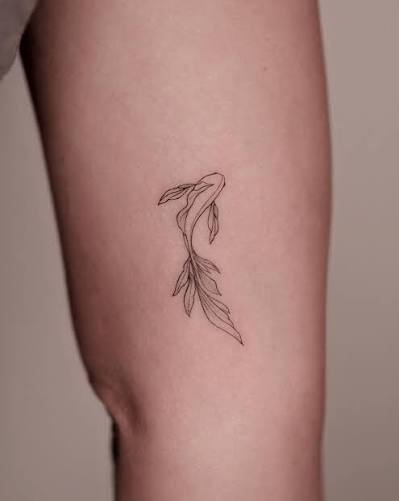
A single koi rendered in fine line uses thin, consistent needle work instead of the thick, saturated outlines you’d see in bold traditional Japanese pieces. Scales are suggested with light hatching rather than solid black, and shading stays minimal so the fish looks like it’s sketched rather than carved. This works best on the forearm, calf, or ribs at 4 to 6 inches, since fine line needs open space to stay legible as it ages. Bring a reference photo of the koi’s body curve, not just a generic fish image, so the artist can match scale direction to your placement. Pain is moderate on the ribs, lighter on the forearm. It’s workplace-friendly if placed on the inner arm, and it reads well as a first tattoo since the commitment level is lower than a full sleeve. From here, let’s look at what happens when you scale that same fish up dramatically.
Bold Traditional Dragon Sleeve

This is the opposite end of the spectrum: thick black outlines, heavy saturated shading, and a dragon body that winds through clouds and water down the entire arm. Traditional Japanese work relies on bokashi shading, a gradual black-to-skin gradient built with dot density rather than a single flat gray wash. A full sleeve typically needs multiple sessions over several months, so budget both time and money accordingly. Ask your artist to draw the dragon’s flow around your arm’s natural muscle lines before you commit to stencil placement. Expect more discomfort here since sleeves cover bony areas like the elbow and wrist alongside fleshier zones. This isn’t ideal for strict workplace dress codes, but it ages beautifully because the bold linework holds shape for decades. Next, let’s shrink the intensity back down with a mask design.
Blackwork Hannya Mask
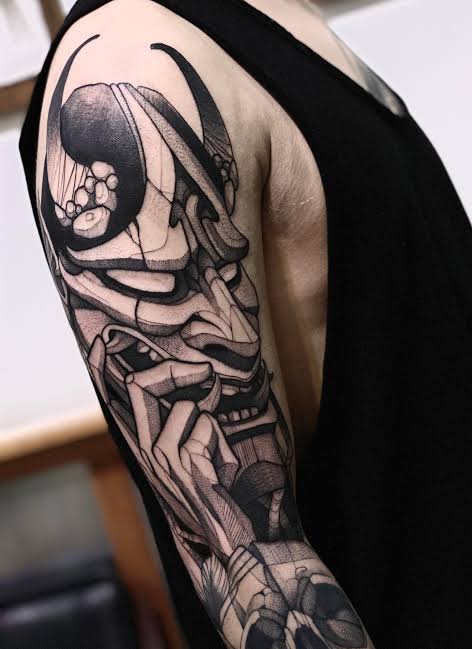
The hannya mask, a jealous or vengeful female spirit from Noh theater, is almost always done in blackwork: solid black fills with sharp negative space carving out the horns, teeth, and furrowed brow. There’s little to no color here, which keeps the design graphic and high-contrast even from a distance. Shoulder blades, upper arms, or the calf all give enough flat surface for the mask’s asymmetry to read correctly. Ask specifically for “negative space eyes” so the artist knows to leave bare skin rather than filling every detail solid black. Solid blackwork on fleshy areas is generally more tolerable than on bone, though sessions can run long due to fill time. It’s a striking choice for a second or third tattoo once you’re used to longer sits, and it’s less matching-friendly since its bold character reads as a solo statement piece. Let’s soften things up with a floral motif next.
Watercolor-Style Cherry Blossom Branch
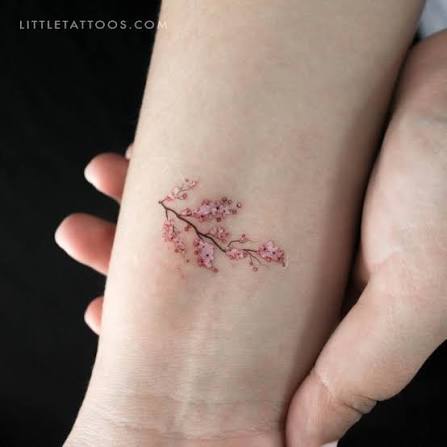
Cherry blossom, or sakura, gets a modern twist here: a fine-line branch structure with soft pink and white color washes bleeding outward like ink in water, rather than the flat, hard-edged petals of traditional Japanese florals. Saturation stays light and diffuse, which is part of what makes it look painterly. This suits the shoulder, upper back, or thigh, where a 6 to 8 inch branch has room to curve naturally. Because color washes fade faster than solid black linework, ask about touch-up scheduling at the consultation, typically 12 to 18 months out. Pain is generally moderate on these placements. It’s a popular matching choice for friends or siblings since each branch can vary slightly while still reading as a set. Now let’s move to a much more graphic, dot-based technique.
Dotwork Great Wave Tattoo
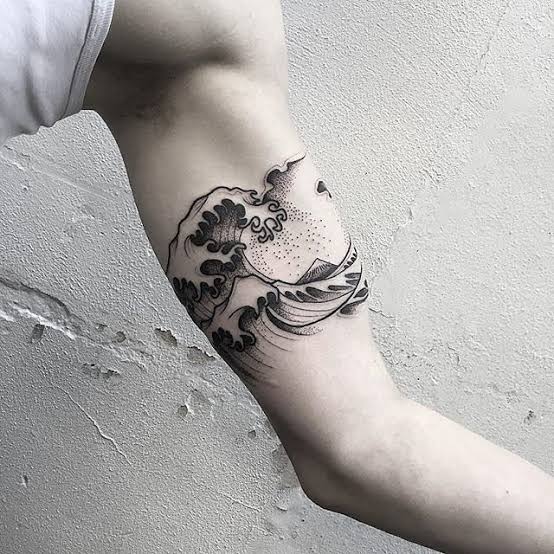
Inspired by the famous woodblock wave imagery, this design swaps traditional bold outlines for dotwork, meaning the entire wave shape and foam texture is built from thousands of individual dots rather than continuous lines or solid fills. The result has a grainy, almost engraved texture that catches light differently than flat black. This works well across the upper back or as a large forearm piece where the dot gradient has room to build gradually from dense to sparse. Bring reference images that show wave curl direction, since dotwork artists plan dot spacing around that flow. Dotwork tends to feel like a persistent buzzing rather than sharp pain, and many people find long sessions manageable. It’s less common for workplace visibility given its size, and it ages well since dot density can be refreshed more easily than fine outlines. Let’s scale that same wave concept down to something much smaller.
Single-Needle Sakura Petals

A scatter of three to five individual cherry blossom petals, done with a single fine needle, gives you the symbolism of sakura (transience, beauty, renewal) without any large-scale commitment. Lines stay razor-thin and there’s no shading at all, just clean outlines. This is a strong choice for the wrist, ankle, or behind the ear, at under 2 inches total. Because single-needle work is so delicate, ask your artist directly what needle configuration they’re using, since a heavier needle will blow out the fine detail within a year. Bony placements like the wrist and ankle tend to be more sensitive than fleshier spots. This is genuinely one of the best first-tattoo options and works beautifully as a matching design between friends. Let’s look at combining a koi with its water element next.
Negative Space Koi and Water

Here the koi’s body is left as bare, untattooed skin, while the surrounding water is filled in with solid black or dense linework, essentially inverting the usual approach. This negative space technique demands a skilled hand, since the fish’s shape is defined entirely by what’s left out. It works best on flatter areas like the forearm or upper back, at 5 inches or larger, so the negative shape stays visually distinct. Ask to see the artist’s portfolio specifically for negative space pieces, since this is a harder skill than standard linework and not every studio does it well. Expect moderate to firm pressure sensation given the amount of solid black fill involved. It’s a striking, conversation-starting piece, though its high contrast makes it less discreet for conservative workplaces. Next, a design built for bold, high-visibility statement pieces.
Traditional Japanese Tiger Tattoo
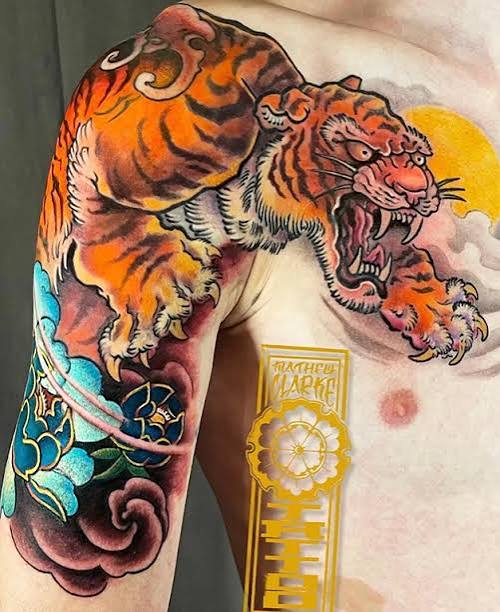
The tiger in Japanese tattoo art symbolizes courage and protection, and it’s almost always done in bold traditional style: thick black stripe outlines, warm orange or yellow bokashi shading, and a snarling expression with heavy linework around the eyes. This design wants space, ideally the thigh, back, or full ribcage, at 8 inches or more, so the stripe pattern doesn’t compress into a blur. Bring reference photos showing the tiger’s specific pose (crouched, leaping, or head-on) since body posture changes how the stripes wrap around your placement. Ribs and sternum areas rank among the more sensitive spots for this kind of extended color work. It’s a bold, less office-friendly piece best suited to established tattoo collectors rather than first-timers. From tigers, let’s move to a gentler, more symmetrical flower.
Fine-Line Chrysanthemum
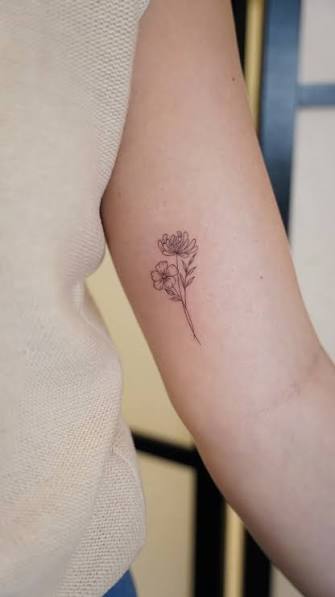
The chrysanthemum, a traditional symbol of longevity in Japanese art, gets translated into fine line as a tightly detailed circular flower head with dozens of thin, individually placed petal lines and zero shading. The geometric symmetry is the whole appeal here. This suits the shoulder, sternum, or upper arm at 3 to 5 inches, where the radial petal pattern has room to stay crisp. Ask your artist about line spacing before the session, since petals placed too close together tend to blur together as skin ages. Sternum placement runs more sensitive due to thin skin and nerve density there. It reads as elegant and subtle enough for most dress codes, and it’s a solid first-tattoo choice for anyone drawn to symmetry over bold color. Now let’s go big with a mythological bird.
Bold Phoenix Back Piece
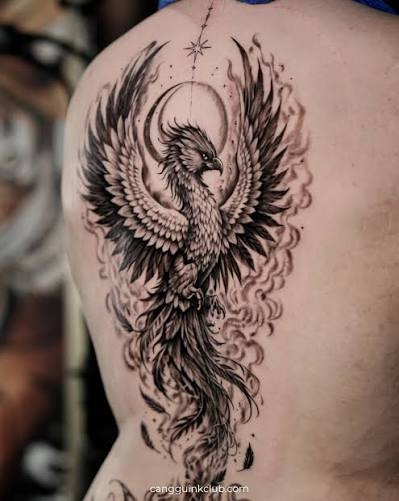
A phoenix in traditional Japanese style uses saturated reds, oranges, and blacks with flowing feather linework that trails into flame or cloud elements around it. This is a large-format piece, typically the full back or a substantial portion of it, running 12 inches or more, since the wingspan needs room to feel dynamic rather than cramped. This is a multi-session commitment, so ask upfront how the artist plans to break the back piece into stages (outline session, then color, then background fill). Full-back work involves a range of sensitivity depending on exact spot, with the spine area generally more sensitive than the shoulder blades. It’s not a first-tattoo or workplace-visible choice, but it’s a striking centerpiece for someone already committed to Japanese traditional work. Let’s bring the intensity back down with a mask piece that leans graphic rather than colorful.
Blackwork Oni Mask

Unlike the hannya, the oni mask (a demon figure) leans more masculine and monstrous in typical Japanese tattoo tradition, with heavier horns, bared fangs, and a scowling brow, usually rendered in solid blackwork with sharp negative space cutting out highlights. This works well on the shoulder, calf, or forearm at 4 to 6 inches. Since blackwork relies on dense, even saturation, ask your artist about their fill technique and healing timeline, since uneven fill can leave patchy spots that need a touch-up. Solid black fill sessions can run long, and discomfort tends to build with sitting time rather than spike sharply. It’s a bold, graphic choice suited to a second tattoo rather than a first, and its dark tone makes it a less common matching option among friend groups. Next, a smaller, more playful figure from folklore.
Fine-Line Kitsune (Fox) Tattoo

The kitsune, a shapeshifting fox spirit in Japanese folklore, works nicely in fine line: a slender fox silhouette with delicate whisker lines and minimal shading, sometimes paired with a small torii gate or single maple leaf. This suits the ankle, wrist, or behind the ear at 2 to 4 inches, since fine detail needs a flatter surface to stay sharp. Bring a reference showing the fox’s tail position, since multi-tailed kitsune designs (a folklore variant) need more linear space than a single-tail version. Ankle and wrist placements rank as more sensitive due to thin skin over bone. It’s an easy first-tattoo pick and works well as a subtle matching design for close friends who want something meaningful but small. Let’s shift to a bolder combination piece next.
Traditional Snake and Peony
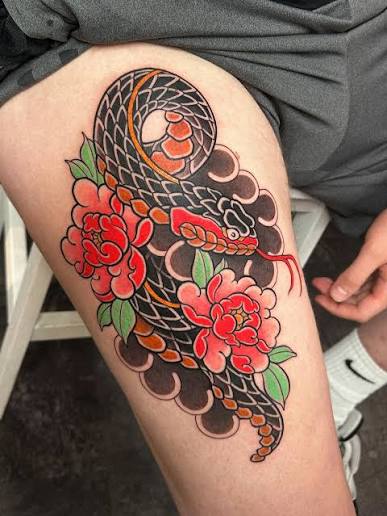
Snake and peony together form a classic Japanese pairing symbolizing protection and beauty in balance. The snake’s scales are built with tight, repeating linework, while the peony petals get soft bokashi shading in pink or red, creating a nice contrast between graphic pattern and painterly gradient. This piece works well on the thigh, ribs, or upper arm at 6 to 8 inches, giving the snake’s coil enough length to look natural rather than cramped. Ask your artist how they plan to route the snake’s body around your specific muscle contours. Rib placement runs more sensitive due to close bone proximity and thin skin. It’s a strong option for someone past their first tattoo who wants a piece with real narrative weight, though its size makes it less office-discreet. From here, let’s look at a minimalist bird design.
Minimalist Crane (Tsuru) Silhouette
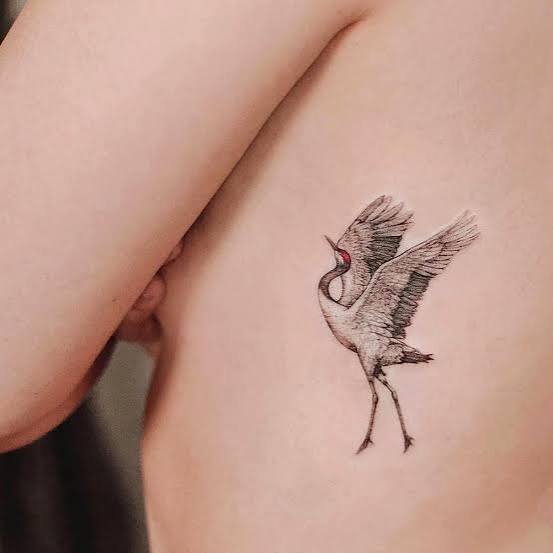
The crane, or tsuru, symbolizes longevity and good fortune, and in minimalist form it’s reduced to a clean single-line silhouette with no shading and no color, just the bird’s wing and neck curve captured in one continuous fine line. This works beautifully small, at 2 to 3 inches, on the collarbone, forearm, or ankle. Ask for a “continuous line” stencil test before your session, since a true single-line tattoo has zero room for the needle to wander off the path. Collarbone placement tends to be more sensitive given thin skin over bone. It’s an excellent first tattoo and a popular matching choice for couples or friend pairs, since the simplicity holds up well even at tiny scale over decades. Next, a guardian figure built for bold visibility.
Bold Foo Dog (Shishi) Guardian

The shishi, often called a foo dog, is a mythical lion-dog guardian figure rendered in bold traditional style with thick curling mane lines, saturated shading, and an intense, protective expression. This piece needs real space, ideally the thigh, chest, or upper back at 8 inches or larger, so the mane’s swirling detail doesn’t compress into mush. Bring reference photos of the specific pose (seated, roaring, or mid-stride) since shishi designs vary significantly in composition. Chest placement over the ribs and sternum tends to run more sensitive. It’s a strong statement piece best suited for someone already comfortable with longer sessions, and it’s not typically a workplace-discreet or first-tattoo choice given its scale. Let’s slow the pace down with a simple botanical design.
Fine-Line Bamboo Stalks

A cluster of two or three bamboo stalks in fine line uses thin, slightly varied line weight to suggest the plant’s natural segments and leaves, with zero shading needed. Bamboo’s symbolism (resilience, flexibility) pairs nicely with its visually simple, elegant form. This design suits a vertical placement like the spine, forearm, or side ribs at 5 to 7 inches tall. Ask your artist to vary line thickness slightly between stalks so the cluster doesn’t read as flat or mechanical. Spine placement is one of the more sensitive spots due to thin skin directly over bone. It’s workplace-friendly on the forearm and a solid first-tattoo option, plus it ages gracefully since simple linework resists blurring better than dense shading. Now, a flowering vine that trails rather than stands.
Traditional Wisteria Vine

Wisteria, with its cascading purple flower clusters, gets rendered in traditional Japanese style with bold outlines around each blossom cluster and soft bokashi gradients moving from deep purple to near-white at the petal tips. This trailing vine design works especially well down the side of the ribs, along the spine, or wrapping the upper arm at 6 to 10 inches, since the natural drooping shape follows the body’s vertical lines. Ask your artist to sketch the vine’s flow directly on your skin before stenciling, since wisteria’s cascading form needs to match your specific body contour. Rib and spine placements are more sensitive given proximity to bone. It’s a beautiful choice for a first larger piece if you’re ready to commit past the smallest single-motif designs, and it’s less matching-oriented given its scale. Let’s return to a graphic pattern technique next.
Dotwork Seigaiha Wave Pattern

Seigaiha is the traditional repeating wave pattern you’ve likely seen on Japanese textiles and pottery, made of overlapping concentric semicircles. In dotwork, each ring is built from tightly packed dots rather than solid lines, giving it a textured, almost fabric-like appearance. This pattern works well as a band around the ankle, wrist, or upper arm, or scaled larger across the shoulder, typically 3 to 8 inches depending on placement. Ask your artist about dot spacing consistency, since uneven spacing is the most common flaw in dotwork pattern pieces. Wristband placement tends to be more sensitive due to thin skin over bone. It’s a great matching-tattoo option since the pattern scales easily for different body sizes while still reading as a cohesive set. Now, a fierce mask figure with wings.
Blackwork Tengu Mask

The tengu, a bird-like mountain spirit with a long nose or beak, is typically done in blackwork with heavy solid fill for the mask’s face and sharp negative space defining the brow and eye sockets. It’s a more unusual choice than hannya or oni, which makes it a distinctive pick if you want Japanese folklore imagery without the more common mask designs. This suits the shoulder or calf at 4 to 6 inches. Ask to see prior tengu work specifically in the artist’s portfolio, since the elongated nose shape is easy to get proportionally wrong. Solid blackwork fill sessions build discomfort gradually rather than spiking. It’s a strong second-tattoo pick for folklore enthusiasts, and its graphic boldness makes it less suited to strict dress codes. Let’s move to a calmer, symbolic flower next.
Fine-Line Lotus Flower

The lotus, symbolizing purity rising from murky water, works well in fine line with delicate, symmetrical petal outlines and light hatching to suggest petal layers without heavy shading. This suits the ankle, wrist, or behind the ear at 2 to 4 inches for a subtle piece, or scaled to 5 to 6 inches on the shoulder for more presence. Ask your artist to draw the petal count and layering by hand before stenciling, since lotus symmetry is easy to get slightly lopsided freehand. Wrist and ankle placements run more sensitive due to bone proximity. It’s an excellent first-tattoo choice and a favorite matching design between friends who each want their own size variation. Now, let’s look at a fully rendered human figure.
Bold Traditional Samurai Warrior

A samurai figure in full traditional style combines bold black outlines, saturated color blocking on armor plates, and dynamic composition, often paired with cherry blossoms or clouds in the background to fill negative space. This is a large-format piece, typically the thigh, back, or full arm at 10 inches or more, since armor detail needs real room to stay legible. Ask your artist how many sessions the full figure will take and how they’ll sequence outline, color, and background work. Thigh and back sessions vary in sensitivity by exact spot, generally more tolerable on fleshier areas than bony ones. This isn’t a first-tattoo or workplace-discreet choice, but it’s a serious, detailed centerpiece for someone building out a larger Japanese-style collection. Let’s shift to a softer seasonal motif.
Watercolor Maple Leaves (Momiji)
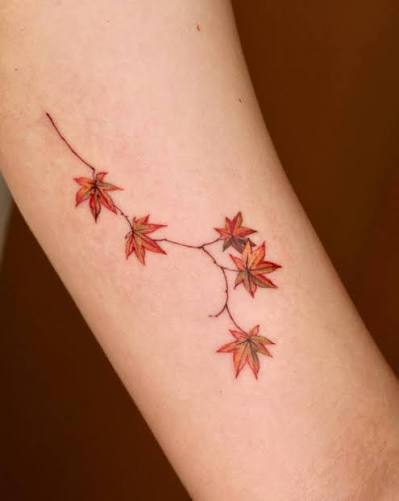
Autumn maple leaves, or momiji, get a modern watercolor treatment here: fine-line leaf outlines filled with soft, diffuse washes of red, orange, and yellow that blend into each other rather than staying in hard color blocks. A small cluster of two or three leaves works nicely on the shoulder, collarbone, or ankle at 3 to 5 inches. Because watercolor-style color fades faster than solid traditional fill, ask about a touch-up timeline at booking, typically within the first two years. Collarbone placement runs more sensitive given thin skin over bone. It’s a lovely matching option for people who want variation (each leaf can shift in color balance) while still reading as a coordinated set. Next, a slow, steady symbol of longevity.
Fine-Line Turtle (Kame) Tattoo

The turtle, or kame, symbolizes longevity and steady progress, and in fine line it’s kept simple: a clean shell pattern built from thin geometric linework with minimal or no shading. This suits the ankle, inner arm, or behind the ear at 2 to 3 inches. Ask your artist to keep shell segment lines evenly spaced, since uneven geometric patterns are the first thing to look sloppy as a fine-line piece settles and heals. Inner arm and ankle placements tend to be moderately sensitive. It’s a strong first-tattoo pick given its small size and simple linework, and it holds up well over decades since there’s minimal shading to fade unevenly. Finally, let’s look at what happens when several of these motifs come together in one composition.
Full Traditional Irezumi Back Piece (Combined Motifs)

This is the most ambitious option on the list: a full back piece combining multiple traditional elements, commonly a dragon or tiger as the central figure, wrapped with water, clouds, or wind bars, and accented with cherry blossoms or maple leaves filling the negative space. Every technique on this list (bold outline, bokashi shading, negative space, and background pattern work) comes together here, which is why full back pieces are typically planned across many separate sessions over a year or more. Ask your artist for a full composition sketch before any needlework begins, since changing major elements mid-piece is far harder than adjusting a small design. Full back work covers a range of sensitivity zones, with the spine consistently the most sensitive strip. This is not a first-tattoo or office-discreet choice, but for committed collectors it represents the fullest expression of Japanese tattoo tradition on the body.
Best Placement Ideas
Different spots on your body trade off visibility, pain, and long-term maintenance differently. Here’s a quick placement guide:
- Forearm: High visibility, moderate pain, holds fine line and bold work equally well, easy to touch up.
- Ribs: Low visibility (easy to cover), higher pain due to thin skin over bone, good for larger pieces like snake, tiger, or wisteria.
- Wrist and ankle: High visibility, higher pain due to bone proximity, best suited to small fine-line or single-needle pieces.
- Shoulder blade and upper back: Easy to cover, moderate to lower pain on fleshier spots, ideal for medium and large pieces like phoenix or shishi.
- Behind the ear: High visibility if hair is up, more sensitive skin, works only for very small designs like kitsune or lotus.
- Spine and sternum: Low to moderate visibility depending on clothing, consistently more sensitive, best for narrow vertical designs like bamboo.
- Full back or thigh: Coverable, sensitivity varies by exact spot, the standard choice for full irezumi or samurai pieces.
Tips for Success
Choosing the right artist matters more than choosing the right design. Look specifically for a portfolio with multiple examples in Japanese traditional or the specific sub-style you want (fine line, blackwork, dotwork, watercolor), not just one standout piece surrounded by unrelated work. At a consultation, ask to see healed photos, not just fresh ink, since fresh tattoos always look sharper than they will in six months. Bring reference images that show composition and technique, not just subject matter. It’s fine to ask direct questions about needle configuration, session count, and touch-up policy. A good artist will answer clearly instead of getting defensive.
Common Mistakes and How to Avoid Them
- Sizing too small for the detail level: Fine linework and dense shading both need enough surface area to stay legible as skin ages. If your reference image is packed with detail, size up.
- Choosing a placement that fights the design’s linework: A design built for a flat back doesn’t always wrap well around a curved calf. Ask your artist to mock up placement on your actual body before committing.
- Skipping aftercare instructions: This is the single biggest cause of blotchy healing and premature fading. Follow whatever sheet your specific artist gives you.
- Copying a design exactly without personalizing it: Japanese tattoo tradition actually encourages custom composition around your body. A direct copy from a flash sheet or someone else’s tattoo often won’t fit your frame the same way.
Similar Variations
Almost every design above can be resized or recombined. A large bold traditional tiger can be scaled down and simplified into a fine-line version for a smaller first piece. A single sakura branch can be duplicated and mirrored for a matching set between two people. Blackwork masks can be paired with a background wind bar or cloud pattern later on to extend into a larger sleeve piece. Color pieces like the phoenix or wisteria can also be done in blackwork-only for a more graphic, lower-maintenance alternative that skips the color touch-up cycle entirely.
Aftercare Basics
Aftercare details vary by studio and by design size, so always follow the specific sheet your artist gives you rather than generic internet advice. In general, most artists recommend keeping the area clean, avoiding direct sun and swimming during initial healing, and avoiding picking at any scabbing or peeling. Healing timelines vary by individual and by placement, with smaller fine-line pieces often settling faster than large color or blackwork sessions. If you notice anything that seems off during healing, such as unusual redness or swelling that doesn’t improve, check in with your artist or a licensed dermatologist rather than guessing.
Fine Line vs. Bold Traditional: Know the Difference
- Fine line: Thin, consistent needle work, little to no shading, subtle and often smaller in scale, tends to soften slightly over many years.
- Bold traditional: Thick black outlines, heavy saturated bokashi shading, larger scale, holds its shape and contrast for decades due to the density of ink.
- Blackwork: Solid black fill with negative space used deliberately, high contrast, graphic rather than painterly.
- Dotwork: Entire shapes and gradients built from individual dots rather than continuous lines or flat fill, gives a textured, engraved look.
Quick FAQ
How much does a Japanese tattoo cost? Small fine-line pieces often start around $100 to $250, while larger bold traditional or full back pieces can run into the thousands across multiple sessions. Exact pricing depends heavily on your artist’s rate and your region.
Does a Japanese tattoo hurt more than other styles? Not inherently. Pain depends far more on placement (bony areas like the ribs, spine, and ankle tend to be more sensitive) than on the specific style or technique.
How long does healing take? Small fine-line pieces often settle within two to three weeks, while larger bold or color pieces can take four to six weeks to fully heal. Individual healing varies, so always follow your artist’s specific aftercare sheet.
Will the design still look good in ten years? Bold traditional outlines and solid blackwork tend to hold their shape longest. Fine line and watercolor-style pieces can soften over time, so occasional touch-ups help maintain crispness.
Final Thoughts
Japanese tattoo art gives you an unusually deep well to draw from, from tiny single-needle sakura petals to a full traditional back piece built around a dragon or tiger. The key is matching the technique (fine line, bold traditional, blackwork, or dotwork) to your placement, pain tolerance, and how visible you want the piece to be day to day. None of this replaces an actual consultation, and pain, healing, and pricing will always vary by individual, so talk to a licensed, professional artist before you book anything.
Whatever design pulls you in, take your time picking both the image and the person putting it on your skin. A well-planned Japanese tattoo is something you’ll still be glad to see on your arm decades from now.