17 Small Tattoos For Women: The Practical Guide to Tiny Ink That Actually Works
Nervous about picking a design you’ll regret in five years? You’re not alone. Small tattoos have exploded in popularity, but most online articles leave you with a photo and a shrug—no real advice on placement, healing, or how to make sure your tiny art doesn’t turn into a blurry blob. This guide is different. I’ve spent years inside tattoo studios watching what works and what doesn’t, and I’m here to give you the honest, technical, and practical details you actually need before you sit in that chair.
So what are the best small tattoos for women? Fine-line icons, minimalist symbols, single-needle linework, and dotwork pieces under two inches are the sweet spot. They heal fast, hide easily when needed, and hold their shape for years if placed wisely. The key is knowing which techniques age well, what size is too small, and how to describe your vision so an artist can nail it on the first try.
Stick with me—I’ll walk you through 17 specific designs, each with placement tips, pain notes, cost ranges, and the one thing most articles skip: how to brief your artist like a pro. Let’s find a tattoo that actually fits you.
Why Small Tattoos Need More Than “Cute” Design Ideas
Tiny tattoos are tempting because they feel low-commitment, but they come with their own challenges. Fine lines can spread over time, colors can fade, and a design that looks crisp on a stencil might read as a smudge a decade later. The designs below are chosen not just for aesthetics, but for how they interact with your skin’s natural movement, sun exposure, and aging. Every idea includes technique-specific advice—line weight, shading style, color saturation—so you can make an informed choice.
The 17 Small Tattoo Designs (With Real Guidance)

1. Fine-Line Matching Heart Tattoos
A tiny heart drawn with a single needle (often called “fine line” or “single needle”) uses ultra-thin lines—usually 1–3RL round liner—to create a delicate outline with no shading. The result is airy and barely there, perfect for a first tattoo or a matching piece with a friend or partner.
Best placement: Inner wrist, behind the ear, or on the finger (side or base). The wrist is bony and more sensitive; behind the ear hides easily but heals slower due to hair friction. Finger tattoos tend to fade faster because of constant hand washing.
Pain level: Wrist and finger are sharp but quick—3 out of 10 average. Behind the ear stings a bit more (4/10).
Healing time: 2–3 weeks for surface healing, but fine lines settle fully in about a month.
Cost range: $80–$150 for a simple heart under 1 inch.
Artist tip: Ask your artist for a “no spread” technique—they’ll use a light hand and proper needle depth to prevent lines from blurring. Bring a reference of a fresh fine-line heart, not a healed photo.
How it ages: Fine lines may thicken slightly over 5–10 years, but a simple heart shape remains recognizable. Avoid sun exposure on this spot to delay fading.
Transition: If hearts feel too common, a geometric micro-dot tattoo offers a modern twist that holds up just as well.
2. Single-Needle Geometric Micro-Dot
This uses dotwork—tiny dots placed in patterns to form shapes like triangles, diamonds, or circles. A single needle creates precise, spaced dots that make the design feel like a subtle constellation on your skin.
Best placement: Collarbone, inner forearm, or ankle. Collarbone shows beautifully but is boney (pain 5/10). Ankle is less sensitive (3/10) but more prone to shoe friction during healing.
Healing time: 3–4 weeks. Dots heal cleanly but need to be kept moisturized to avoid scabbing that could lift ink.
Cost: $100–$200 depending on complexity.
Artist tip: Ask for “tight dot spacing” for a solid shape or “loose dots” for a softer look. Show your artist a photo of dotwork healed at least one year old—poorly done dots can blur into messy patches.
Why it works: Negative space is key—the skin between dots creates the design. This style ages gracefully because the dots stay separated if done properly.
Transition: If you prefer pure black lines without dots, a minimal script word is a classic choice.
3. Minimal Script Word Tattoo (Fine-Line)
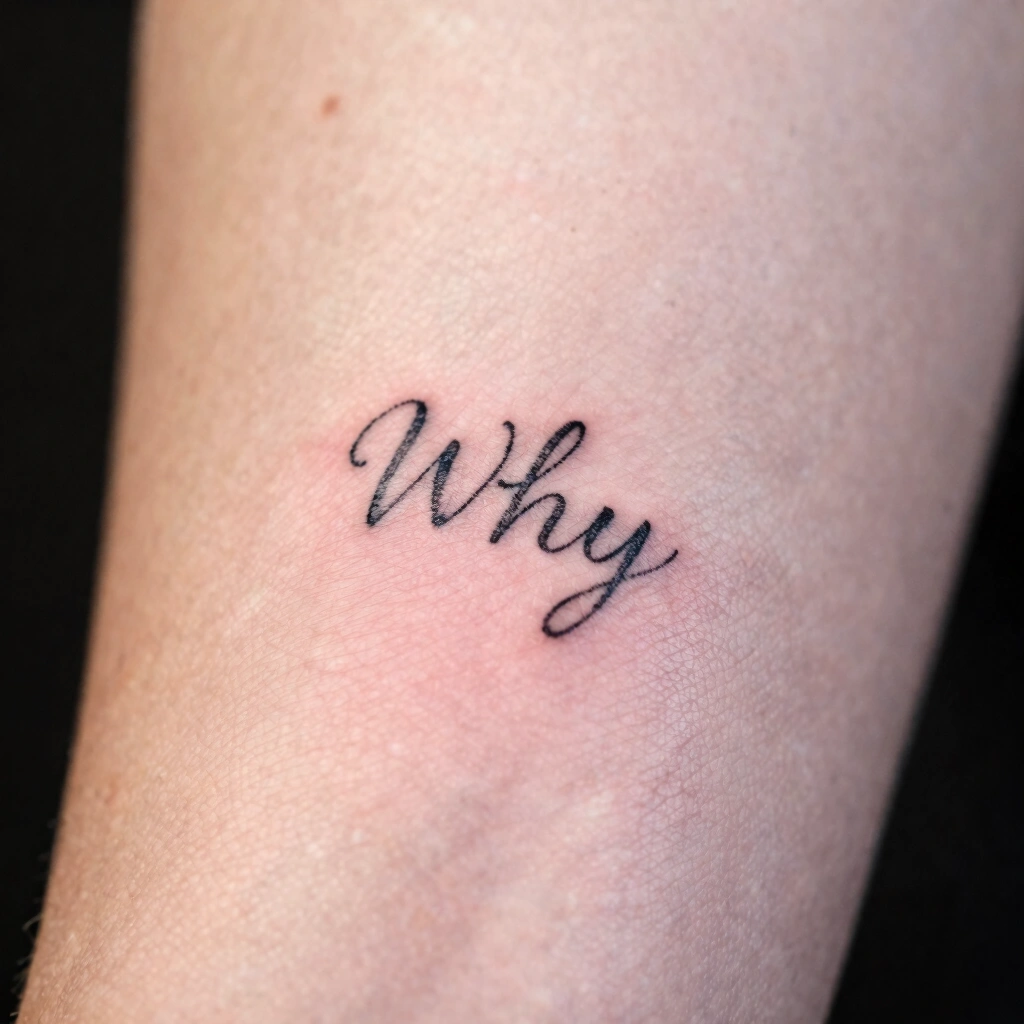
A single word or name in cursive or sans-serif letters, done with a small round liner (3RL or 5RL). The key is choosing a font that remains legible at small sizes—avoid overly ornate scripts with tight loops.
Best placement: Rib cage (pain 6/10), inner wrist (3/10), or behind the ear (4/10). Rib cage moves with breathing, so healing is tricky—avoid tight bras or shirts for two weeks.
Healing time: 2–3 weeks. Letters can scab thickly; don’t pick!
Cost: $80–$150 for one word.
Artist tip: Bring a printout of the exact font at the size you want. Ask the artist to adjust the spacing slightly larger than digital—skin makes letters appear tighter.
How it ages: Words smaller than 1/2 inch will blur into unreadable smudges within 5 years. Stick to at least 3/4 inch letter height.
Transition: For something more playful, a tiny animal silhouette in blackwork packs personality into a small space.
4. Blackwork Animal Silhouette
A solid black shape of an animal—cat, bird, elephant—using no outlines, just a filled silhouette. Done with a magnum shader for smooth, even black saturation.
Best placement: Ankle, inner arm, or shoulder blade. Ankle silhouettes are cute but can fade on the inside if legs rub together often. Shoulder blade is a pain 2/10—easy healing.
Healing time: 2–3 weeks. Solid black may peel in patches; that’s normal.
Cost: $100–$180.
Artist tip: Make sure the silhouette is at least 1 inch tall to keep the animal’s shape recognizable. Ask for “tight black packing” so no skin shows through when healed.
Transition: If solid black feels too bold, try a negative space design where the skin itself becomes the image.
5. Negative Space Moon and Stars
The tattoo is actually black around the shape—your skin remains untouched to form the moon or stars. This technique requires an artist skilled in “reverse” thinking.
Best placement: Inner forearm, behind the ear, or wrist. Avoid areas with lots of hair (like the wrist if you’re hairy) because regrowth can obscure the negative space.
Pain: 3–4/10.
Healing time: 3 weeks. The black areas may swell more than linework.
Cost: $120–$200.
Artist tip: Request a “soft edge” where black fades into skin with tiny dots—this helps the design look natural years later rather than a harsh border.
Transition: Want a pop of color? A watercolor-style tiny flower might be your pick.
6. Watercolor Abstract Flower
Soft washes of color blended into the skin without harsh outlines. The technique uses diluted ink and special shading needles, often with a “blowout” effect that mimics paint splatter.
Best placement: Hip, outer forearm, or shoulder. Watercolor requires ample space—at least 2 inches—to let colors breathe. Avoid hands or fingers: watercolor fades fast there.
Pain: 3/10 on fleshy areas.
Healing time: 4–5 weeks. Color may look uneven at first, then settle.
Cost: $150–$300 due to more time and materials.
Artist tip: Watercolor needs touch-ups every 3–5 years to stay vibrant. Ask for a “saturated base layer” before blending to minimize fading.
How it ages: Color migrates more than black. Sunblock is non-negotiable.
Transition: If you want something that lasts without touch-ups, dotwork mandalas are a solid choice.
7. Dotwork Minimalist Mandala
A small mandala built entirely from dots, with no connecting lines. The pattern radiates from a center point using varying dot sizes.
Best placement: Wrist, forearm, behind the ear, or ankle. Wrist works well but needs to be at least 1.5 inches to show the pattern clearly.
Pain: 3–5/10 depending on bone proximity.
Healing time: 3 weeks. Dots heal cleanly if you don’t scratch.
Cost: $100–$250.
Artist tip: Ask the artist to show you healed dotwork in their portfolio—many claim they can do it but produce fuzzy results. Stick with a specialist in “stippling” or “pointillism.”
Transition: For a literal connection, matching infinity symbols are a go-to friendship tattoo.
8. Ultra-Thin Infinity Symbol
Done with a 1RL needle (the smallest), this is two delicate loops that look like a figure-eight lying on its side.
Best placement: Side of the finger (pain 5/10, fades fast), inner wrist (3/10), or behind the ear (4/10). Finger options fade the most—plan on a touch-up in 2 years.
Healing time: 2–3 weeks.
Cost: $60–$120.
Artist tip: Keep the design simple—no shading. A thicker line (3RL) lasts longer on finger placements. Ask for “bold as possible for the size.”
Transition: If you want a symbol that’s more subtle, a tiny arrow or feather in blackwork works well.
9. Blackwork Arrow or Feather
A single arrow with fletching lines, or a feather with visible quills, done in solid black silhouette with no internal details.
Best placement: Forearm, calf, or collarbone. Collarbone arrows look directional and sporty. Calf hides easily and heals well (pain 2/10).
Healing time: 2–3 weeks.
Cost: $80–$150.
Artist tip: For an arrow, make sure the shaft is straight; ask the artist to trace along the natural line of your bone or muscle to avoid crookedness.
Transition: Need something truly tiny before committing? A single needle dot or line is the ultimate test patch.
10. Single Needle Dot (The “Test Dot”)
Exactly what it sounds like—one tiny dot, maybe a pinprick of black. It’s the smallest possible tattoo, often used as a “can you handle it?” test.
Best placement: Anywhere, but hidden spots like behind the ear or inside the wrist work best.
Pain: 1–2/10.
Healing time: 1 week. It might even flake off entirely if done too lightly.
Cost: $50–$80 (some artists do it as a freebie).
Artist tip: This is not a “real” tattoo for most—consider it a novelty. If you want a visible dot, make it a bold point using a curved magnum shader.
Transition: A more meaningful version is a tiny semicolon tattoo, popular for mental health awareness.
11. Fine-Line Semicolon Tattoo
A semicolon in fine line, usually 1–2 inches tall, with no extra decoration.
Best placement: Inner wrist, ankle, or side of the finger. The semicolon’s shape (a dot and a comma) requires at least 1/2 inch height for clarity.
Pain: 3/10.
Healing time: 2 weeks.
Cost: $80–$120.
Artist tip: Make the dot slightly larger than the comma line—this helps readability. Also, ask the artist to curve the tail slightly so it looks more organic.
Transition: Want something more decorative? A small floral branch in black and grey is elegant.
12. Black and Grey Floral Stem
A single stem with leaves and a small bud, shaded with greywash (diluted black ink) for a soft, painterly look.
Best placement: Rib, forearm, or ankle. Ribs hurt more (6/10) but the shape of a stem follows the body nicely.
Healing time: 3 weeks.
Cost: $150–$250.
Artist tip: Choose a flower with simple petal shapes—roses are too complex for tiny sizes. A lavender sprig or eucalyptus leaf works better.
How it ages: Greywash fades faster than pure black; expect a touch-up every 5 years.
Transition: If you prefer something geometric, a tiny diamond or triangle in blackwork makes a sharp statement.
13. Blackwork Diamond Shape
A solid black diamond, or a diamond outline with cross-hatch shading inside. The corners should be sharp—use a tight 5RL liner for crisp edges.
Best placement: Behind the ear, ankle, or side of the neck. Neck is visible but fades slower than expected because of constant washing.
Pain: 4/10.
Healing time: 2–3 weeks.
Cost: $80–$120.
Artist tip: Ask the artist to “pack” the black more densely near the edges to prevent fading at corners.
Transition: For something ethereal, a tiny star or constellation in dotwork can cover a scar or celebrate a memory.
14. Dotwork Star Constellation
A set of 3–5 dots connected by very faint lines (or just the dots alone) forming a recognizable constellation like the Big Dipper.
Best placement: Wrist, collarbone, or shoulder blade. Collarbone draws the eye naturally.
Pain: 3/10.
Healing time: 2 weeks for lines, 3 weeks for dots.
Cost: $100–$180.
Artist tip: Provide a clear star map of your chosen constellation. Ask for the lines to be drawn with a 3RL so they aren’t invisible but still delicate.
Transition: Want a meaningful date? Roman numeral tattoos are classy and compact.
15. Roman Numeral Date Tattoo
Thin numbers (e.g., IX.VII.MMXX) with serif style, done in black ink.
Best placement: Inner bicep, forearm, or rib cage. Avoid the wrist if you’re typing all day—friction can distort numbers.
Pain: 4/10 average.
Healing time: 2–3 weeks.
Cost: $100–$200.
Artist tip: At least 1/2 inch tall per numeral. Use a “stencil” first and check spacing—Roman numerals can run together. Ask your artist for a “shadow” (grey ink) under the numbers for a vintage look.
Transition: For a literal touch of nature, a tiny wave or mountain range in fine line captures adventure.
16. Fine-Line Wave or Mountain
A simple line drawing of a single wave crest or three mountain peaks, with no shading.
Best placement: Ankle, inner forearm, or behind the ear. Mountains work well on the inner arm because the peaks point upward.
Pain: 3/10.
Healing time: 2 weeks.
Cost: $80–$150.
Artist tip: Keep the line thickness uniform. A 3RL needle gives enough visibility without being too bold. Ask for a “continuous line” if you want it to look like one unbroken stroke.
Transition: Lastly, if you want a personal symbol no one else has, a custom line drawing of your pet’s silhouette is both unique and touching.
17. Pet Silhouette (Custom Blackwork)
A black silhouette of your cat, dog, or other pet based on a photo. The artist traces the outline and fills it solid.
Best placement: Inner arm, shoulder, or calf. Shoulder hides easily under sleeves.
Pain: 3/10.
Healing time: 2–3 weeks.
Cost: $150–$300 for custom work.
Artist tip: Bring a high-contrast side-profile photo. Ask the artist to simplify the neckline and ears—too much detail at small size equals mush. Request “negative space” for eyes (leave the skin unpainted) instead of white ink, which fades.
Best Placement Ideas for Small Tattoos

- Wrist – High visibility, moderate pain (3/10), but fades faster due to hand washing. Good for fine line and dotwork.
- Behind the Ear – Discrete, pain 4/10, heals slower because of hair friction. Best for simple shapes.
- Ankle – Low pain (2–3/10), easy to hide, but can fade from shoe friction. Silhouettes work well.
- Collarbone – Attractive, bony (pain 5/10), shows off geometry. Needs at least 1.5 inches.
- Finger – Trendy but high maintenance. Fades quickly, needs touch-ups every 1–2 years. Stick to tiny lines.
- Rib Cage – Painful (6/10), heals slowly due to movement. Only choose if you love the spot.
- Inner Forearm – Balanced pain (3/10), visible, and easy to care for. Most versatile placement.
Tips for Success When Booking a Small Tattoo

- Choose an artist who specializes in fine line or micro tattoos. Not every shop does this well. Look for healed photos in their portfolio—fresh photos can be deceiving.
- Bring reference images, but be open to adaptation. A good artist will adjust line weight and size to your skin type.
- Ask about needle type. For tiny lines, a 3RL or 1RL is standard. For solid black, a magnum shader.
- Discuss aftercare before you book. Small tattoos are easy to neglect. Prepare to clean and moisturize twice daily for two weeks.
- Consider a custom design over flash. Flash (pre-drawn designs) is fine for simple concepts, but custom ensures your tattoo is unique and fits your body perfectly.
Common Mistakes and How to Avoid Them

- Mistake: Sizing too small for detail. A 1/4-inch rose will turn into a blob. Solution: Keep designs simple; if the detail won’t fit at 1 inch, choose a different image.
- Mistake: Choosing the wrong placement for linework. Curved areas (like collarbone) can distort straight lines. Solution: Ask the artist to trace the stencil and check alignment in a mirror.
- Mistake: Copying a tattoo exactly without personalizing. That might be fine for a matching piece, but generic designs can feel impersonal. Solution: Add a tiny element—a color accent, a different placement, or a changed shape.
- Mistake: Skipping aftercare. Small tattoos are just as prone to infection as large ones. Solution: Follow your artist’s aftercare sheet religiously for at least two weeks.
- Mistake: Ignoring how the design ages. Thin lines spread, color fades. Solution: Choose black over white ink, and go slightly bolder than you think you need.
Similar Variations to Explore

- Resizing: Take any of the above designs and scale them up to 2–3 inches for more detail without changing the concept.
- Recoloring: Switch black ink for dark blue or forest green for a softer look that still lasts.
- Combining: Layer a fine-line heart over a dotwork background, or add a single word inside a constellation.
- Style switch: Turn a blackwork silhouette into watercolor by adding a soft color wash behind it.
Aftercare Basics (General Advice)

- Keep it clean: Wash with mild soap and water twice a day. Pat dry (don’t rub).
- Moisturize: Use a fragrance-free lotion or healing balm recommended by your artist.
- Avoid soaking: No pools, hot tubs, or baths for at least two weeks. Showers are fine.
- Sun protection: Once healed, apply sunscreen whenever the area is exposed. This prevents fading.
- Don’t pick scabs: Let them fall off naturally. Picking pulls out ink.
Disclaimer: Pain tolerance and healing vary by individual. Always consult a licensed professional artist and follow their specific aftercare instructions.
Quick FAQ

Q: How much does a small tattoo cost?
A: Expect $50–$300. Tiny dotwork or fine line under $150 is common. Custom designs and watercolor cost more.
Q: Does getting a small tattoo hurt?
A: Yes, but usually less than larger pieces. Pain level depends on placement—bony areas (wrist, collarbone, ribs) are more sensitive than fleshy spots (forearm, calf). Most people rate small tattoos at 2–5 out of 10.
Q: How long does a small tattoo take to heal?
A: Surface healing in 2–3 weeks. Full settling (ink stabilizing) takes about a month. Follow aftercare for best results.
Q: Will my small tattoo last?
A: With proper placement and good technique, yes. Fine lines may spread slightly over 10+ years, and color fades faster than black. Touch-ups every few years can keep it looking fresh.
Final Thoughts

Small tattoos for women are a fantastic way to express yourself without a huge commitment, but they’re not “set it and forget it.” The designs above give you a starting point, but the real magic happens when you pair the right idea with the right artist and placement. Take your time, ask questions, and don’t settle for a design that feels “just okay.” A tiny piece of art on your skin should make you smile every time you see it—and with the advice in this guide, you’re ready to find that perfect match. Go book that consultation, and enjoy the process. Your skin has a new canvas waiting.