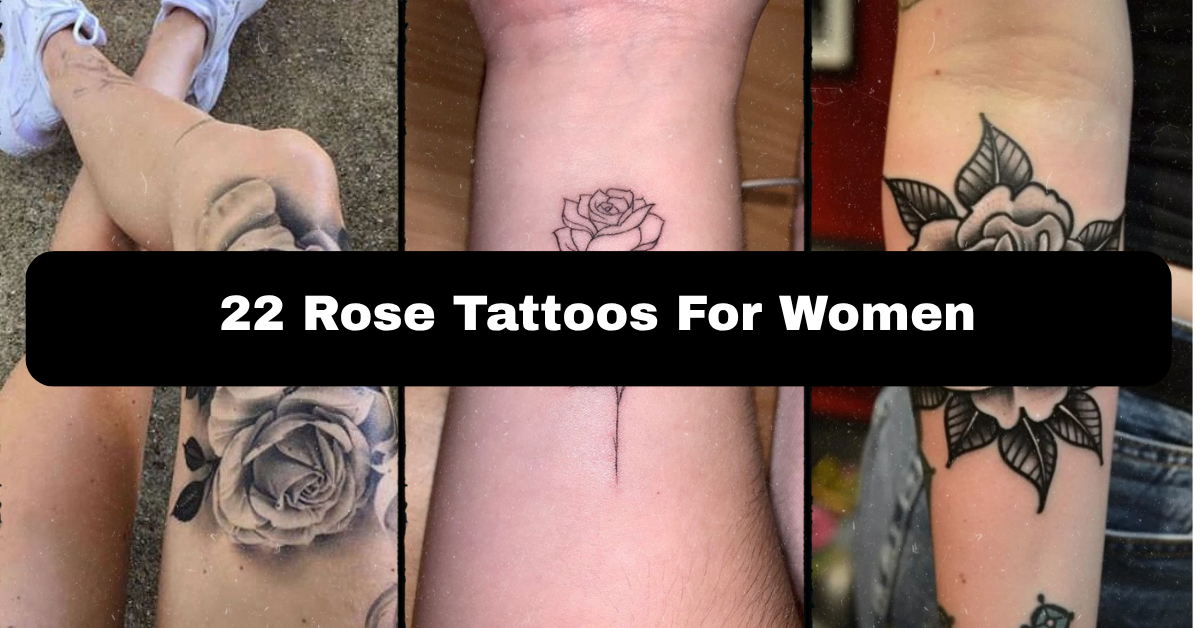
22 Rose Tattoos for Women: The Complete Guide to Design, Pain, Cost & Aftercare
Nervous about getting a rose tattoo that doesn’t quite look right on your body? You’re not alone. The rose is one of the most popular tattoo designs out there, but getting it to look stunning on you takes more than just picking a pretty picture off Pinterest. Let’s break down exactly what works, what doesn’t, and how to make sure your ink stays gorgeous for years.
So what are the best rose tattoos for women? Fine-line single roses on the wrist, bold traditional blooms on the forearm, black and grey realism pieces on the thigh, and watercolor-style roses with soft color washes all work exceptionally well. The most successful designs use contrast to create depth—dark petals against lighter highlights, bold outlines against soft shading. Simple linework tends to age better than heavily shaded pieces on smaller placements like the wrist or ankle .
This guide gives you the full picture—not just design ideas, but placement advice, pain levels, cost estimates, aftercare essentials, and exactly what to say to your artist. Let’s find the rose tattoo that actually fits you.
Understanding Rose Tattoo Techniques
Before we dive into the designs, here’s a quick breakdown of the key techniques you’ll see mentioned throughout this guide:
| Technique | What It Means | Best Used For |
|---|---|---|
| Fine Line | Uses a single needle or very small groupings for thin, delicate lines | Minimalist roses, small placements, subtle designs |
| Bold Traditional | Thick black outlines with a limited color palette | Classic roses that last decades, upper arm or calf |
| Blackwork | Uses only black ink, often with heavy saturation | High-contrast pieces, dramatic designs |
| Black and Grey Wash | Diluted black ink built up in layers for depth and softness | Realistic roses, soft shading, timeless designs |
| Watercolor | Mimics paint splashes with minimal outlines | Abstract, colorful, dreamy designs |
| Realism | Complex layering for photographic quality | Large placements like thigh or back |
| Dotwork | Creates shading using thousands of tiny dots | Textured, organic-looking designs |
22 Rose Tattoo Design Ideas for Women
1. Fine-Line Single Rose on the Wrist

This is one of the safest, most elegant choices in tattooing. A single fine-line rose on the wrist is subtle, feminine, and readable at a small size .
Technical breakdown: A fine line or single needle specialist is essential here. The rose should have clean outer contours, a few well-placed inner petal lines, and very light shading—if any shading is used at all . The key is restraint—too many petals and the design clogs up over time. Your artist will use a stencil to ensure the placement sits naturally on your wrist’s curve.
Placement & size: The wrist works because it gives you visibility without demanding a huge commitment of space. You can glance at it daily, but it still sits neatly enough to feel professional in most settings . Size it at 1.5-2 inches. A rose that’s too tiny won’t age gracefully—the details will blur.
Pain note: The wrist has thin skin and nerve endings, so expect moderate discomfort around 6-7 out of 10 . The inner wrist is more sensitive than the outer.
Healing time: Fine line heals in 1-2 weeks for the surface, with full recovery in about 2 months .
How to brief your artist: Bring a reference and say: “I want a fine-line single rose on my wrist. Clean, simple lines. Minimal shading. I want it to look delicate but still be readable in a few years.”
Cost range: $150-$300 .
Why it suits you: This solves the desire for a subtle, elegant design that’s low-commitment but still meaningful. It’s also a great first tattoo .
Transition: If you want something with more weight and longevity, a traditional rose on the forearm might be your style.
2. Bold Traditional Rose on the Forearm

This classic, old-school style features bold lines, vibrant colors, and a timeless illustrative quality . It’s a powerful choice for women who appreciate enduring tattoo artistry.
Technical breakdown: Bold traditional uses thick black outlines (often a 9-round liner) with limited, saturated colors—red, yellow, green, and black. Minimal shading is used, mostly for depth. Your artist will “pack” the color in using a magnum shader, which requires more passes over the same area . This style is built to last decades.
Placement & size: The forearm is one of the best canvases for traditional work—it’s a broad, flat area with good visibility. Size it at 3-4 inches for maximum impact.
Pain note: The forearm has decent muscle and fat, so pain is moderate (4-5 out of 10) .
Healing time: Color-packed traditional tattoos take longer to heal—expect 2-3 weeks for the surface, 3-4 months for full recovery .
How to brief your artist: Bring traditional tattoo flash (reference designs) and say: “I want a bold traditional rose on my forearm. Thick outlines, saturated red and green colors. I want the classic sailor-style look.”
Cost range: $250-$500 .
Why it suits you: This solves the desire for a classic, timeless design that will age beautifully. It’s for the woman who wants her ink to be bold and unapologetic.
Transition: If you want something softer and more delicate, a black and grey realism rose on the thigh is a beautiful alternative.
3. Black and Grey Realism Rose on the Thigh

This design creates a lifelike, photographic-quality rose using only black and grey ink. It’s soft, elegant, and incredibly detailed .
Technical breakdown: Your artist will use black and grey wash—diluted ink built up in layers—to create depth and softness . A bugpin magnum needle configuration is often preferred for hyper-detailed realism work . The shading needs to be smooth, with careful transitions from dark shadows to light highlights. The result is a rose that looks almost three-dimensional.
Placement & size: The thigh is one of the best placements for large realism pieces—the skin stays stable over time and gives the artist genuine room to work . Size it at 6-10 inches.
Pain note: The thigh has good muscle and fat, so pain is moderate (4-5 out of 10) .
Healing time: 2-3 weeks for surface healing, 2-3 months for full recovery .
How to brief your artist: Bring reference photos of black and grey realism roses and say: “I want a realistic rose on my thigh in black and grey. I want the petals to look lifelike with smooth shading.”
Cost range: $600-$1,200+ .
Why it suits you: This solves the desire for a soft, sophisticated, and deeply artistic design that feels like a work of art on your body.
Transition: If you want to add a soft, painterly feel, a watercolor rose is a stunning choice.
4. Watercolor Rose on the Shoulder

This design looks like it was painted directly onto your skin with watercolors. There are no hard outlines—just soft, blended washes of color .
Technical breakdown: The watercolor technique uses diluted inks to create soft, bleeding edges. Your artist will use a magnum shader to lay down the color, then work quickly to blend it before it sets. The rose might have a soft red wash with hints of pink and purple bleeding into the surrounding skin. No outlines—just pure, flowing color.
Placement & size: The shoulder or collarbone are elegant placements for delicate watercolor pieces . Size it at 3-5 inches. Watercolor needs enough space for the colors to blend naturally.
Pain note: The shoulder is moderate (4-5 out of 10). The collarbone is more sensitive (6-7 out of 10) .
Healing time: Watercolor can heal differently—expect 2-3 weeks for the surface, 3-4 months for full recovery. Colors may fade more quickly than black ink.
How to brief your artist: Bring watercolor art references and say: “I want a watercolor rose on my shoulder. Soft, blended colors—no outlines. I want it to look like a painting.”
Cost range: $400-$1,000.
Why it suits you: This solves the desire for a soft, artistic, unique design that feels like a painting.
Transition: If you want something edgy and meaningful, a rose with a dagger tells a powerful story.
5. Rose and Dagger Tattoo
This design pairs a blooming rose with a sharp dagger, symbolizing protection, sacrifice, or the balance between beauty and pain .
Technical breakdown: Your artist will use bold linework for the dagger and black and grey shading for the rose. The contrast between the sharp, straight dagger and the soft, curved petals is what makes the design work. The dagger often runs through the center of the rose or sits beside it.
Placement & size: This works well on the forearm, thigh, or calf. Size it at 4-6 inches.
Pain note: The forearm is moderate (4-5 out of 10). The calf is also moderate.
Healing time: 2-3 weeks for surface healing, 2-3 months for full recovery.
How to brief your artist: Bring references of rose and dagger tattoos and say: “I want a rose with a dagger. Use bold lines for the dagger and soft shading for the rose. I want it to feel powerful and meaningful.”
Cost range: $400-$900.
Why it suits you: This solves the desire for a design that represents strength, protection, and overcoming challenges.
Transition: If you want to include multiple roses, a rose bouquet is a lush, romantic choice.
6. Rose Bouquet on the Upper Back
This design features a bouquet of roses (and possibly other flowers) arranged on the upper back. It’s romantic, lush, and visually stunning .
Technical breakdown: Your artist will use a combination of fine line and black and grey shading to create depth. Each rose should be distinct, with different sizes and angles. Leaves and stems weave through the bouquet, connecting the blooms. The composition can be symmetrical (center of the back) or asymmetrical (flowing over one shoulder).
Placement & size: The upper back is a large, flat canvas. Size it at 6-10 inches.
Pain note: The upper back is moderate (4-6 out of 10). The spine is more sensitive (7-8 out of 10) .
Healing time: 2-3 weeks for surface, 2-3 months for full recovery.
How to brief your artist: Bring images of flower bouquets and say: “I want a rose bouquet on my upper back. Use black and grey shading. I want it to feel lush and romantic.”
Cost range: $600-$1,500.
Why it suits you: This solves the desire for a large, statement piece that feels romantic and complete.
Transition: If you want something more structured and architectural, a geometric rose is a modern alternative.
7. Geometric Rose Tattoo

This design uses sharp lines, triangles, and polygons to create a rose that feels modern and architectural .
Technical breakdown: This is all about precise linework and negative space. Your artist will use a single needle or fine liner to create the geometric shapes. The rose might be an outline composed of triangles, or a solid shape with geometric petals.
Placement & size: This design pops on the forearm, upper arm, or calf. Size it at 3-5 inches.
Pain note: The forearm and calf are moderate (4-5 out of 10).
Healing time: Linework heals in 1-2 weeks for the surface, 2 months for full.
How to brief your artist: Bring geometric art references and say: “I want a geometric rose. Use sharp angles and clean lines. No shading, just linework.”
Cost range: $300-$700.
Why it suits you: This solves the desire for a modern, unique, and visually striking design.
Transition: If you want to honor someone you’ve lost, a memorial rose with a name is a beautiful tribute.
8. Memorial Rose with Name and Dates

This design incorporates a loved one’s name and dates into a rose design. It’s a meaningful tribute that keeps them close to your heart .
Technical breakdown: The rose is done in fine line or black and grey style. The name and dates are rendered in single needle script, often placed on a ribbon or banner wrapped around the stem. Your artist will need to carefully balance the composition.
Placement & size: This works on the forearm, shoulder, or ribs. Size it at 3-5 inches.
Pain note: The forearm is moderate (4-5 out of 10). The ribs are more sensitive (7-8 out of 10) .
Healing time: Fine line heals in 1-2 weeks surface, 2 months full.
How to brief your artist: Bring the name and dates and say: “I want a memorial rose with this name and these dates. Use fine line for the rose and single needle for the script.”
Cost range: $350-$800.
Why it suits you: This solves the desire for a deeply personal, meaningful design that honors a loved one.
Transition: If you want to blend the rose with another symbol of love, a heart and rose is a classic pairing.
9. Heart and Rose Combination
This design places a rose inside or next to a heart, creating a powerful symbol of love and passion .
Technical breakdown: Your artist will use bold traditional or black and grey techniques. The heart can be done in bold outline with solid color fill, while the rose is detailed and shaded. The contrast between the simple heart and the complex rose is visually striking.
Placement & size: This works on the forearm, upper arm, or chest. Size it at 3-5 inches.
Pain note: The forearm and upper arm are moderate (4-5 out of 10). The chest is more sensitive (6-7 out of 10) .
Healing time: 2-3 weeks surface, 2-3 months full.
How to brief your artist: Bring references and say: “I want a heart and rose combination. Use bold lines for the heart and soft shading for the rose.”
Cost range: $350-$800.
Why it suits you: This solves the desire for a romantic, classic design that represents love in its many forms.
Transition: If you want something that stands out from the crowd, a blue rose is a unique choice.
10. Blue Rose Tattoo

A blue rose symbolizes mystery, rarity, and the unattainable . It’s a bold, unconventional choice.
Technical breakdown: Your artist will use realism or black and grey techniques with blue tones. The petals need to be layered and shaded to create depth. A blue rose tattoo often uses cool tones, which can look striking against warm skin tones .
Placement & size: This works on the forearm, thigh, or shoulder. Size it at 3-5 inches.
Pain note: Moderate (4-5 out of 10) on fleshy areas.
Healing time: 2-3 weeks surface, 2-3 months full.
How to brief your artist: Bring references of blue roses and say: “I want a blue rose. Use realism with cool tones. I want it to feel mysterious and unique.”
Cost range: $400-$1,000.
Why it suits you: This solves the desire for a unique, unconventional design that stands out.
Transition: If you want a dark, gothic feel, a black rose is a powerful choice.
11. Black Rose Tattoo
A black rose symbolizes grief, mourning, the end of an era, or a rebellious spirit . It’s dramatic and powerful.
Technical breakdown: Blackwork is the technique here. Your artist will use heavy saturation to create deep, solid black petals. Light areas can be left as negative space or done in light grey wash for contrast .
Placement & size: This works on the forearm, thigh, or shoulder. Size it at 3-5 inches.
Pain note: Moderate to high (5-6 out of 10). Heavy saturation requires more passes over the same area, which increases discomfort .
Healing time: Heavy blackwork takes longer—2-3 weeks surface, 3-4 months full.
How to brief your artist: Bring references and say: “I want a black rose. Use heavy blackwork. I want it to feel dark and powerful.”
Cost range: $400-$1,000.
Why it suits you: This solves the desire for a dark, dramatic, and introspective design.
Transition: If you want to combine different techniques, a neo-traditional rose is a stunning choice.
12. Neo-Traditional Rose

This style takes the bold outlines of traditional tattooing and adds more detail, depth, and dimension .
Technical breakdown: Neo-traditional uses bold linework but with more shading and color blending than traditional. Your artist might use a bugpin magnum for smooth gradients and single needle for fine details . The result is a rose that feels both classic and modern.
Placement & size: This works on the thigh, forearm, or back. Size it at 4-6 inches.
Pain note: Moderate (4-5 out of 10) on fleshy areas.
Healing time: 2-3 weeks surface, 2-3 months full.
How to brief your artist: Bring references and say: “I want a neo-traditional rose. Use bold outlines with smooth shading and blended colors.”
Cost range: $500-$1,200.
Why it suits you: This solves the desire for a classic style that still feels modern and detailed.
Transition: If you’re looking for a couples tattoo, matching rose tattoos are a beautiful option.
13. Matching Rose Tattoos for Couples

This is a classic couples tattoo—two people get matching roses. It’s a symbol of love, connection, and growing together.
Technical breakdown: The roses should be designed as a matching set. They could have similar linework styles (both fine line or both bold traditional) or share a design element. They could be mirror images or complementary designs.
Placement & size: Often placed on the wrist, forearm, or behind the ear. Keep each piece 1-2 inches.
Pain note: The wrist and behind the ear are sensitive (6-8 out of 10). The forearm is more moderate (4-5 out of 10).
Healing time: 1-2 weeks surface, 2 months full.
How to brief your artist: Bring two references and say: “We want matching rose tattoos. Use the same style for both. They should feel like a pair.”
Cost range: $150-$400 each.
Why it suits you: This solves the desire for a meaningful couples tattoo that’s subtle and stylish.
Transition: If you want a unique take, a rose combined with a compass is an adventurous choice.
14. Rose and Compass Tattoo

This design combines a rose with a compass, symbolizing guidance, direction, and finding your way .
Technical breakdown: Your artist will use a mix of blackwork for the compass and fine line or black and grey for the rose. The compass can be placed inside the rose or beside it. The contrast between the geometric compass and the organic rose is visually striking.
Placement & size: This works on the forearm, thigh, or shoulder. Size it at 4-6 inches.
Pain note: Moderate (4-5 out of 10).
Healing time: 2-3 weeks surface, 2-3 months full.
How to brief your artist: Bring references and say: “I want a rose with a compass. Use blackwork for the compass and soft shading for the rose.”
Cost range: $500-$1,200.
Why it suits you: This solves the desire for a design about finding your path and staying grounded.
Transition: If you want to be reminded of the passage of time, a rose with a clock is a meaningful choice.
15. Rose and Clock Tattoo
This design pairs a rose with a clock, symbolizing time, memory, and the fleeting nature of life .
Technical breakdown: Your artist will use realism for both elements. The clock can be a pocket watch or a vintage face, with Roman numerals and fine details. The rose should be soft and romantic. The contrast between the cold, mechanical clock and the warm, organic rose is what makes the design work.
Placement & size: This works on the forearm, thigh, or back. Size it at 4-6 inches.
Pain note: Moderate (4-5 out of 10).
Healing time: 2-3 weeks surface, 2-3 months full.
How to brief your artist: Bring references and say: “I want a rose with a clock. Use realism for both. I want the rose to be soft and the clock to be detailed.”
Cost range: $600-$1,500.
Why it suits you: This solves the desire for a design about time, memory, and the preciousness of life.
Transition: If you want something that feels truly personal, a rose with script is a great choice.
16. Rose with Script or Quote

This design combines a rose with meaningful text—a name, date, or quote .
Technical breakdown: The rose is done in black and grey or fine line. The script is done in single needle. Your artist will need to carefully balance the composition so the text and rose work together.
Placement & size: This works on the forearm, ribs, or shoulder. Size it at 3-5 inches.
Pain note: The forearm is moderate (4-5 out of 10). The ribs are more sensitive (7-8 out of 10) .
Healing time: Fine line heals in 1-2 weeks surface, 2 months full.
How to brief your artist: Bring the text and a rose reference and say: “I want a rose with this text. Use fine line for the rose and single needle for the script.”
Cost range: $350-$900.
Why it suits you: This solves the desire for a deeply personal, meaningful design.
Transition: If you want a softer, more romantic take, a rose with a butterfly is a beautiful choice.
17. Rose and Butterfly Tattoo

This design pairs a rose with a butterfly, symbolizing transformation, freedom, and beauty .
Technical breakdown: Your artist will use fine line or black and grey for both elements. The butterfly can be perched on the rose or flying near it. The contrast between the delicate butterfly and the layered rose is beautiful.
Placement & size: This works on the forearm, shoulder, or ankle. Size it at 3-5 inches.
Pain note: The forearm and shoulder are moderate (4-5 out of 10). The ankle is more sensitive (6-7 out of 10) .
Healing time: 2-3 weeks surface, 2-3 months full.
How to brief your artist: Bring references and say: “I want a rose with a butterfly. Use fine line for both. I want it to feel soft and romantic.”
Cost range: $400-$1,000.
Why it suits you: This solves the desire for a design about transformation and new beginnings.
Transition: If you want a small, subtle design, a micro rose is perfect.
18. Micro Rose Tattoo

This is a tiny, delicate rose—often on the finger, behind the ear, or on the wrist .
Technical breakdown: Single needle is essential here. The design needs to be simple—just a few petals, a stem, and maybe a leaf. Detail is limited by size, so the focus should be on clean, crisp lines .
Placement & size: Finger, behind the ear, or wrist. Size it at 0.5-1 inch.
Pain note: The finger is quite painful (7-8 out of 10) due to the lack of fat. Behind the ear is also sensitive (7-8 out of 10). The wrist is moderate (6-7 out of 10) .
Healing time: Fine line heals in 1-2 weeks surface, 2 months full. However, finger tattoos may fade faster.
How to brief your artist: Say: “I want a tiny rose. Single needle, clean lines. Keep it simple—just a few petals.”
Cost range: $100-$250 .
Why it suits you: This solves the desire for a subtle, minimal design that’s easy to hide but personal.
Transition: If you want a design that climbs, a rose vine is a dynamic choice.
19. Rose Vine Tattoo

This design features a climbing vine with multiple roses and leaves, wrapping around the arm or leg .
Technical breakdown: Your artist will use a mix of fine line for the vine and black and grey for the roses. The design should flow organically, following the natural curve of your limb. The vine can be delicate or bold, depending on your preference.
Placement & size: This works on the forearm, calf, or ankle. Size it to wrap around the limb—3-6 inches.
Pain note: The forearm and calf are moderate (4-5 out of 10). The ankle is more sensitive (6-7 out of 10) .
Healing time: 2-3 weeks surface, 2-3 months full.
How to brief your artist: Bring references and say: “I want a rose vine wrapping around my [forearm/calf]. Use fine line for the vine and soft shading for the roses.”
Cost range: $500-$1,200.
Why it suits you: This solves the desire for a dynamic, flowing design that follows your body’s natural lines.
Transition: If you want something abstract and moody, a dark botanical rose is stunning.
20. Dark Botanical Rose
This design uses fine lines and layered black shading to give the rose a dark, almost gothic edge .
Technical breakdown: Your artist will use fine line and blackwork to create a moody, dramatic effect. The petals are detailed but dark, with heavy shading. The leaves are often sharp and jagged, adding to the edgy feel.
Placement & size: This works on the forearm, thigh, or back. Size it at 4-6 inches.
Pain note: Moderate (4-5 out of 10).
Healing time: Heavy blackwork takes longer—2-3 weeks surface, 3-4 months full.
How to brief your artist: Bring references and say: “I want a dark botanical rose. Use fine lines and heavy blackwork. I want it to feel moody and edgy.”
Cost range: $500-$1,200.
Why it suits you: This solves the desire for a dark, dramatic, and uniquely beautiful design.
Transition: If you want to remind yourself to seize the day, a memento mori rose is a powerful choice.
21. Memento Mori Rose
This design combines a rose with memento mori symbolism—a reminder of mortality .
Technical breakdown: Your artist will use fine line or blackwork. The rose is often dark, with the petals having a black tint. The words “Memento Mori” are often included in elegant script along the stem . It’s a minimal but powerful design.
Placement & size: This works on the forearm, wrist, or ribs. Size it at 3-5 inches.
Pain note: The forearm is moderate (4-5 out of 10). The wrist and ribs are more sensitive (6-8 out of 10) .
Healing time: 2-3 weeks surface, 2-3 months full.
How to brief your artist: Bring references and say: “I want a memento mori rose. Use fine line. Include the words ‘Memento Mori’ in script.”
Cost range: $350-$800.
Why it suits you: This solves the desire for a design that’s both beautiful and deeply philosophical.
Transition: If you want a complete floral scene, a rose sleeve is the ultimate commitment.
22. Full Rose Sleeve

This is a full arm sleeve (or half-sleeve) featuring multiple roses in a cohesive, flowing design .
Technical breakdown: Your artist will use a combination of techniques—bold traditional, black and grey, or realism—depending on your preference. The roses should flow together, connected by vines, leaves, and shadows. The composition should follow the natural lines of your arm.
Placement & size: Full or half sleeve. This is a major commitment.
Pain note: Varies by location—inner arm is more sensitive (5-6 out of 10), outer arm is more moderate (4-5 out of 10).
Healing time: Multiple sessions—plan for 3-6 months of total healing time.
How to brief your artist: Bring references and say: “I want a full rose sleeve. I want the roses to flow together with vines and leaves. I prefer [bold traditional / black and grey / realism].”
Cost range: $1,500-$4,000+.
Why it suits you: This solves the desire for a major, cohesive, and visually stunning statement piece.
Best Placement Ideas for Rose Tattoos
Here’s a quick summary to help you decide where to put your design:
| Placement | Visibility | Pain Level (1-10) | Maintenance | Best For |
|---|---|---|---|---|
| Wrist | High | 6-7 | Can rub on clothing | Small designs, daily reminders |
| Forearm | High | 4-5 | Easy to care for | Medium designs, first tattoos |
| Upper Arm | Moderate | 4-5 | Easy to care for | Traditional, medium-to-large pieces |
| Thigh | Low to Moderate | 4-5 | Easy to care for | Large realism pieces |
| Shoulder | Moderate | 4-5 | Easy to care for | Medium-to-large designs |
| Ribs | Low (covered) | 7-8 | Watch for bra friction | Small, personal designs |
| Ankle | Moderate | 6-7 | Watch for socks/shoes | Small designs, vine wraps |
| Back of Hand | High | 7-8 | Fades faster, needs touch-ups | Tiny designs |
Common Mistakes and How to Avoid Them
1. Sizing Too Small for Detail
- The Mistake: You want a highly detailed realism rose, but you want it to be only 2 inches.
- Why It Fails: Ink spreads under the skin over time. Fine details will blur into a blob within 5-10 years .
- The Fix: Go bigger. If you want detail, give the artist room to work. For intricate roses, 4 inches minimum. A fine-line rose on the wrist works because it’s kept simple—not because it’s small .
2. Choosing the Wrong Style for the Placement
- The Mistake: Getting a realism rose on a small placement like the wrist.
- Why It Fails: Realism needs space to breathe. On a small area, the details get lost .
- The Fix: Match the style to the placement—fine line for wrists, realism for thighs, traditional for forearms .
3. Ignoring Skin Tone
- The Mistake: Assuming a design will look the same on all skin tones.
- Why It Fails: Lighter skin shows detail better; darker skin needs bolder lines to be readable .
- The Fix: Talk to your artist about how the design will work on your skin tone. They may recommend bolder lines or more contrast.
4. Not Considering Fading
- The Mistake: Getting a fine-line rose and expecting it to stay crisp forever.
- Why It Fails: Fine-line tattoos fade faster and may need touch-ups within a few years .
- The Fix: Be realistic about maintenance. If you want longevity, choose bold traditional or black and grey .
5. Skipping Aftercare
- The Mistake: Getting the tattoo and then ignoring it.
- Why It Fails: You’ll get infections, scarring, and faded ink.
- The Fix: Follow aftercare religiously—it’s not optional.
Tips for Success: How to Choose an Artist and Prepare
How to Judge a Portfolio
- Look for healed photos: Anyone can take a photo right after the tattoo. Look for photos of healed tattoos (3-6 months later) .
- Check for line consistency: Are the lines smooth or shaky? A good artist has steady hands. For roses, uneven lines are obvious.
- Look at the shading: Is it smooth? Are there visible needle marks? Realism requires smooth shading.
- Check their specialty: Don’t ask a fine-line artist to do a bold traditional rose .
What to Bring to a Consultation
- Reference photos: Not just tattoos—photos of roses, art, or symbols you like.
- A size idea: Use a tape measure to show them the approximate size.
- Placement ideas: Show them exactly where you want it.
- A clear budget: Be upfront about what you want to spend.
- Questions: Ask about their experience with rose tattoos, their hourly rate, and how many sessions it will take.
How to Prepare for Your Appointment
- Eat a good meal: Tattooing releases adrenaline. Low blood sugar makes you dizzy.
- Stay hydrated: Drink water.
- Dress comfortably: Wear loose clothing over the area.
- Bring distractions: Headphones, a book, a phone charger.
- Get good sleep: Being tired makes pain worse.
Aftercare Basics: What You Need to Know
Note: These are general guidelines. Always follow the specific aftercare sheet your artist gives you .
Days 1-3 (Fresh Tattoo)
- Keep it covered: Your artist will wrap it. Leave the wrap on for the recommended time (usually 2-24 hours).
- Wash gently: Use lukewarm water and a mild, fragrance-free soap. Pat it dry with a clean paper towel. Don’t rub .
- Moisturize: Apply a thin layer of tattoo-specific ointment. Don’t over-apply—you want it to breathe.
Days 4-14 (Peeling Stage)
- It will peel: This is normal. Don’t pick the flakes—you’ll pull out the ink .
- Switch to lotion: After a few days, switch from ointment to an unscented lotion. Keep it moisturized.
Weeks 2-6 (Healing)
- Avoid sun: UV rays fade ink—and with roses, you want that color to stay vibrant .
- No swimming: No pools, oceans, or baths for at least 3-4 weeks. Showers are fine, but don’t soak .
- No gym: Sweat and tight clothing irritate the tattoo. Take at least 1-2 weeks off from heavy exercise.
Long-Term Care
- Sunscreen forever: Sun exposure will fade and blur your tattoo over time. Use SPF 50+ on it .
- Moisturize: Healthy skin keeps the tattoo looking vibrant.
Quick FAQ
How much does a rose tattoo cost?
It varies. A tiny fine-line rose might cost $100-$300 . A medium full-color traditional rose on the forearm can range from $250-$500 . A large custom realism piece on the thigh could cost $600