22 Pastel Goth Tattoo Ideas That Actually Work on Skin (Not Just on Pinterest)
Nervous about picking a pastel goth tattoo design you’ll still love in five years? You’re not alone, and you’re asking the right question before booking anything permanent. This guide comes from paying attention to what actually holds up in the chair and on skin over time, not just what looks good in a saved folder of reference photos.
So what are the best pastel goth tattoo ideas? The strongest designs pair soft, dusty colors (lavender, blush, mint, baby blue) with classic dark-aesthetic imagery like bats, skulls, moons, and thorns, using fine line or dotwork techniques that keep the contrast gentle instead of harsh. This combination reads as goth in subject matter but soft in execution, which is exactly what makes it age well.
Stick around, because I’m covering placement strategy for each idea, honest pain expectations, realistic healing windows, what to actually say to your artist during a consultation, and the mistakes that turn a good pastel goth concept into a blurry regret two years down the line.
Why Pastel Goth Works So Well as a Tattoo Aesthetic
Pastel goth tattoos work because they solve a real tension a lot of people feel: wanting the symbolism and edge of traditional goth imagery without the heavy black saturation that can feel too bold for daily life, work environments, or a first tattoo. By swapping deep black shading for muted pastel washes or thin colored linework, you keep the meaning of the design while softening its visual weight. This matters technically too. Pastel pigments generally sit lighter in the skin than solid black ink, so artists often combine them with fine line or dotwork outlines to keep the image readable, since pastel shading alone can fade into a soft blur without a defined edge holding it together.
Before diving into specific designs, it helps to know the difference between the core techniques you’ll hear artists mention, since these words will come up in almost every consultation.
Fine line: Thin, single-pass linework done with a small needle, usually one or three needles grouped together. Creates delicate outlines with minimal shading. Best for small, detailed pastel goth motifs like bats or moon phases.
Dotwork: Shading and texture built from small dots instead of solid fill. Gives a stippled, textural look that pairs well with pastel washes because it creates gradient without heavy saturation.
Blackwork: Bold, solid black fill used for contrast anchors within a piece. In pastel goth designs, it’s often used sparingly, like an outline or a single dark element next to pastel color.
Negative space: Using the untouched skin itself as part of the design, letting pastel or black linework curve around a shape rather than fill it in completely.
Single needle: A tattooing approach using one fine needle for extremely thin, precise lines, common in minimalist pastel goth pieces where detail needs to stay crisp at small sizes.
Fine-Line Pastel Bat Silhouette
A small bat done in fine line with a soft lavender or dusty rose fill instead of solid black reads as spooky-cute rather than heavy. The outline stays thin and consistent, usually under a millimeter of line weight, while the body gets a light single-pass color fill rather than layered shading. This works best at 1.5 to 3 inches, placed on the wrist, ankle, or behind the ear where fine detail stays visible without crowding. Healing typically runs 10 to 14 days for a piece this size, though individual healing varies. Bony placements like the wrist tend to feel sharper during the session than fleshier spots like the forearm. Bring a clean reference image with a defined wing shape, and ask your artist whether they recommend a slightly thicker outline to help the color hold up over the years. This design suits first-timers well since it’s low-commitment and easy to keep hidden for work.
Dotwork Pastel Skull
A skull rendered mostly in dotwork, using stippled shading to build the eye sockets and cheekbone shadows, softens what could otherwise be a harsh image. Instead of solid black shadowing, the artist builds gradients dot by dot, then adds a pastel wash, often mint or baby blue, across the forehead or jaw area for contrast. This technique takes longer in the chair than straight linework, so expect a size of at least 3 inches to let the dot pattern read clearly; anything smaller risks the dots merging into a muddy blob after healing. Upper arm, calf, or shoulder blade placements give the artist room to space the dots properly. Fleshier areas like the upper arm are generally more comfortable than the ribs or shins. Ask to see healed photos of your artist’s dotwork specifically, since this technique ages differently than solid fill and not every artist executes it with consistent spacing.
Blackwork Moon Phases with Lavender Wash
The classic moon phase line, crescent to full and back, gets a pastel goth update when each phase is outlined in solid blackwork and then given a faint lavender or blush background wash instead of staying plain white. The black keeps the geometry sharp, while the color adds atmosphere without competing with the linework. This design works particularly well as a horizontal strip along the forearm or spine, typically 4 to 6 inches wide for the full sequence. Spine placement tends to be more sensitive due to thin skin over bone, so budget extra recovery time and expect a more intense sensation during the session. When briefing your artist, specify how many moon phases you want and whether you’d like even spacing or a slight curve to follow your body’s natural line. This piece photographs well and ages gracefully since the black anchors the design even if the pastel wash softens slightly over the years.
Pastel Goth Spider and Web (Negative Space)
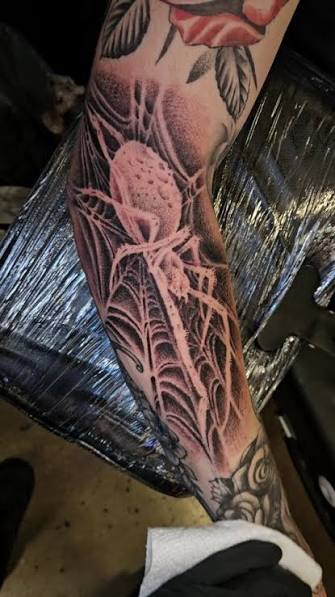
Instead of drawing a solid web, this design uses negative space, meaning the artist tattoos the spider and a few anchor lines while letting the untouched skin represent the open sections of the web. A pastel gray or lilac spider body against thin blackwork web strands creates depth without heavy ink saturation. Because negative space relies on precise placement, this works best on smoother, less textured skin like the collarbone, upper back, or inner arm. Keep it at 2 to 4 inches so the web strands have enough room to breathe. Collarbone placement carries moderate sensitivity due to the thin skin and bone proximity. A useful tip: ask your artist to sketch the design directly on your skin before tattooing so you can check the negative space actually reads as web strands and not just random gaps. This is a strong matching-tattoo option for friend groups who want variation without identical designs.
Soft Pink Thorned Rose
A rose done in soft pink or dusty rose with thin blackwork thorns creates a classic pastel goth contrast: something traditionally romantic paired with something traditionally threatening. The petals use light shading, usually watercolor-adjacent technique but with more defined edges to avoid the blown-out look pure watercolor tattoos can get after healing. Thorns stay in solid fine line black to keep structure. Ribs, thigh, or forearm placements at 3 to 5 inches give the shading room to sit properly. Rib placement is widely considered one of the more painful spots due to thin skin and bone proximity, so pace yourself if you choose it for a first tattoo. Bring reference photos showing the exact pink tone you want, since “pastel pink” can mean very different things across skin tones. This design transitions well from a first tattoo into a larger sleeve project down the line.
Muted Lilac Crystal Cluster
Crystal clusters translate naturally into pastel goth work because their geometric facets take color washes well without needing heavy shading. Each crystal point gets a thin black outline with a light lilac or icy blue fill inside, creating a faceted look through simple color blocking rather than complex gradient work. This design sits nicely at 2 to 3 inches on the ankle, wrist, or behind the ear. Ankle skin can be more sensitive due to less padding over the bone, so expect a sharper sensation than on the upper arm. When briefing your artist, ask about line weight consistency across the facets, since uneven outlines are one of the more common issues with geometric designs at small sizes. This piece works well as a subtle, workplace-friendly option and pairs easily with matching or complementary designs for friends who want a shared theme without identical art.
Pastel Goth Ghost with Bow
A rounded, friendly ghost shape with a small pastel bow softens the traditional spooky ghost into something closer to a cute character illustration. The body uses a light gray or lavender fill with minimal shading, just enough to suggest a fold or curve, while the bow gets a saturated pastel pink or mint for contrast. Because the shapes are simple, this design holds up well even at a small size, around 1.5 to 2.5 inches, making it a solid option for the wrist, ankle, or forearm. Wrist placement tends to be more sensitive due to bone proximity but heals relatively quickly given the small size. Ask your artist about keeping the linework slightly thicker than standard fine line if you want the shape to stay crisp for a decade or more, since ultra-thin lines can blur faster on smaller, simpler designs. This is a genuinely good first-tattoo choice for anyone worried about commitment or pain.
Single-Needle Bat Wings
Rather than a full bat, this design isolates just the wings, extended and detailed with single-needle linework, meaning the thinnest possible needle grouping for maximum precision. A faint pastel wash, usually gray-lavender, fills the webbing between the wing bones. This works especially well as a pair, one wing on each side of the spine or one on each shoulder blade, at around 3 to 4 inches per wing. Shoulder blade placement is generally moderate on the pain scale, more comfortable than ribs but more noticeable than the outer arm. A practical tip: request a stencil placement check with a mirror before the artist starts, since symmetry matters enormously for paired wing designs and it’s much easier to fix on paper than after the machine starts. This design ages well because single-needle work, when done by an experienced artist, tends to hold its crispness longer than expected.
Pastel Ouija Planchette
The Ouija board planchette, that pointer piece with the small circular window, makes a distinct pastel goth motif when outlined in fine line black and filled with a soft cream or dusty yellow wash instead of the traditional dark wood tone. The circular window can be left as negative space or filled with a tiny secondary color for detail. This works at 2 to 4 inches on the forearm, calf, or upper arm. Calf placement is typically lower on the pain scale compared to bonier areas, making it a reasonable pick if you’re nervous about discomfort. Bring a reference photo showing the exact planchette shape you like, since these vary quite a bit between antique and modern board designs, and specify to your artist whether you want the wood grain lines included or a smoother, simplified shape. This design carries clear symbolic weight for anyone into vintage occult aesthetics without leaning graphic.
Blackwork Cat Skull with Pastel Accents
A cat skull, ears intact, done mostly in solid blackwork for the skull structure with pastel pink or blue accenting the eye sockets or a small flower crown, blends two aesthetics people often pick between instead of combining. The black keeps the anatomical shape sharp and gives the piece longevity, since solid black fill generally holds up better over time than light color washes alone. This design needs some size to read clearly, ideally 3 to 4 inches, and works well on the upper arm, thigh, or shoulder. Thigh placement tends to be more comfortable than bonier spots, making it a good candidate for a slightly larger, more detailed piece. When consulting your artist, ask specifically about their blackwork saturation technique, since patchy black fill is one of the more common touch-up requests down the line. This design suits people who want a strong pastel goth statement piece rather than something subtle.
Negative Space Pastel Coffin
A coffin shape where the outline is minimal blackwork and the “inside” is left as bare skin, sometimes with a thin pastel lining just inside the edge, uses negative space to keep the design from feeling heavy or morbid. The trick with negative space designs is contrast: they need placement on skin that’s relatively even in tone to read clearly. This works at 2 to 3 inches on the forearm, ankle, or upper back. Forearm placement is usually moderate on the pain scale and heals fairly predictably. A useful booking tip: ask to see the stencil on your actual skin under good lighting before starting, since negative space designs can look different on paper versus how they’ll actually contrast against your specific skin tone. This piece is popular for small matching tattoos among friend groups who want something clearly goth-coded but visually light.
Dotwork Mushroom with Pastel Shading
Mushrooms have become a mainstay in pastel goth flash sheets, and dotwork is what gives them their soft, slightly dreamy texture. The cap gets a stippled gradient moving from a deeper dusty purple at the edge to a lighter pastel near the center, while the stem stays in simple fine line. This technique needs a bit more size than pure linework to avoid the dots blending together, so aim for 2.5 to 4 inches. Ankle, forearm, or behind-the-knee placements all work, though behind-the-knee is known to be one of the more sensitive spots due to nerve density, so it’s worth mentioning to your artist if pain is a concern. Ask about needle grouping size for the dotwork shading specifically, since finer groupings create smoother gradients but take longer in the chair. This design works nicely as a small cluster of two or three mushrooms rather than a single motif.
Pastel Goth Eye (All-Seeing Eye)
The all-seeing eye, often associated with protection or awareness symbolism, gets softened in pastel goth work through a light iris wash in mint, lavender, or blush instead of the traditional stark black and white. The surrounding lash lines and lid crease stay in fine black linework to keep the eye anatomically readable. This design needs a decent amount of detail, so 2.5 to 4 inches is the realistic minimum. Chest, upper arm, or forearm placements give enough room. Chest placement varies in sensitivity depending on exact spot but tends to run moderate to high near the sternum. Bring reference images that show the specific lash and lid style you want, since “eye tattoo” covers a huge range of interpretations and vague direction leads to a generic result. This design carries symbolic weight for people drawn to protection or intuition themes within the pastel goth aesthetic.
Soft Shaded Pastel Snake
A coiled or slithering snake in soft sage green or dusty blue, shaded with light gradient work rather than solid scale-by-scale detail, gives a pastel goth take on a classic bold-traditional subject. The head and eyes stay in crisp fine line for definition while the body uses a smoother color transition. This works well at 3 to 5 inches along the forearm, calf, or ribcage, following the body’s natural curve. Ribcage placement is consistently reported as one of the more intense spots for pain due to thin skin and bone, so this is worth discussing with your artist if it’s your first tattoo. A solid tip: ask for a “flow test,” meaning a stencil placement check while you move naturally, so the snake’s curve matches your body rather than looking flat. This design scales up easily later into a larger nature-and-goth themed piece.
Pastel Witch Hat
A simple witch hat, done in fine line with a soft violet or slate-blue fill and a tiny pastel bow or buckle detail, is one of the more beginner-friendly pastel goth designs because the shape itself is uncomplicated. This keeps the piece readable even at a small size, around 1.5 to 2.5 inches, making it suitable for the wrist, behind the ear, or ankle. Behind-the-ear placement is generally quick to tattoo but can feel sharp due to thin skin and cartilage proximity. Ask your artist whether a slightly curved brim or a straight geometric brim suits your personal style better, since this small choice changes the whole feel of the design. This piece is an easy, low-commitment entry into pastel goth tattoos and works well for seasonal or witchy matching tattoos among friends.
Fine-Line Pastel Web with Dew
A spiderweb rendered in ultra-thin fine line black, with small dew-drop details filled in pale blue or silver-lavender, turns a typically eerie image into something delicate and almost jewelry-like. The web strands require a steady, consistent hand since uneven spacing is immediately noticeable in a symmetrical pattern like this. Best placement is the collarbone, wrist, or side of the neck, at around 2 to 3 inches. Neck placement carries higher sensitivity and is worth discussing thoroughly with your artist beforehand, including visibility concerns for work environments. A practical tip: ask to see examples of your artist’s web-specific linework, since symmetry issues show up fast in healed pieces. This design suits people wanting something delicate and detailed rather than bold, and it holds up well precisely because the design is simple enough for thin lines to stay legible over time.
Pastel Goth Cross (Small)
A small cross with subtly rounded edges and a soft pastel fill, sometimes accented with a thin chain-link border, offers a quieter symbolic option within the pastel goth category. The linework stays minimal, and shading is either skipped entirely or kept to a very light single-tone wash. At 1 to 2 inches, this works almost anywhere: wrist, finger, behind the ear, or ankle. Finger placement, while trendy, tends to fade faster than other spots due to constant friction and hand-washing, something worth discussing openly with your artist before booking. This design is an easy first tattoo, low on the pain scale in fleshier spots, and works well as a small matching design for siblings or close friends who want shared symbolism without a large commitment.
Blackwork Raven with Pastel Wash
A raven in flight, wings spread, done mostly in solid blackwork with a faint pastel wash (usually icy blue or lavender) along the wing edges, gives a strong visual anchor piece for a pastel goth collection. The black holds the shape’s definition long-term, while the pastel wash adds just enough softness to differentiate it from a purely traditional blackwork raven. This design needs room, ideally 4 to 6 inches, and works best on the shoulder, upper back, or thigh. Upper back placement is generally moderate on the pain scale and gives the artist a large, relatively flat canvas. Ask your artist about their approach to wing feather detail, specifically whether they use dotwork or fine line for the feather texture, since this changes the final look significantly. This piece works well as a centerpiece design that smaller pastel goth tattoos can build around later.
Pastel Candle and Flame
A single candle with a softly shaded flame, done in warm pastel peach or yellow against a cooler pastel-toned candle body, creates visual contrast through temperature rather than heavy black shading. The wax drips can be added in fine line for extra texture. This design works well at 2 to 3 inches on the forearm, ankle, or upper arm. Forearm placement tends to be moderately comfortable and heals predictably. A useful tip: specify to your artist whether you want a realistic flame shape or a more stylized, geometric flame, since this single choice significantly changes the design’s overall tone. This piece often carries personal symbolic meaning around hope, remembrance, or introspection, making it a popular choice for a meaningful first tattoo within the pastel goth aesthetic.
Dotwork Pastel Heart with Thorns
A heart wrapped in a single thorned vine, shaded through dotwork rather than solid fill, gives texture and depth without heavy black saturation. The heart itself often gets a light pastel pink or mauve wash while the thorns and vine stay in crisp black fine line. This design works at 2 to 3.5 inches on the wrist, ankle, or ribcage. Wrist placement is moderately sensitive due to bone proximity but heals in a fairly standard 10 to 14 day window. Ask your artist about dot density for the heart’s shading, since too sparse a pattern can look unfinished while too dense can start resembling solid fill. This design is a popular matching-tattoo choice for couples or close friends who want shared symbolism with a slightly edgier visual twist than a plain heart.
Pastel Goth Tarot Card Motif
A miniature tarot card, often “The Moon” or “The Star,” rendered with a fine line border and soft pastel interior illustration, brings occult symbolism into a compact, structured format. The card’s border stays crisp black while the interior scene uses light color washes and minimal shading to keep detail from getting muddy. Because tarot card designs involve multiple small elements, they need real size to stay legible, ideally 3 to 5 inches. Upper arm or thigh placements give enough space. Upper arm placement is generally one of the more tolerable spots pain-wise. Bring a specific tarot card reference and discuss with your artist which details can realistically survive at your chosen size, since overly intricate scenes often lose clarity once healed. This design suits people wanting a personal, symbolic statement piece rather than a small flash-style tattoo.
Soft Pastel Chain-Link Bracelet Tattoo
A thin chain-link design wrapping the wrist or ankle like jewelry, done in fine line black with alternating pastel-filled links, blends the “tattoo as accessory” trend with pastel goth’s signature soft-dark contrast. The repetitive geometric pattern requires precise, even spacing, so this is a good design to specifically ask about in terms of your artist’s experience with linear, repeating patterns. At roughly 4 to 6 inches wrapped around the wrist or ankle, this design stays subtle enough for most workplaces while still reading clearly as intentional jewelry-style art. Wrist and ankle placements are both moderately sensitive due to bone proximity. A practical tip: request a printed stencil test wrapped around your actual wrist or ankle before the session starts, so you can check the spacing looks even from every angle. This design works particularly well as a shared matching tattoo since the pattern stays consistent regardless of body size.
Best Placement Ideas
- Wrist — highly visible, moderate pain due to bone proximity, best for small fine-line or single-needle designs
- Behind the ear — low visibility, quick healing, moderate sensitivity due to thin skin
- Forearm — good visibility control (easy to cover), generally moderate pain, ideal for medium-sized detailed pieces
- Ankle — easy to hide with socks or shoes, moderate pain, works well for small to medium designs
- Ribcage — high pain due to thin skin over bone, best reserved for those with prior tattoo experience
- Upper arm/shoulder — lower pain, great for larger blackwork or dotwork pieces needing space
- Collarbone — moderate to high sensitivity, works well for negative space and delicate linework
- Thigh — generally lower pain, large flat area good for statement pieces like ravens or tarot motifs
Tips for Success
Choosing the right artist matters more than choosing the “perfect” design, since even a great concept looks weak with inconsistent linework or muddy shading. Look through an artist’s portfolio specifically for healed photos, not just fresh ink, since fresh tattoos almost always look sharp regardless of skill. Pay attention to line consistency, clean color saturation, and whether their dotwork or fine line pieces have held up cleanly over months or years. When you go in for a consultation, bring reference photos, but also be ready to describe what you don’t want, like avoiding heavy black shading if you want a truly soft pastel look. Ask directly about needle size, expected healing time for your specific design and placement, and whether a touch-up session is included or billed separately. A licensed, experienced artist should welcome these questions without hesitation.
Common Mistakes and How to Avoid Them
- Going too small for the detail level — intricate dotwork or multi-element designs like tarot cards need real size to stay legible after healing
- Choosing a painful placement for a first tattoo — ribs and inner arm are rough starting points if you’re new to tattoos
- Skipping the aftercare conversation — every artist has slightly different instructions, and following theirs matters more than generic internet advice
- Copying a design exactly from Pinterest — personalizing even a small detail (color, size, one added element) avoids an identical, uninspired result
- Ignoring skin tone in the consultation — pastel colors read differently across different skin tones, and a good artist will adjust saturation accordingly
- Not asking about touch-ups upfront — pastel washes sometimes need a follow-up session to stay vibrant, and pricing should be discussed before booking
Similar Variations
Nearly every design above can shift tone with a simple change. A fine-line bat can become bolder by switching to a thicker blackwork outline, or softer by dropping the color fill entirely and staying in pure negative space. A dotwork skull can shrink into a minimalist single-needle version for a first tattoo, or expand into a larger blackwork piece with pastel accents for a statement look. Chain-link and web designs both scale easily from delicate single-strand versions into fuller wraparound pieces later. Combining two smaller motifs, like a witch hat and a crystal cluster, into one composition is also a common way to personalize a design without starting from scratch.
Aftercare Basics
General tattoo aftercare typically includes keeping the area clean, avoiding direct sun exposure during healing, avoiding swimming or soaking the area, and not picking at any peeling skin. Healing time for the designs above generally runs 10 to 14 days for smaller pieces and up to three weeks for larger, more detailed work, though healing varies by individual and by aftercare routine. Always follow the specific aftercare sheet your artist provides, since products and timelines can differ between studios. If you notice unusual redness, swelling, or symptoms beyond typical healing, consult a licensed dermatologist or your tattoo artist directly rather than relying on general online advice.
Quick FAQ
Q: What exactly is a pastel goth tattoo?
A: Pastel goth tattoos combine soft, sweet colors like lavender, mint green, baby pink, and powder blue with dark, edgy imagery—think skulls, bats, spiders, ouija boards, and blackwork linework . The contrast creates a look that’s both cute and slightly haunting. It’s a subculture aesthetic that’s been growing in popularity since 2024.
Q: How much does a pastel goth tattoo cost?
A: Small pieces (2-4 inches) typically range from $150 to $400. Medium designs (4-8 inches) run $400 to $1,000+. Large custom pieces can exceed $2,000. Pastel colors often require more time because the artist has to layer pigments carefully to achieve saturation and smooth gradients.
Q: How painful are pastel goth tattoos?
A: Pain depends entirely on placement, not the style itself. Bony areas like ribs, collarbone, and spine hurt more (6-8/10) . Fleshy areas like forearms, thighs, and outer shoulders are more manageable (3-5/10). Pastel colors don’t change the pain level—the needle feels the same regardless of ink color.
Q: Do pastel goth tattoos fade faster than regular tattoos?
A: Yes, pastel colors are more prone to fading than darker pigments because lighter inks have less pigment density . Soft pinks, lavenders, and light blues break down faster under UV exposure. You’ll need to be diligent about sunscreen and expect to schedule touch-ups every 3-5 years to keep the colors vibrant.
Q: How long does a pastel goth tattoo take to heal?
A: Surface healing takes 2-3 weeks, with complete deep healing in 4-6 weeks . Pastel tattoos may look cloudy or dull during healing as new skin forms over the ink—that’s normal. The true color only reveals itself after about a month.
Q: How do pastel goth tattoos age over time?
A: The blackwork elements (outlines, dark shading) age very well and remain crisp for decades . The pastel colors will fade and soften over time, developing a more muted, vintage look. This is actually part of the aesthetic’s appeal for some people. Bold black outlines help anchor the design so the soft colors don’t become unreadable.
Q: Should I get a pastel goth tattoo as my first tattoo?
A: Absolutely, if that’s the aesthetic you love. However, be aware that pastel colors require more maintenance and more frequent touch-ups than traditional blackwork . If you want a low-maintenance first tattoo, consider a blackwork-only design with a few small pastel accents rather than a full-color piece.
Q: What skin tone works best for pastel goth tattoos?
A: Pastel colors show up best on fair to light-medium skin tones . On deeper skin tones, pastel pigments can appear more muted or wash out entirely. If you have darker skin, consider using slightly more saturated versions of pastel colors (like a richer lavender instead of a pale one) and rely more heavily on the blackwork contrast to make the design pop. Always ask your artist to show you healed examples on similar skin tones.
Q: How do I find an artist who specializes in pastel goth tattoos?
A: Search Instagram for hashtags like #pastelgoth, #pasteltattoo, #softgoth, and #colortattoo. Look for artists who post healed photos of their pastel work, not just fresh ones. Ask them specifically: “How do your pastel colors hold up after a few years?” An experienced artist will give you an honest answer about longevity and touch-up expectations.
Q: Can I combine pastel goth with other styles?
A: Yes. Pastel goth blends beautifully with fine-line, blackwork, watercolor, and neo-traditional styles . Many artists are mixing these elements to create unique hybrid designs. Just be clear with your artist about which aesthetic elements are most important to you.
Q: How should I brief my artist for a pastel goth tattoo?
A: Bring 3-4 reference photos that show the color palette and imagery you like . Say: “I want a [design] in pastel goth style. I want soft pink and lavender accents with bold black outlines. I want the dark elements to contrast with the soft colors.” Be specific about which elements must be pastel and which can be black or grey.
Final Thoughts
Pastel goth tattoos are the perfect blend of sweet and sinister—they let you express your darker side without committing to heavy blackwork, and they’re playful enough to make you smile every time you catch a glimpse. But they’re not for the faint of heart when it comes to maintenance. The pastel colors that make these designs so dreamy also fade faster and need more care. So if you’re ready for a bit of extra attention—SPF 50 every time you step outside, touch-ups every couple of years, and an artist who really understands pastel color packing—then go for it. Find a design that makes your heart skip, choose a placement that fits your lifestyle, and wear that creepy-cute ink with pride. Your pastel goth tattoo should feel like the perfect balance of dark and light—and with this guide, you’ve got everything you need to make it happen.