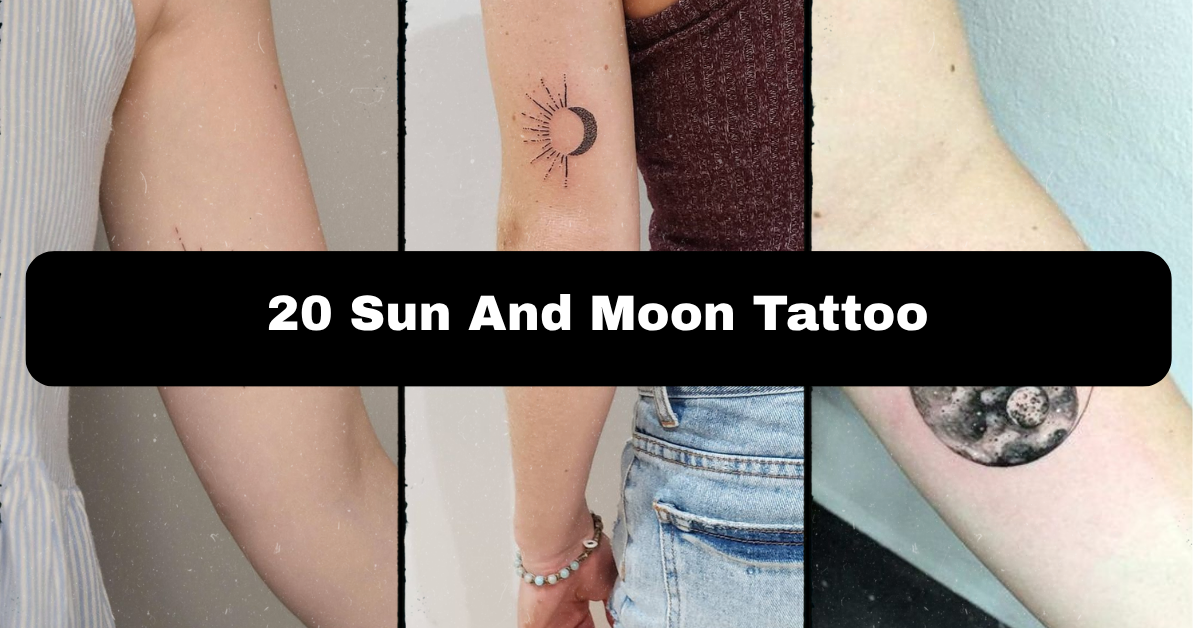
20 Sun and Moon Tattoo Ideas: The Complete Guide to Design, Pain, Cost & Aftercare
Nervous about picking a sun and moon tattoo that actually looks balanced and meaningful? You’re not alone. This celestial combo is one of the most popular tattoo choices out there, but getting it right takes more than just picking a pretty design off the wall. Let’s break down exactly what works, what doesn’t, and how to make sure your ink stays stunning for years.
So what are the best sun and moon tattoo ideas? A half-sun, half-moon design, the classic yin-yang celestial fusion, a minimalist fine-line outline, or a detailed mandala combination all work beautifully. The most successful designs use strong contrast—light versus dark, bold blackwork versus delicate dotwork—to play up the natural duality of these symbols. Simple linework tends to age better than heavily shaded or watercolor pieces, especially on smaller placements like the wrist or behind the ear.
This guide gives you the full picture—not just design ideas, but placement advice, pain levels, cost estimates, aftercare essentials, and exactly what to say to your artist. Let’s find the sun and moon tattoo that actually fits you.
Understanding Sun and Moon Tattoo Techniques
Before we dive into the designs, here’s a quick breakdown of the key techniques you’ll see mentioned throughout this guide:
| Technique | What It Means | Best Used For |
|---|---|---|
| Fine Line | Uses a single needle or very small groupings for thin, delicate lines | Minimalist outlines, intricate details, script |
| Bold Traditional | Thick black outlines with a limited color palette | Classic designs that need to last decades |
| Blackwork | Uses only black ink, often with heavy saturation | High-contrast pieces, tribal, mandalas |
| Dotwork | Creates shading using thousands of tiny dots | Soft gradients, geometric patterns, spiritual designs |
| Watercolor | Mimics paint splashes with minimal outlines | Abstract, colorful, dreamy designs |
| Negative Space | Uses un-inked skin as part of the design | Optical effects, structural designs |
| Single Needle | The finest possible line work | Micro-realism, tiny details, delicate script |
20 Sun and Moon Tattoo Design Ideas
1. Half Sun, Half Moon Fusion
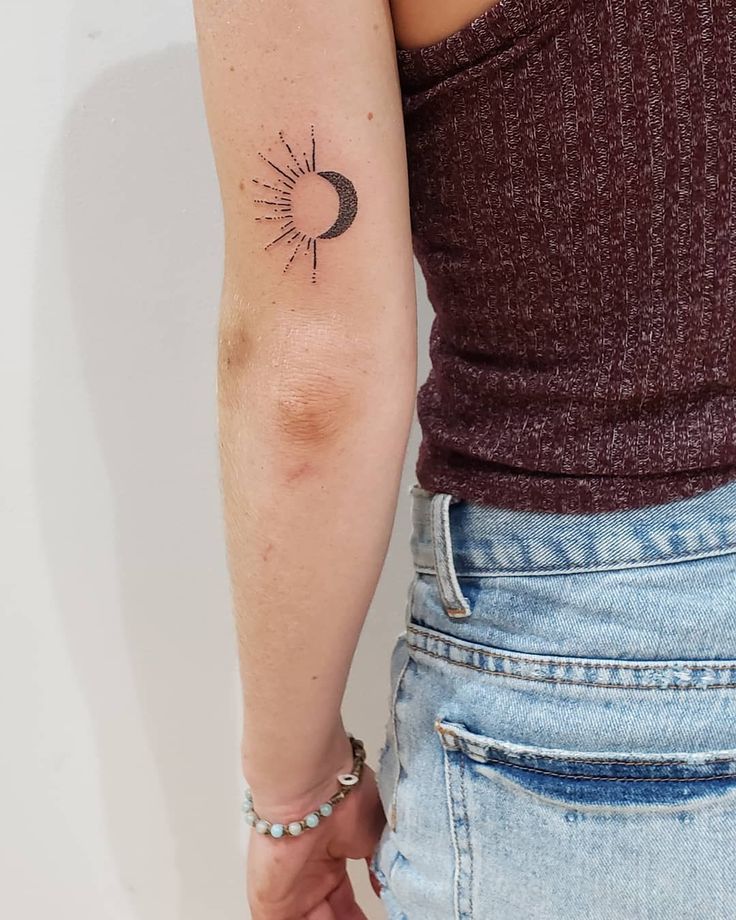
This is the most iconic sun and moon design because it directly represents balance and duality. One side is the sun, the other is the moon, united in a single circular composition.
Technical breakdown: Your artist will use bold linework to separate the two halves, then blackwork shading on the moon side and lighter dotwork or negative space on the sun side to create contrast. The sun’s rays should be sharp and radiating outward, while the moon’s crescent curves smoothly inward. A fine line specialist can add small stars or dots in the background for a celestial feel.
Placement & size: This design works beautifully on the upper back, chest, or forearm. For a back placement, center it on your spine—it’ll be about 4-6 inches across. On the forearm, keep it 2-3 inches so it reads clearly.
Pain note: Bony areas like the spine or wrist will be more sensitive (around 7-8/10). Fleshy areas like the forearm or upper back are more manageable (4-5/10).
Healing time: Expect 2-3 weeks for surface healing, with full deep-tissue recovery taking 2-3 months.
How to brief your artist: Bring two reference images—one sun you like and one moon. Say: “I want a half-sun, half-moon design in a circle. Use bold linework for the separation, blackwork for the moon side, and negative space with light dotwork for the sun side.”
Cost range: $300-$800 for a medium-sized piece, depending on detail and artist reputation.
Why it suits you: This solves the desire for a simple yet deeply symbolic design that captures the balance of opposites in your life.
Transition: If you want a softer, more spiritual take on this concept, the yin-yang sun and moon might be your style.
2. Yin-Yang Sun and Moon

This design takes the classic yin-yang symbol and replaces the traditional dots with a sun and moon. It’s a powerful representation of harmony between opposing forces.
Technical breakdown: Your artist will use a combination of bold traditional and fine line techniques. The sun side (yang) should have sharp, warm-looking lines and rays, while the moon side (yin) uses softer, curved lines. The key is the contrast—the sun side is visually “active” while the moon side is “passive.” A single needle can be used for the small details that make each side distinct.
Placement & size: This design is perfect for the wrist, behind the ear, or on the ankle. Keep it 1.5-2.5 inches for these smaller spots. For a larger piece, place it on the chest or upper back at 4-5 inches.
Pain note: The wrist and ankle are boney and sensitive (6-7/10). Behind the ear is also quite tender (7-8/10). The chest or upper back is more moderate (4-5/10).
Healing time: Fine linework heals relatively quickly—1-2 weeks for the surface, 2 months for full recovery.
How to brief your artist: Bring a yin-yang image and say: “I want to replace the dots with a sun on one side and a moon on the other. Keep it in a circular composition. I’d prefer fine line work.”
Cost range: $200-$500 for a small piece, more for larger placements.
Why it suits you: This solves the desire for a deeply spiritual design that represents balance, harmony, and the interconnectedness of all things.
Transition: If you want something even more minimal, a simple outline might be perfect.
3. Minimalist Sun and Moon Outline
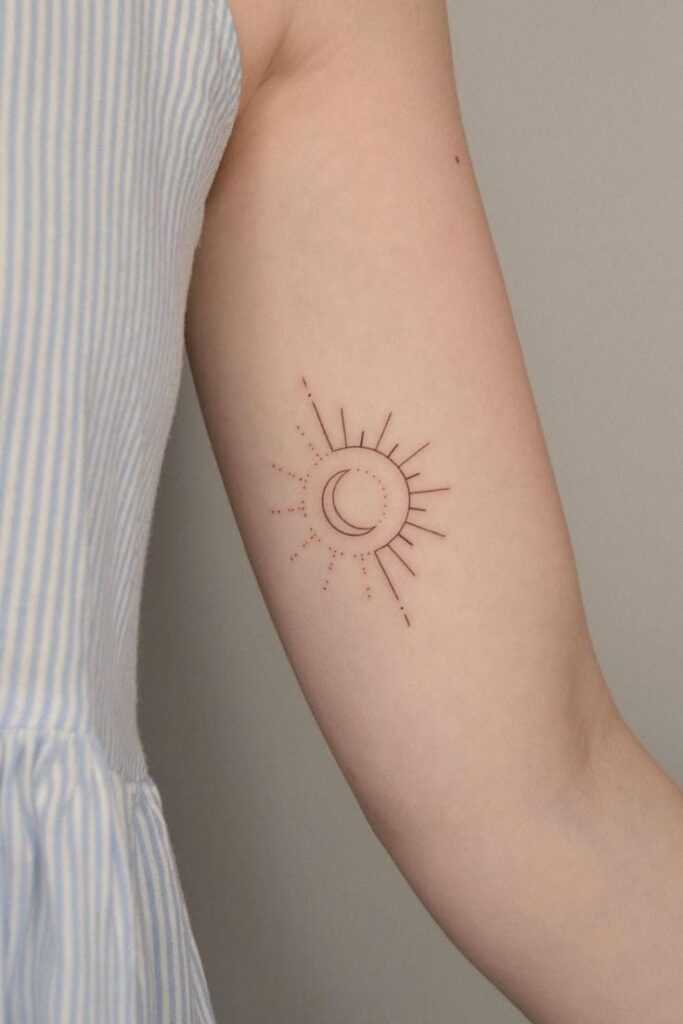
This design strips everything back to the essentials. Just clean, thin lines creating the shapes of the sun and moon—no shading, no color, no fuss.
Technical breakdown: A fine line or single needle artist is essential here. The lines need to be crisp, consistent, and evenly weighted. The sun should have a defined circle with rays (maybe 8-12 rays), and the moon should be a clear crescent. The beauty is in the simplicity and precision of the linework.
Placement & size: This is incredibly versatile. It looks stunning on the wrist, behind the ear, on the finger, or along the collarbone. For a subtle look, keep each element under 1 inch. For more visibility, go up to 2-3 inches.
Pain note: Finger tattoos can be quite painful (7-8/10) due to the lack of fat. The wrist and collarbone are also sensitive (6-7/10). Behind the ear is moderate (5-6/10).
Healing time: Fine line heals in 1-2 weeks on the surface, with full recovery in about 2 months. However, finger tattoos may fade faster and require more frequent touch-ups.
How to brief your artist: Bring a simple line drawing and say: “I want a minimalist outline of a sun and moon. Clean lines, no shading. Can you make the lines consistent in weight?”
Cost range: $100-$300, depending on size and placement.
Why it suits you: This solves the desire for a subtle, elegant design that’s low-commitment but still meaningful. It’s also great for a first tattoo.
Transition: If you want to add some geometric flair, a geometric sun and moon is a modern alternative.
4. Geometric Sun and Moon
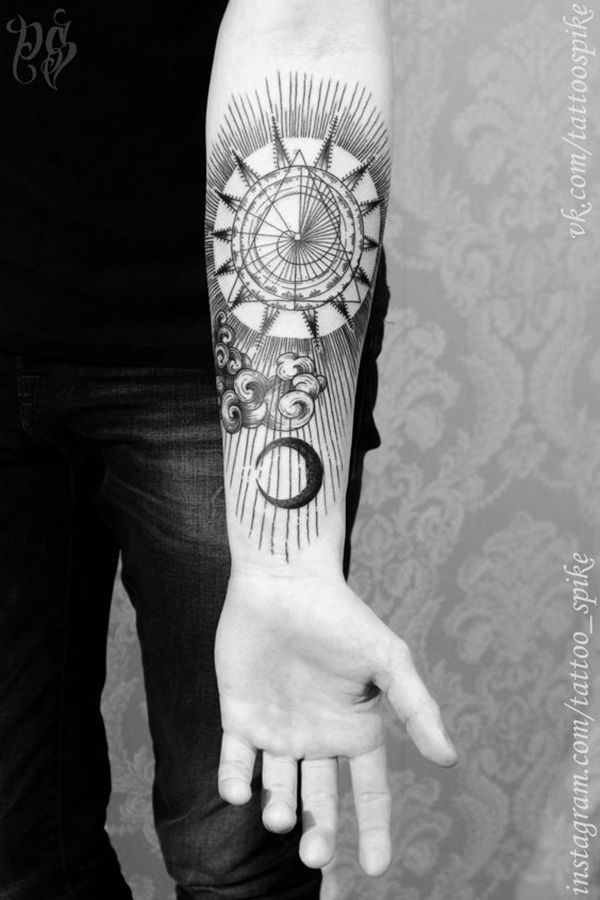
This design uses sharp lines, triangles, and polygons to create a sun and moon that feel modern and architectural. It’s a favorite for guys who want something clean and edgy.
Technical breakdown: This is all about precise linework and negative space. Your artist will use a single needle or a fine liner to create the geometric shapes. The sun might be a circle with triangular rays radiating outward, while the moon could be a crescent made of angular segments. Symmetry is crucial—the design needs to be perfectly balanced to work.
Placement & size: This design pops on the forearm, upper arm, or calf. For a statement piece, go 4-6 inches. For something subtler, 2-3 inches works well.
Pain note: The forearm and calf have decent muscle and fat, so pain is moderate (4-5/10). The upper arm is also manageable. Bony areas like the shin would be more intense.
Healing time: Linework heals in 1-2 weeks surface, 2 months full.
How to brief your artist: Bring geometric art or tattoo references. Say: “I want a geometric sun and moon. Use sharp angles and triangles. I want it symmetrical and clean. No shading, just linework.”
Cost range: $300-$700.
Why it suits you: This solves the desire for a modern, architectural design that feels unique and visually striking.
Transition: If you want something that feels more cosmic and mystical, the celestial sun and moon is a beautiful option.
5. Celestial Sun and Moon with Stars
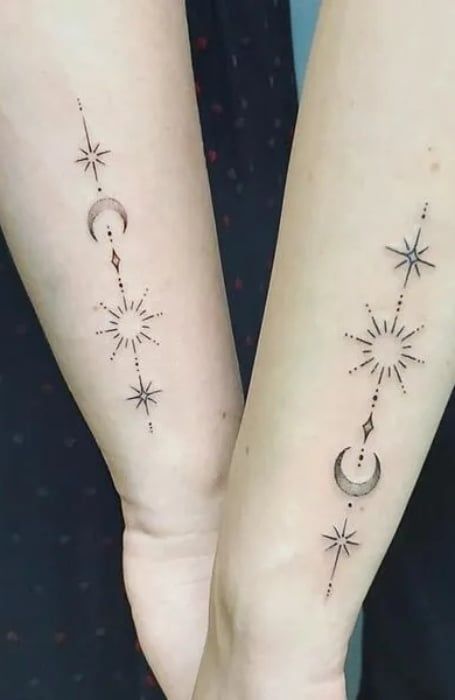
This design places the sun and moon in a cosmic scene, surrounded by stars, galaxies, or a nebula. It’s dreamy, expansive, and full of wonder.
Technical breakdown: This often combines watercolor and dotwork. The watercolor creates the colorful, dreamy background (purples, blues, pinks), while the dotwork adds texture and depth to the celestial bodies. The sun and moon themselves can be done in fine line or bold blackwork, depending on the look you want. The contrast between the soft background and the sharp sun/moon is what makes the design pop.
Placement & size: This is best as a larger piece—upper back, thigh, or chest. It needs space to breathe. Think 6-10 inches.
Pain note: Larger pieces mean more time under the needle. Upper back is moderate (4-6/10), chest is more sensitive (6-7/10).
Healing time: Watercolor can heal differently—expect 2-3 weeks surface, 3-4 months full.
How to brief your artist: Bring images of space and celestial tattoos. Say: “I want a celestial scene with the sun, moon, and stars. Use watercolor for the background and dotwork for the texture. The sun and moon should be in blackwork.”
Cost range: $500-$1,500+.
Why it suits you: This solves the desire for a colorful, immersive design that feels like a piece of the universe on your skin.
Transition: If you want something more grounded in ancient spirituality, the sun and moon mandala is a great choice.
6. Sun and Moon Mandala

This design combines the intricate, symmetrical patterns of a mandala with the sun and moon at its center. It’s spiritual, meditative, and visually stunning.
Technical breakdown: This is a dotwork and fine line masterpiece. The mandala’s rings expand outward from the central sun and moon. Your artist will use a stencil to ensure perfect symmetry. The dotwork creates the shading and texture, while the fine lines form the intricate petal-like shapes. The center—the sun and moon—should be the focal point, perhaps with bold linework to make it stand out.
Placement & size: This works on the upper back, chest, or forearm. For the back, size it at 4-6 inches. For the forearm, keep it around 3 inches.
Pain note: Back and chest are moderate to high (5-7/10). The forearm is more manageable (4-5/10).
Healing time: Dotwork and fine line heal in 2-3 weeks surface, 2-3 months full.
How to brief your artist: Bring mandala references. Say: “I want a mandala with the sun and moon in the center. Use dotwork for the shading and fine lines for the patterns. I want it perfectly symmetrical.”
Cost range: $400-$1,000.
Why it suits you: This solves the desire for a spiritual, meditative design that’s also incredibly beautiful and intricate.
Transition: If you want a softer, more painterly look, the watercolor sun and moon is a stunning alternative.
7. Watercolor Sun and Moon
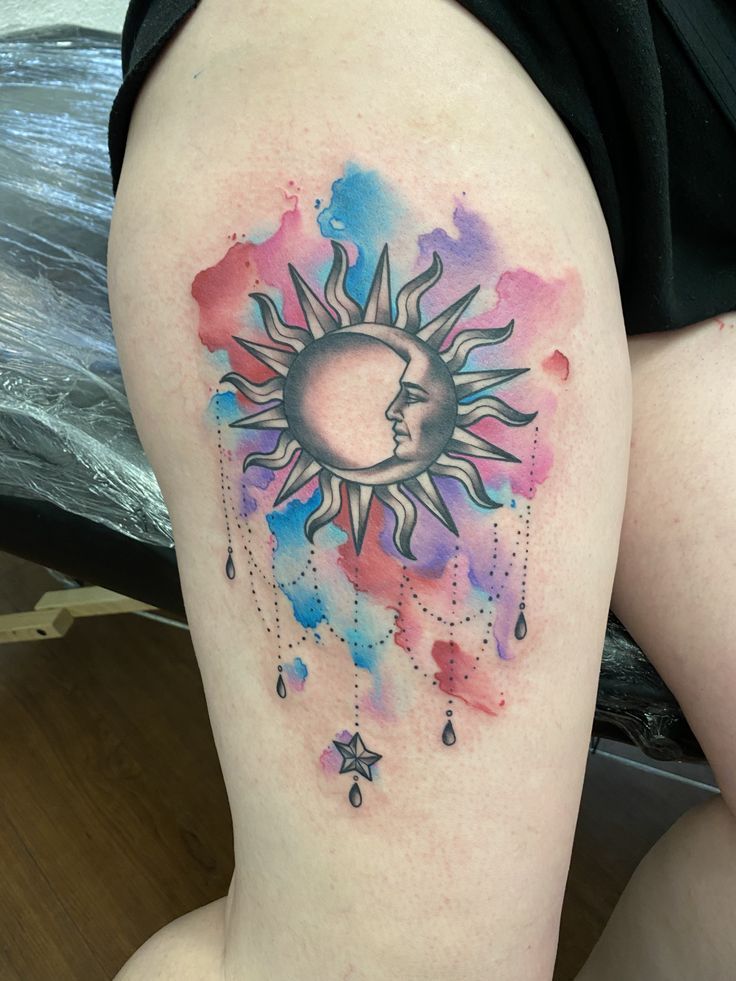
This design looks like it was painted directly onto your skin with watercolors. There are no hard outlines—just soft, blended washes of color.
Technical breakdown: The watercolor technique uses diluted inks to create soft, bleeding edges. The sun might be a wash of yellow and orange, the moon a wash of blue and purple. The colors blend into each other and into your skin. Your artist will use a magnum shader to lay down the color, then work quickly to blend it before it sets. There are no outlines—just pure, flowing color.
Placement & size: This is best on the forearm, thigh, or shoulder. Size it at 3-5 inches. It needs enough space for the colors to blend naturally.
Pain note: The forearm and shoulder are moderate (4-5/10). The thigh is also manageable.
Healing time: Watercolor can heal differently—expect 2-3 weeks surface, 3-4 months full. The colors may fade more quickly than black ink.
How to brief your artist: Bring watercolor art or tattoo references. Say: “I want a watercolor sun and moon. Use warm colors for the sun, cool colors for the moon. No outlines—just blended washes.”
Cost range: $400-$1,200.
Why it suits you: This solves the desire for a soft, artistic, and unique design that feels like a painting.
Transition: If you want something that feels more romantic and intricate, the sun and moon with floral accents is a beautiful choice.
8. Sun and Moon with Floral Accents

This design weaves flowers into the celestial imagery, creating a soft, romantic, and nature-inspired piece. Think roses wrapping around the sun’s rays or vines entwining with the moon’s crescent.
Technical breakdown: This design uses fine line for the delicate petals and leaves, and blackwork or dotwork for the sun and moon. The contrast between the soft, organic flowers and the bold celestial bodies is visually striking. Your artist will need to carefully balance the composition so the flowers enhance rather than overwhelm the sun and moon.
Placement & size: This works well on the upper back, shoulder, forearm, or ribs. Size it at 4-6 inches. The ribs are a sensitive spot, so consider that.
Pain note: The ribs are high pain (7-8/10). The upper back and shoulder are moderate (4-6/10). The forearm is lower (4-5/10).
Healing time: Fine line heals in 1-2 weeks surface, 2 months full.
How to brief your artist: Bring images of flowers and celestial tattoos. Say: “I want the sun and moon with floral accents. Use fine lines for the flowers and blackwork for the sun and moon. The flowers should frame the design, not overpower it.”
Cost range: $500-$1,200.
Why it suits you: This solves the desire for a romantic, nature-inspired design that still carries deep meaning.
Transition: If you want something that feels like it’s moving, the intertwined sun and moon is a dynamic option.
9. Intertwined Sun and Moon

This design shows the sun and moon physically intertwined—their shapes melting into each other or wrapped around each other. It’s a powerful symbol of connection and unity.
Technical breakdown: This is a great opportunity for bold linework and negative space. The sun and moon are connected by flowing lines that wrap around each other. Your artist might use a single needle for the fine connecting details and a thicker liner for the main shapes. The design should feel fluid and organic, not stiff.
Placement & size: This works beautifully on the forearm, upper arm, or calf. Size it at 3-5 inches.
Pain note: The forearm and calf are moderate (4-5/10). The upper arm is also manageable.
Healing time: 2-3 weeks surface, 2-3 months full.
How to brief your artist: Bring references of intertwined designs. Say: “I want the sun and moon intertwined with flowing lines. Use bold linework for the shapes and fine lines for the connecting details.”
Cost range: $400-$900.
Why it suits you: This solves the desire for a design that symbolizes a deep connection—perhaps with a partner, family, or a personal journey.
Transition: If you want a natural landscape feel, the sun and moon with mountains is a grounded choice.
10. Sun and Moon with Mountains
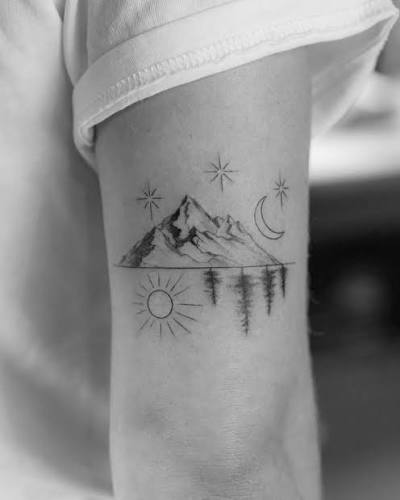
This design places the sun and moon above a mountain range, creating a landscape scene. It symbolizes grounding, adventure, and the beauty of nature.
Technical breakdown: This design often uses blackwork or fine line with dotwork. The mountains are rendered in sharp lines with dotwork shading for texture. The sun and moon sit above the mountains, perhaps with the sun rising on one side and the moon setting on the other. The contrast between the solid land and the celestial sky is the key to the design’s success.
Placement & size: This works on the upper back, forearm, or thigh. Size it at 4-6 inches.
Pain note: The upper back is moderate (4-6/10). The forearm is lower (4-5/10). The thigh is also manageable.
Healing time: 2-3 weeks surface, 2-3 months full.
How to brief your artist: Bring images of mountains and celestial tattoos. Say: “I want the sun and moon above a mountain range. Use blackwork for the mountains and fine lines for the sun and moon. I want it to feel like a landscape.”
Cost range: $400-$1,000.
Why it suits you: This solves the desire for a nature-inspired design that feels grounded and adventurous.
Transition: If you want to combine sun and moon with a bit of edge, the crescent sun design is worth a look.
11. Crescent Sun Design

This is a clever twist—the sun is shaped like a crescent moon, with rays shooting out. It’s a unique and mysterious take on the classic sun.
Technical breakdown: Your artist will use bold linework to create the crescent shape, with sharp blackwork rays radiating from the curves. The design is simple but highly effective. The key is precision—the crescent needs to be perfectly curved, and the rays need to be evenly spaced.
Placement & size: This is perfect for the wrist, ankle, or behind the ear. Keep it small—1-2 inches.
Pain note: The wrist and ankle are boney and sensitive (6-7/10). Behind the ear is also quite tender (7-8/10).
Healing time: Linework heals in 1-2 weeks surface, 2 months full.
How to brief your artist: Bring a reference drawing. Say: “I want a crescent-shaped sun with rays shooting out. Use bold linework. I want it sharp and clean.”
Cost range: $150-$350.
Why it suits you: This solves the desire for a unique, subtle design that’s still instantly recognizable and carries the energy of the sun.
Transition: If you want a design that’s even more symmetrical, the sunburst eye is a great option.
12. Sunburst Eye Tattoo
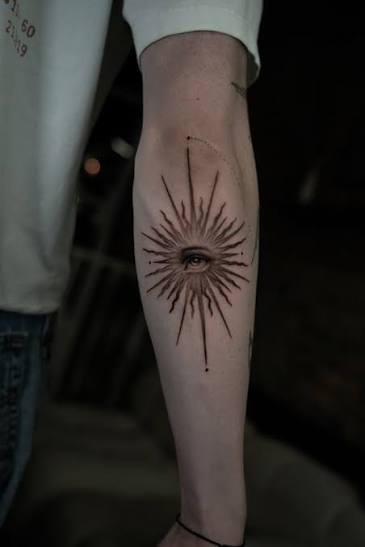
This design replaces the pupil of an eye with a sun, with rays radiating outward like an eclipse. It’s a powerful symbol of vision, enlightenment, and inner light.
Technical breakdown: This is a realism or bold blackwork piece. The eye needs to be detailed and realistic (using single needle for the iris and lid details), while the sun’s rays are bold and sharp (using a larger liner). The contrast between the soft, organic eye and the sharp, geometric rays is what makes the design work.
Placement & size: This works best on the forearm, calf, or shoulder. Size it at 3-4 inches.
Pain note: The forearm and calf are moderate (4-5/10). The shoulder is also manageable.
Healing time: 2-3 weeks surface, 2-3 months full.
How to brief your artist: Bring images of eyes and sunbursts. Say: “I want an eye with a sun in the center. Use realism for the eye and bold linework for the rays. The sun should replace the pupil.”
Cost range: $500-$1,200.
Why it suits you: This solves the desire for a deeply symbolic, edgy design that represents insight and enlightenment.
Transition: If you want to honor your Celtic heritage, the Celtic knotwork sun and moon is a beautiful choice.
13. Celtic Knotwork Sun and Moon
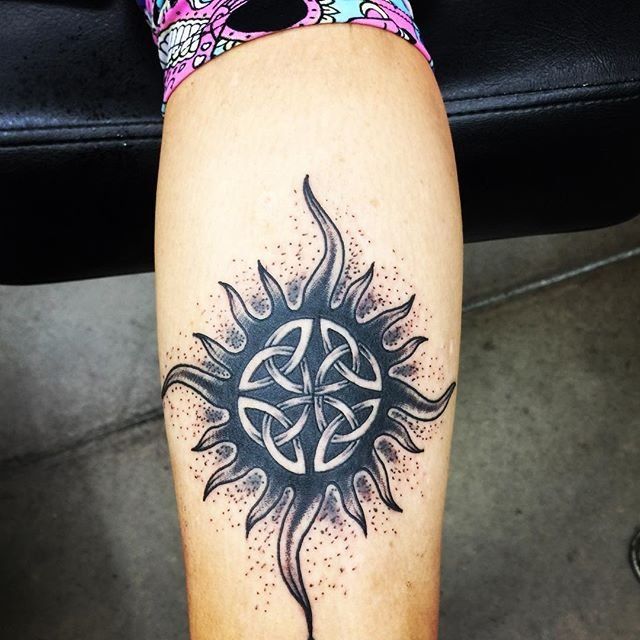
This design uses intricate Celtic knots to form the shapes of the sun and moon. It’s a celebration of heritage, eternity, and interconnectedness.
Technical breakdown: This is pure linework. Your artist will use a consistent line weight (often a 5-round liner) to create the continuous, interlocking patterns that form the sun and moon. The design is complex and requires precision. The sun’s rays are formed by knotwork patterns, and the moon’s crescent is made of interlocking lines. There’s no shading—just clean, continuous lines.
Placement & size: This works on the upper back, forearm, or chest. Size it at 3-5 inches.
Pain note: The upper back is moderate (4-6/10). The chest is more sensitive (6-7/10). The forearm is lower (4-5/10).
Healing time: Linework heals in 1-2 weeks surface, 2 months full.
How to brief your artist: Bring Celtic knot references. Say: “I want a sun and moon made of Celtic knotwork. Use continuous lines, no breaks. I want it perfectly symmetrical.”
Cost range: $500-$1,500.
Why it suits you: This solves the desire for a culturally rich, intricate design that celebrates heritage and eternity.
Transition: If you want to combine celestial imagery with protection, the dreamcatcher sun and moon is a beautiful option.
14. Sun and Moon Dreamcatcher
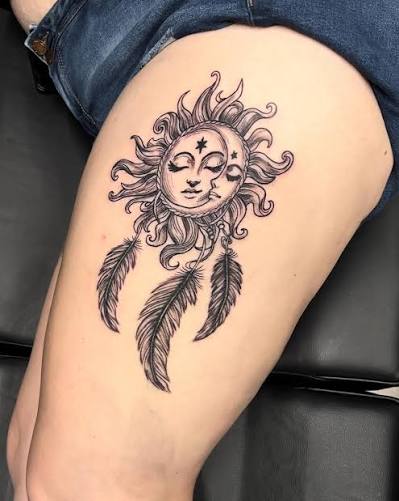
This design places the sun and moon inside or around a dreamcatcher. It’s a symbol of protection, dreams, and the balance of day and night.
Technical breakdown: Your artist will use a combination of fine line (for the web) and bold blackwork (for the sun and moon). The dreamcatcher’s web is intricate and delicate, while the sun and moon are bold and solid. The contrast between the two techniques is visually striking.
Placement & size: This works on the upper back, forearm, or thigh. Size it at 4-6 inches.
Pain note: The upper back is moderate (4-6/10). The forearm is lower (4-5/10). The thigh is also manageable.
Healing time: 2-3 weeks surface, 2-3 months full.
How to brief your artist: Bring dreamcatcher references. Say: “I want a dreamcatcher with the sun and moon. Use fine lines for the web and blackwork for the sun and moon. I want it to feel balanced.”
Cost range: $500-$1,200.
Why it suits you: This solves the desire for a design that combines spiritual protection with celestial imagery.
Transition: If you want to add a text element, script with sun and moon is a great choice.
15. Script with Sun and Moon
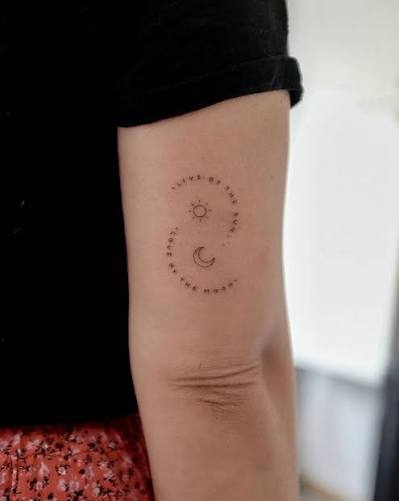
This design combines meaningful words or names with sun and moon imagery. It’s personal, powerful, and deeply symbolic.
Technical breakdown: The script should be done in fine line or single needle for readability. The sun and moon should be visual accents—perhaps small symbols flanking the text. Your artist will need to carefully balance the composition so the text and imagery work together.
Placement & size: This works on the forearm, ribs, or collarbone. Size it at 2-4 inches.
Pain note: The ribs are high pain (7-8/10). The collarbone is also sensitive (6-7/10). The forearm is lower (4-5/10).
Healing time: Fine line heals in 1-2 weeks surface, 2 months full.
How to brief your artist: Bring the text and a sun/moon reference. Say: “I want this text with a small sun and moon. Use single-needle for the script. The sun and moon should be accent pieces.”
Cost range: $300-$700.
Why it suits you: This solves the desire for a deeply personal, meaningful design.
Transition: If you want a couples tattoo, the matching sun and moon is a classic choice.
16. Matching Sun and Moon Couples Tattoos
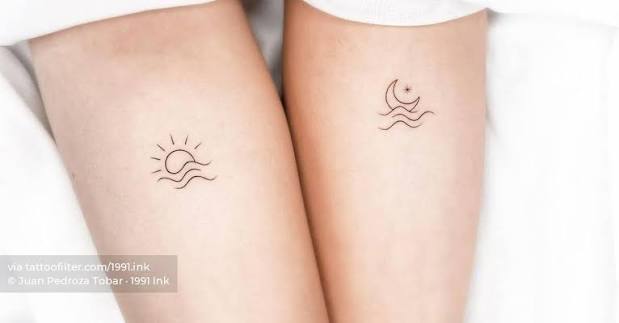
This is a classic couples tattoo—one person gets the sun, the other gets the moon. It’s a symbol of balance, connection, and complementary love.
Technical breakdown: The sun and moon should be designed as a matching set. They could have similar linework styles (both in fine line or both in bold traditional), or they could share a design element (like the same geometric pattern or dotwork shading). The key is that the two designs feel like they belong together.
Placement & size: These are often placed on the wrist, forearm, or behind the ear. Keep each piece 1-2 inches.
Pain note: The wrist and behind the ear are sensitive (6-8/10). The forearm is more moderate (4-5/10).
Healing time: 1-2 weeks surface, 2 months full.
How to brief your artist: Bring two references. Say: “We want matching sun and moon tattoos. Use the same linework style for both. They should feel like a pair.”
Cost range: $150-$400 each.
Why it suits you: This solves the desire for a meaningful couples tattoo that’s subtle and stylish.
Transition: If you want a more tribal or cultural look, the tribal sun and moon is worth exploring.
17. Tribal Sun and Moon
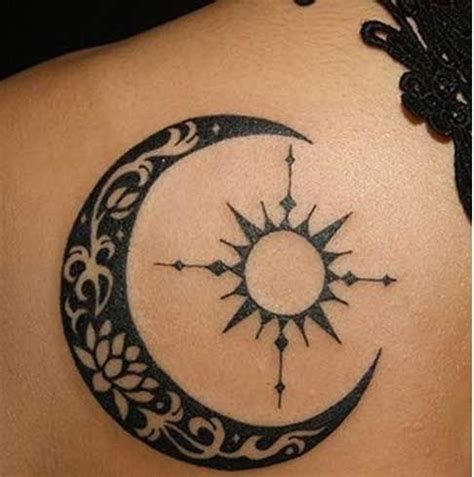
This design uses bold, black tribal patterns to create the sun and moon. It’s a powerful, aggressive, and culturally inspired design.
Technical breakdown: This is bold blackwork. Your artist will use thick lines and heavy saturation to create the tribal patterns. The sun might have sharp, angular rays, while the moon is a bold, solid crescent. The design is all about the contrast between black ink and your skin.
Placement & size: This works on the upper back, chest, or bicep. Size it at 4-6 inches.
Pain note: The chest is more sensitive (6-7/10). The upper back and bicep are moderate (4-5/10).
Healing time: Heavy blackwork takes longer—2-3 weeks surface, 3-4 months full.
How to brief your artist: Bring tribal tattoo references. Say: “I want a tribal sun and moon. Use bold blackwork, thick lines, and heavy saturation. I want it to feel powerful.”
Cost range: $400-$1,000.
Why it suits you: This solves the desire for a masculine, bold, and culturally inspired design.
Transition: If you want to incorporate a larger scene, the sun and moon with ocean waves is a beautiful choice.
18. Sun and Moon with Ocean Waves
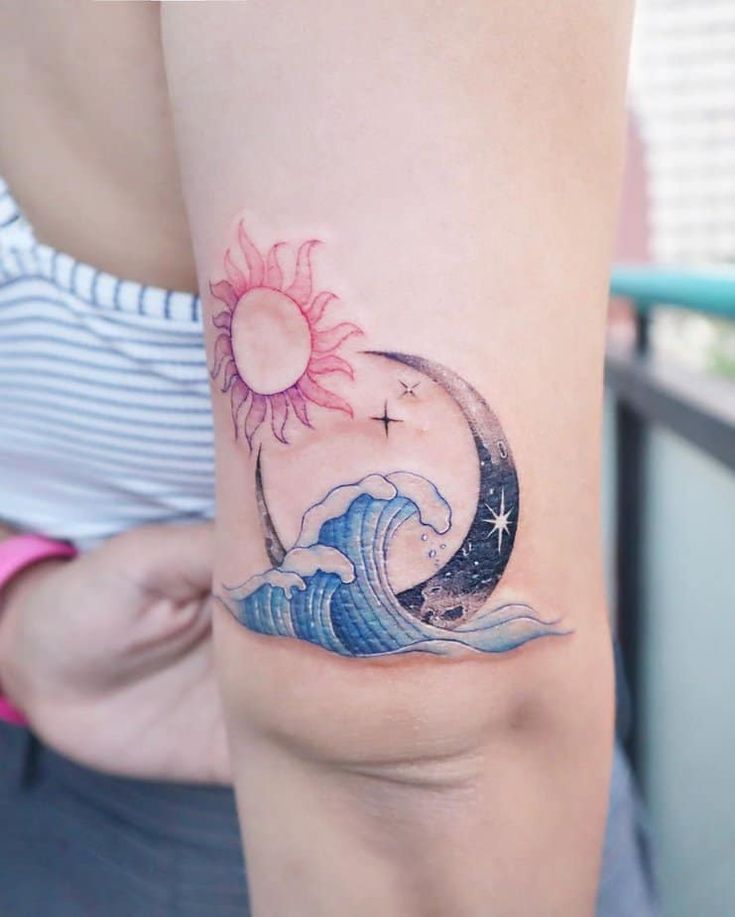
This design combines the celestial bodies with ocean waves, creating a serene, nature-inspired scene. It’s about the interplay between sky, sun, moon, and water.
Technical breakdown: Your artist will use a mix of blackwork for the waves and dotwork for the sky. The sun and moon are bold and central, while the waves flow around them. The composition should feel fluid and dynamic.
Placement & size: This works on the forearm, thigh, or back. Size it at 4-6 inches.
Pain note: The back is moderate to high (5-7/10). The forearm and thigh are more manageable (4-5/10).
Healing time: 2-3 weeks surface, 2-3 months full.
How to brief your artist: Bring wave and celestial references. Say: “I want the sun and moon with ocean waves. Use blackwork for the waves and dotwork for the sky. The composition should feel fluid.”
Cost range: $500-$1,200.
Why it suits you: This solves the desire for a nature-inspired, serene design.
Transition: If you want to play with perspective, a sun and moon eclipse offers a powerful visual.
19. Sun and Moon Eclipse
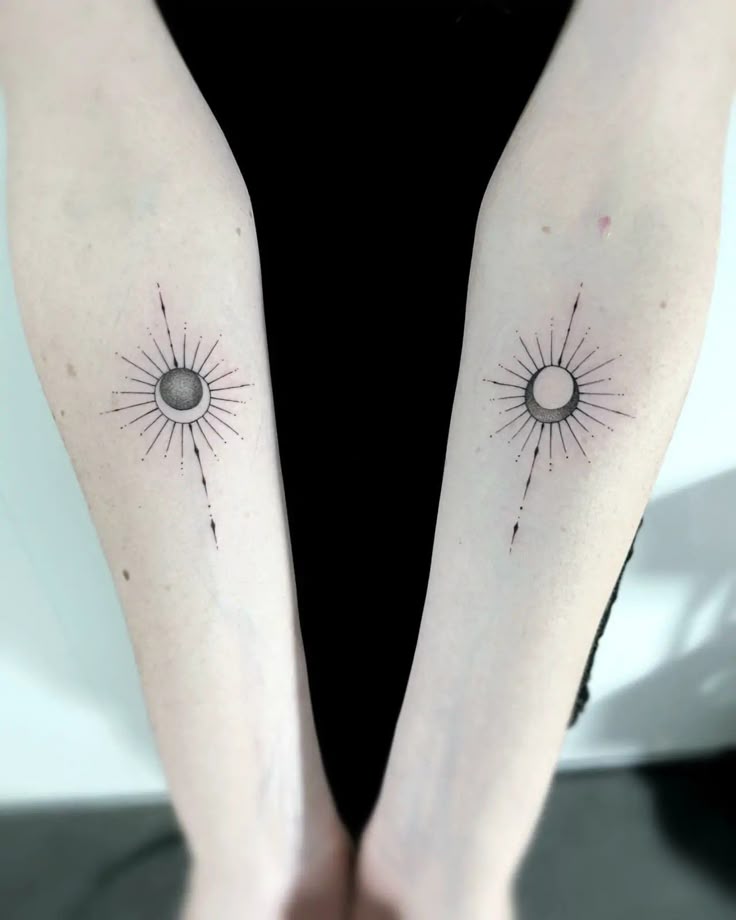
This design depicts a solar or lunar eclipse—the moon passing in front of the sun, creating a ring of light. It’s dramatic and visually stunning.
Technical breakdown: This is a blackwork and negative space masterpiece. The sun is a large circle with rays radiating outward. The moon is a smaller circle that overlaps the sun. The space where the moon overlaps is left as negative space (your skin), creating the illusion of the eclipse. Your artist will need to carefully balance the light and dark areas.
Placement & size: This works on the forearm, chest, or back. Size it at 4-6 inches.
Pain note: The chest and back are moderate to high (5-7/10). The forearm is lower (4-5/10).
Healing time: 2-3 weeks surface, 2-3 months full.
How to brief your artist: Bring eclipse images. Say: “I want a sun and moon eclipse. Use blackwork for the sun and moon, and negative space for the ring of light. I want it to feel dramatic.”
Cost range: $400-$1,000.
Why it suits you: This solves the desire for a visually striking, dramatic design.
Transition: Finally, if you want to add a touch of mystery, a sun and moon with feathers is a beautiful choice.
20. Sun and Moon with Feathers
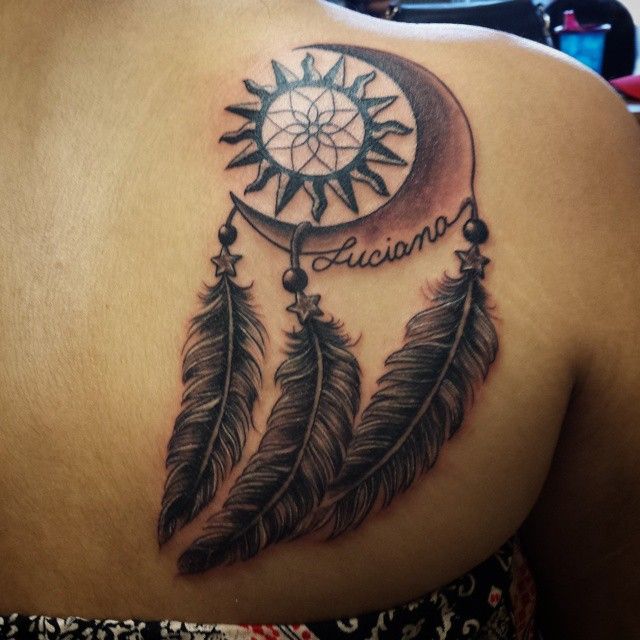
This design combines the celestial bodies with feathers, creating a soft, spiritual, and romantic piece. It’s about lightness, freedom, and the connection between earth and sky.
Technical breakdown: Your artist will use a mix of fine line for the feathers and blackwork for the sun and moon. The feathers should be delicate and detailed, while the sun and moon are bold and solid. The contrast between the two techniques is visually beautiful.
Placement & size: This works on the shoulder, upper back, or forearm. Size it at 4-6 inches.
Pain note: The upper back is moderate (4-6/10). The shoulder is also moderate. The forearm is lower (4-5/10).
Healing time: Fine line and blackwork heal in 2-3 weeks surface, 2-3 months full.
How to brief your artist: Bring feather and celestial references. Say: “I want the sun and moon with feathers. Use fine lines for the feathers and blackwork for the sun and moon. The composition should feel light and spiritual.”
Cost range: $500-$1,200.
Why it suits you: This solves the desire for a soft, spiritual, and romantic design that still carries the power of the sun and moon.
Best Placement Ideas for Sun and Moon Tattoos
Here’s a quick summary to help you decide where to put your design:
| Placement | Visibility | Pain Level (1-10) | Maintenance | Best For |
|---|---|---|---|---|
| Wrist | High (always visible) | 6-7 | Can rub on clothing | Small designs, daily reminders |
| Forearm | High | 4-5 | Easy to care for | Medium designs, first tattoos |
| Upper Back | Low (covered by shirts) | 4-6 | Easy to care for | Larger pieces, symmetrical designs |
| Behind Ear | Moderate (shows with short hair) | 7-8 | Keep hair away during healing | Tiny, delicate designs |
| Chest | Low (covered by shirts) | 6-7 | Watch for tight clothing | Larger, meaningful pieces |
| Ankle | Moderate | 6-7 | Watch for socks/shoes | Small, subtle designs |
| Finger | High | 7-8 | Fades faster, needs touch-ups | Tiny, minimal designs |
Common Mistakes and How to Avoid Them
1. Sizing Too Small for Detail
- The Mistake: You want a highly detailed sun and moon, but you want it to be only 2 inches tall.
- Why It Fails: Ink spreads under the skin over time. Those tiny, beautiful details will blur into a blob within 5-10 years.
- The Fix: Go bigger. If you want detail, give the artist room to work. For intricate designs, 4 inches minimum.
2. Ignoring Contrast
- The Mistake: Getting a sun and moon that are too similar in tone—both light, both heavily shaded.
- Why It Fails: The design loses the visual tension that makes it interesting. The sun should feel bright; the moon should feel dark.
- The Fix: Ask your artist to use contrast—bold blackwork for the moon, negative space or light dotwork for the sun.
3. Not Considering Skin Tone
- The Mistake: Assuming a design will look the same on all skin tones.
- Why It Fails: Lighter skin shows detail better; darker skin needs bolder lines to be readable.
- The Fix: Talk to your artist about how the design will work on your skin tone. They may recommend bolder lines or more contrast.
4. Skipping the Consultation
- The Mistake: Walking into a shop and picking a design off the wall.
- Why It Fails: Flash designs aren’t customized for your body. They might not flow with your anatomy or suit your personal style.
- The Fix: Book a consultation. Let the artist see your placement, discuss the size, and create a custom design for you.
5. Not Budgeting for a Good Artist
- The Mistake: Thinking any artist can do any style.
- Why It Fails: A fine-line artist and a bold traditional artist are different specialists. Choose the wrong one, and you’ll get a poor result.
- The Fix: Research artists who specialize in the style you want. Save up. Don’t cheap out on something permanent.
6. Ignoring Aftercare
- The Mistake: Getting the tattoo and then ignoring it.
- Why It Fails: You’ll get infections, scarring, and faded ink. The sun and moon—especially delicate fine-line or watercolor pieces—need careful care.
- The Fix: Follow aftercare religiously. It’s not optional.
Tips for Success: How to Choose an Artist and Prepare
How to Judge a Portfolio
- Look for healed photos: Anyone can take a photo right after the tattoo. Look for photos of healed tattoos (3-6 months later).
- Check for line consistency: Are the lines smooth or shaky? A good artist has steady hands.
- Look at the shading: Is it smooth? Are there visible needle marks?
- Check their specialty: Don’t ask a bold traditional artist to do a fine-line watercolor piece. Look for someone who specializes in the style you want.
What to Bring to a Consultation
- Reference photos: Not just tattoos—photos of the celestial imagery, art, or symbols you like.
- A size idea: Use a tape measure to show them the approximate size.
- Placement ideas: Show them exactly where you want it.
- A clear budget: Be upfront about what you want to spend.
- Questions: Ask about their experience with celestial tattoos, their hourly rate, and their availability.
How to Prepare for Your Appointment
- Eat a good meal: Tattooing releases adrenaline. Low blood sugar makes you dizzy.
- Stay hydrated: Drink water.
- Dress comfortably: Wear a loose shirt (if the tattoo is on your back or chest) or something with sleeves you can roll up (if it’s on your arm).
- Bring distractions: Headphones, a book, a phone charger.
- Get good sleep: Being tired makes pain worse.
Aftercare Basics: What You Need to Know
Note: These are general guidelines. Always follow the specific aftercare sheet your artist gives you.
Days 1-3 (Fresh Tattoo)
- Keep it covered: Your artist will wrap it. Leave the wrap on for the recommended time (usually 2-24 hours).
- Wash gently: Use lukewarm water and a mild, fragrance-free soap. Pat it dry with a clean paper towel. Don’t rub.
- Moisturize: Apply a thin layer of tattoo-specific ointment (like Aquaphor or a product recommended by your artist). Don’t over-apply—you want it to breathe.
Days 4-14 (Peeling Stage)
- It will peel: This is normal. Don’t pick the flakes—you’ll pull out the ink.
- Switch to lotion: After a few days, switch from ointment to an unscented lotion. Keep it moisturized.
Weeks 2-6 (Healing)
- Avoid sun: UV rays fade ink—and with sun and moon tattoos, you want that contrast to last. Keep it covered or use a high-SPF sunscreen.
- No swimming: No pools, oceans, or baths for at least 3-4 weeks. Showers are fine, but don’t soak.
- No gym: Sweat and tight clothing irritate the tattoo. Take at least 1-2 weeks off from heavy exercise.
Long-Term Care
- Sunscreen forever: Sun exposure will fade and blur your tattoo over time. Use SPF 50+ on it.
- Moisturize: Healthy skin keeps the tattoo looking vibrant.
Quick FAQ
How much does a sun and moon tattoo cost?
It varies. A small, minimalist design might cost $100-$300. A larger, detailed piece on the back or chest could cost $500-$1,500 or more, depending on the artist’s reputation and the design’s complexity.
How long does a sun and moon tattoo take to heal?
The surface heals in about 2-3 weeks, but the deeper layers can take 2-3 months to fully recover. During this time, avoid direct sun, swimming, and heavy friction on the area.
What does a sun and moon tattoo feel like?
Pain depends on placement. Bony areas like the wrist, ankle, and behind the ear are more sensitive (6-8/10). Fleshy areas like the forearm, upper back, and thigh are more comfortable (4-5/10).
Do sun and moon tattoos fade faster than other designs?
Fine-line and watercolor styles may fade faster than bold traditional or blackwork pieces. Sun exposure is the biggest culprit—always use sunscreen on your tattoo to keep it looking crisp.
Your Perfect Sun and Moon Tattoo Awaits
Choosing a sun and moon tattoo isn’t just about picking a cool image. It’s about finding a design that reflects your sense of balance, your connection to the universe, and your personal story. Whether you go for a bold blackwork piece, a delicate fine-line design, or a colorful watercolor scene, the key is working with an artist who understands your vision and can bring it to life.
Take your time. Research your artist. Ask questions. Think about placement, size, and how the design will age. The best sun and moon tattoo isn’t the one that’s trendy—it’s the one that’s truly yours.
Ready to start your journey? Find a specialist whose portfolio speaks to you, book that consultation, and begin creating your perfect sun and moon tattoo today.