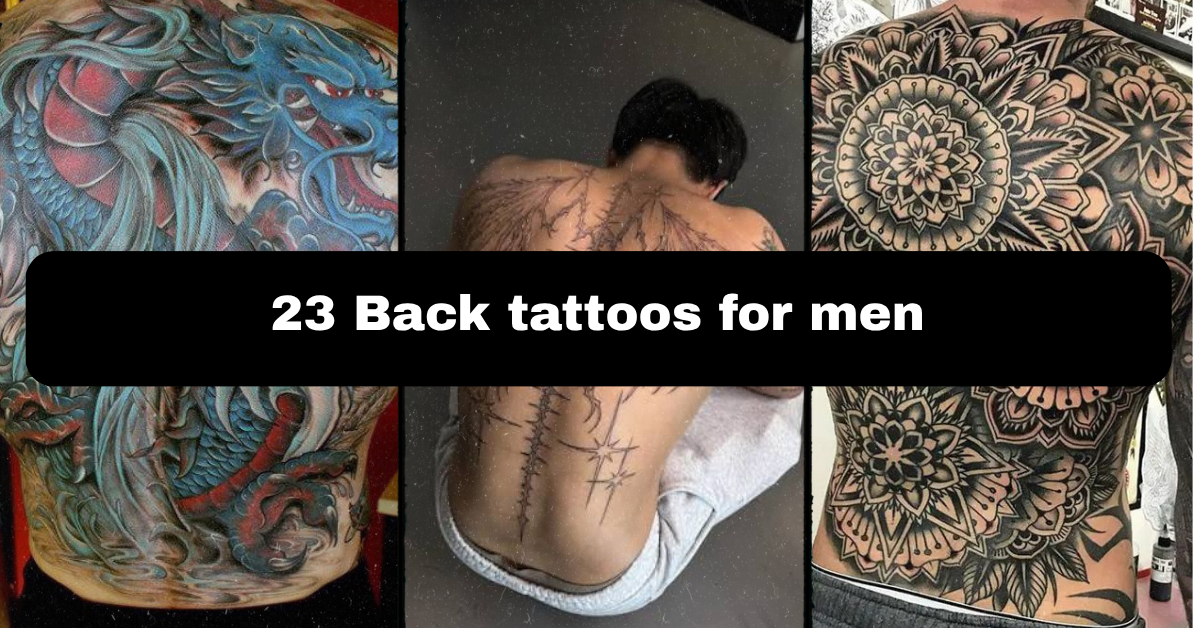
23 Back Tattoos for Men: The Ultimate Practical Guide to Design, Pain, Cost & Aftercare
Nervous about picking a back tattoo you’ll regret in five years? Let’s break down how to choose a design that not only looks epic today but ages well with you. The best back tattoos for men aren’t just about aesthetics—they’re about a powerful canvas, strategic placement, and proper planning.
So what are the best back tattoos for men? Bold full-back pieces like a roaring lion, a cinematic Archangel Michael, or an abstract black-and-grey wave pattern all work exceptionally well because they follow the body’s natural contours. A large, single-subject “hero” design creates an immediate visual impact, while a cohesive “story” piece or architectural “structure” design can be a true masterpiece. The best choice is a design direction that fits your personality and is expertly planned to flow with your spine and shoulder blades.
This guide isn’t just a lookbook. It’s a blueprint. We’ll walk you through 23 distinct design ideas, pain levels, healing time, cost ranges, and exactly what to tell your artist so you get the tattoo you envision.
Understanding Tattoo Techniques: A Quick Reference
Before we dive into the designs, let’s clarify some key terms you’ll encounter:
| Technique | What It Means | Best Used For |
|---|---|---|
| Fine Line | Uses a single needle or very small groupings for thin, delicate lines | Detailed portraits, script, geometric patterns |
| Bold Traditional | Thick black outlines (usually 5-9 round shader needles) with limited color palette | Classic Americana, sailor tattoos, designs that need to last decades |
| Blackwork | Uses only black ink, often with heavy saturation and solid black areas | Tribal, mandalas, silhouettes, high-contrast pieces |
| Dotwork | Creates shading and texture using thousands of tiny dots | Geometric patterns, spiritual designs, soft gradients |
| Watercolor | Mimics paint splashes with minimal outlines, using diluted inks | Abstract art, nature scenes, colorful pieces |
| Negative Space | Uses the skin itself as part of the design, leaving un-inked areas | Optical illusions, structural designs, modern minimalism |
| Single Needle | The finest possible line work, using just one needle | Micro-realism, tiny details, script |
23 Back Tattoo Design Ideas for Men
1. Full-Back Lion with Geometric Mane

This design works because it combines raw power with structural precision. The lion’s face sits between the shoulder blades, while its mane expands outward using geometric patterns—triangles and hexagons—that flow down toward the shoulder blades.
Technical breakdown: Your artist will use bold traditional linework (around a 7-round liner) for the lion’s facial features to ensure they stay readable for decades. The mane, however, uses fine line and dotwork techniques to create texture without overwhelming the piece. The geometric elements rely on negative space—leaving skin un-inked between shapes—to give the design breathing room.
Placement & size: Center the lion’s face directly on the spine, about 4 inches below the base of your neck. The mane should expand to fill your upper back, reaching the tops of your shoulder blades. For a full-back version, the geometric patterns can continue down to your waist.
Pain note: The spine area will be the most sensitive—expect a sharp, almost electric sensation when the needle hits bone. The fleshy parts of your upper back are more tolerable, feeling like a dull ache (4-6/10).
Healing time: Allow 2-3 weeks for the surface to heal, but expect 3-6 months for full deep-tissue recovery. Geometric areas with heavy blackwork may scab more and require extra care.
How to brief your artist: Bring a reference photo of a lion you like, plus a separate image of geometric patterns you find appealing. Say: “I want the lion’s face here [point to spine], with the mane transitioning into these geometric shapes. I’d prefer bold linework for the face and dotwork shading for the mane.”
Cost range: $800-$2,500 depending on size and artist reputation. A full-back version with detailed geometric work could exceed $3,000.
Why it suits you: This design solves the problem of wanting a meaningful, powerful symbol that also looks modern and artistic. It’s not just a lion—it’s a statement piece.
Transition: If wildlife isn’t your style, let’s look at a design that brings myth and legend to life.
2. Archangel Michael Battle Scene

This cinematic design captures the epic moment of Michael defeating Lucifer. It’s a classic choice for men who want a narrative tattoo that tells a story of triumph and protection.
Technical breakdown: A design like this requires a realism specialist. Your artist will use a combination of single needle for fine details (feathers, facial expressions) and larger groupings (9-round shaders) for the darker, shadowed areas. The contrast between the angel’s white robe (using negative space and light grey wash) and the dark, fiery underworld below creates visual drama. The best artists use a technique called “cross-hatching” for the wings—layering fine lines in opposite directions to create texture.
Placement & size: This is a full-back piece. Michael should be centered, with his wings expanding to your shoulder blades. Lucifer should be smaller, positioned lower down, perhaps near your waist. The composition should follow your spine’s natural curve.
Pain note: The ribs and spine will be the most challenging (7-9/10). The shoulders and upper back are more manageable (4-6/10). Because this is a large piece requiring multiple sessions, your pain tolerance will be tested.
Healing time: Plan for 4-6 sessions, each spaced 3-6 weeks apart. Full healing takes 4-6 months.
How to brief your artist: Bring a high-resolution image of a classical painting of Archangel Michael, plus a photo of a tattoo style you like. Be specific: “I want the wings to have fine feather details using single-needle work. The background should be dark and moody—heavy blackwork saturation.”
Cost range: $2,000-$6,000+ for a full-back, multi-session piece.
Why it suits you: This is for the guy who wants a conversation starter—a piece that people will study and admire. It solves the desire for a deeply meaningful, religious, or mythological tattoo.
Transition: Prefer something more modern and abstract? Let’s explore architectural designs next.
3. Cyber Sigilism Spine Tattoo

This is the future of tattooing. Cyber sigilism uses thin, jagged lines, sharp angles, and abstract symbols that look like they belong in a sci-fi movie.
Technical breakdown: Your artist will use a single needle or a very fine 3-round liner to create these intricate, sharp lines. The style is all about linework—no shading, no color, just pure black ink forming complex, angular patterns. It looks chaotic but is actually highly structured. The artist will use a stencil to ensure symmetry, especially along the spine.
Placement & size: This design is perfect for a vertical run down your spine, from your neck to your lower back. It can also wrap around your shoulder blades. Keep it 2-4 inches wide for maximum impact.
Pain note: The spine is where this hurts most (8-9/10). The needle’s vibration on the bone creates a distinct buzzing sensation. If you’re nervous, start with the upper back, which is less painful.
Healing time: Fine-line tattoos often heal faster than heavy blackwork—expect 1-2 weeks for the surface, with full healing in 2-3 months. However, the thin lines are delicate, so avoid tight clothing that might rub.
How to brief your artist: Bring images of cyber sigilism you find online. Say: “I want an asymmetrical but balanced design along my spine. I prefer single-needle work for ultra-sharp lines. Can you create a custom stencil based on these symbols?”
Cost range: $400-$1,200 for a spinal piece. More if it wraps around.
Why it suits you: This solves the problem of wanting a tattoo that feels cutting-edge and mysterious. It’s for the guy who doesn’t want a traditional design and likes the idea of a pattern that looks like it’s from another world.
Transition: If you want something more organic, a wave pattern might be your speed.
4. Full-Back Black and Grey Wave Pattern
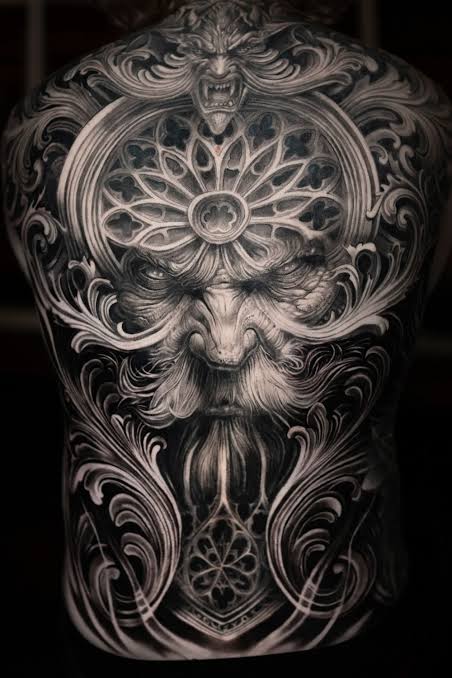
This design captures the power and flow of the ocean using only black ink. It’s abstract enough to be artistic but recognizable enough to have meaning.
Technical breakdown: The best wave tattoos use dotwork and blackwork shading to create the illusion of moving water. Your artist will use a combination of stippling (thousands of tiny dots) and smooth shading (using a magnum shader) to create gradients from dark foam to light crests. The key is contrast—deep blacks in the wave’s curl, negative space for the white foam, and mid-tones for the water’s body.
Placement & size: This is a full-back piece. The main wave should curl across your upper back, with smaller waves and foam cascading down toward your waist. Follow the natural curve of your spine.
Pain note: The shoulder blades can be sensitive because the bone is close to the surface (6-7/10). The fleshy mid-back is more comfortable (4-5/10).
Healing time: With heavy blackwork, expect 2-3 weeks for peeling, and up to 3 months for full healing. The large black areas may scab more—don’t pick them.
How to brief your artist: Bring a reference photo of a wave, ideally a Japanese woodblock print or a black-and-grey tattoo. Say: “I want the wave to feel powerful. Use heavy blackwork for the dark parts and dotwork for the foam. I’d like it to flow diagonally across my back.”
Cost range: $1,500-$4,000.
Why it suits you: This solves the desire for a nature-inspired piece that’s masculine and timeless. It’s not a typical tribal or lion tattoo—it’s unique.
Transition: Looking for something symmetrical and spiritual? Mandalas are a great option.
5. Full-Back Mandala Tattoo
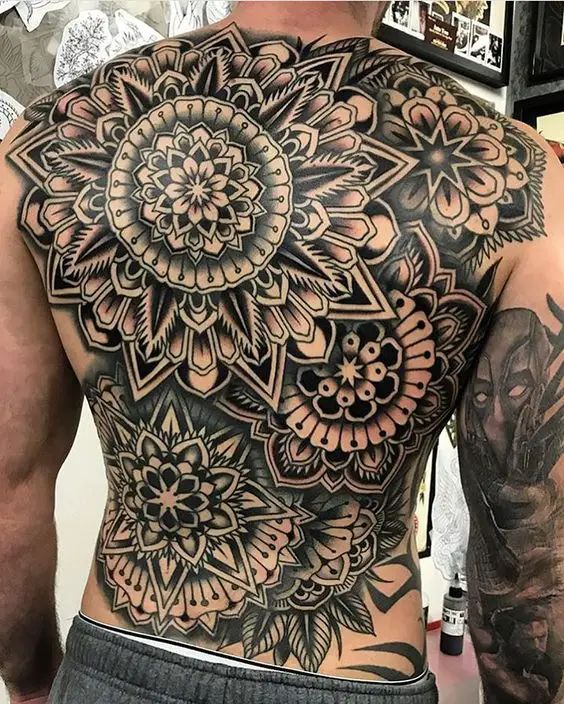
Mandala tattoos are all about balance, symmetry, and spirituality. They create a mesmerizing visual that draws the eye inward.
Technical breakdown: This design relies heavily on dotwork and fine linework. The center of the mandala should sit on your spine, with layers of intricate patterns expanding outward in perfect symmetry. Your artist will use a stencil to ensure each ring of the design mirrors the others. The best mandalas use varying line weights—thicker lines for the main structure, thinner lines for the intricate details inside each petal.
Placement & size: Center it on your back, with the largest ring reaching to your shoulder blades. A mandala can cover your entire back or just the upper section—it’s versatile.
Pain note: The spine will be intense (8-9/10). The areas off the spine, where there’s more flesh, are more comfortable (4-5/10). This is a long session, so be prepared.
Healing time: Because mandalas often have large black areas (the center), expect 2-3 weeks for surface healing and 2-3 months for full recovery.
How to brief your artist: Bring examples of mandala styles you like. Be specific: “I want a symmetrical mandala centered on my spine. Use dotwork for the shading between the petals. The center should be solid black, fading into finer details.”
Cost range: $600-$2,000 depending on size and detail.
Why it suits you: This solves the desire for a spiritual, meditative design that also functions as a powerful visual statement. It’s for the guy who values balance and order.
Transition: If you want something more aggressive, let’s look at a dragon design.
6. Japanese Dragon Full-Back
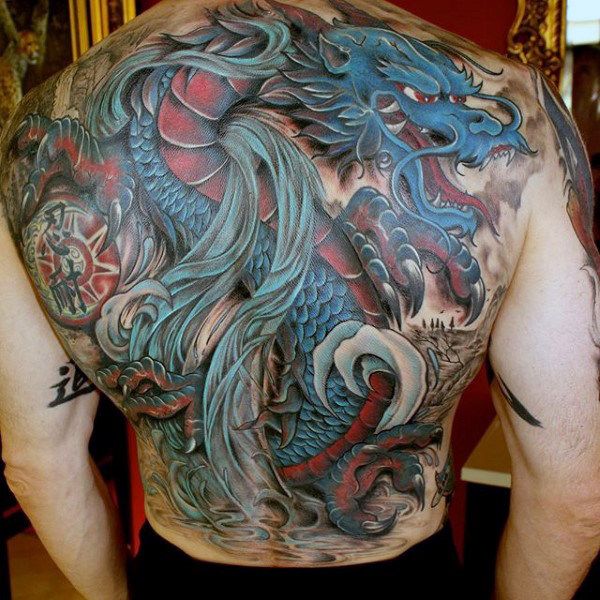
The Japanese dragon is a symbol of strength, wisdom, and protection. It’s a classic choice for men who want a powerful, flowing design.
Technical breakdown: Japanese traditional tattoos use bold traditional linework with thick outlines and a limited color palette (black, grey, red, gold). Your dragon should coil and twist, following the natural curves of your back. The scales are created using a technique called “scaling”—your artist will use a round shader to create hundreds of individual scale shapes. The dragon’s face should be detailed, with fine lines for whiskers and teeth.
Placement & size: The dragon should flow from your shoulder, down your back, wrapping around your ribs. It’s a dynamic, asymmetrical design that works best as a full-back or half-back piece.
Pain note: The ribs are a challenge (7-8/10). The back muscles are more forgiving (4-5/10).
Healing time: Color and heavy blackwork take longer to heal. Expect 2-3 weeks for the surface, 3-4 months for full healing.
How to brief your artist: Bring a reference photo of a Japanese dragon tattoo. Say: “I want a traditional dragon wrapping from my shoulder to my lower back. Use thick outlines and red/black ink. Can you add clouds and wind bars for movement?”
Cost range: $2,000-$5,000+ for a full-back.
Why it suits you: This solves the desire for a masculine, culturally rich design that looks powerful from any angle.
Transition: Prefer something more grounded? The Roman gladiator is a brilliant choice.
7. Gladiator Full-Back Battle Scene
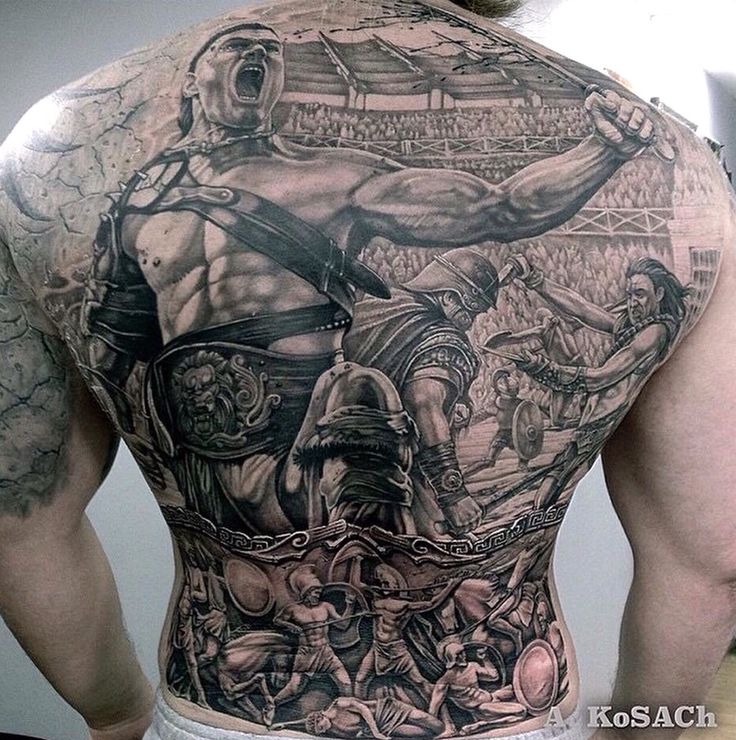
This design captures the spirit of a warrior—courage, discipline, and strength. It’s a narrative piece that tells a story of combat and triumph.
Technical breakdown: Realism is your friend here. Your artist will use single needle for fine details (the gladiator’s face, armor etchings, weapons) and blackwork for dramatic shadows. The composition should be cinematic—the gladiator in the center, maybe a defeated opponent at his feet, with a dramatic sky or coliseum backdrop. Contrast is everything: dark shadows in the background make the lighter-skinned gladiator pop.
Placement & size: Center the gladiator on your spine. The scene should fill your upper back, with the action spilling down to your mid-back.
Pain note: The spine and ribs are painful (7-9/10). The upper back is more moderate (4-6/10). This is a multi-session piece.
Healing time: As with any large realism piece, plan for 3-6 months for full healing.
How to brief your artist: Bring images of gladiators, Roman armor, and battle scenes. Say: “I want a realistic gladiator in the center, with a dark, moody background. Use single-needle for the armor details and blackwork for the shadows.”
Cost range: $1,800-$5,000.
Why it suits you: This solves the desire for a masculine, historical piece that represents personal strength.
Transition: If you prefer something less violent, a samurai offers a similar warrior ethos.
8. Samurai Fighting Dragon

This is the ultimate clash of titans—a samurai warrior facing a dragon. It’s a symbol of courage, honor, and overcoming impossible odds.
Technical breakdown: This design blends Japanese traditional with realism. The samurai should be detailed (armor, sword, face), while the dragon is more stylized. Your artist will use bold linework for the dragon’s scales and fine lines for the samurai’s armor details. Color can be used sparingly (red for the dragon, gold for the armor) to draw the eye.
Placement & size: This is a full-back piece. The samurai stands strong in the center, while the dragon coils around him, creating a dynamic, circular composition.
Pain note: Expect intense pain on the spine and ribs (7-9/10). This is a long, multi-session commitment.
Healing time: 3-4 weeks for surface healing, 3-6 months for full recovery.
How to brief your artist: Bring images of samurai and dragons. Say: “I want the samurai in the center, the dragon wrapping around him. Use black and grey with some red and gold accents. Can you make the composition feel like a battle scene?”
Cost range: $2,500-$6,000+.
Why it suits you: This solves the desire for a powerful, narrative tattoo that symbolizes personal strength and resilience.
Transition: If you want a more modern, geometric take, let’s look at the ornamental style.
9. Ornamental Blackwork Shoulder-to-Shoulder

Ornamental tattoos use geometric and organic patterns to frame and accentuate the body’s natural shape. They’re like architectural adornments for your skin.
Technical breakdown: This is a blackwork specialty. Your artist will use a combination of thick lines, thin lines, and dotwork to create patterns that flow from one shoulder to the other, across your upper back. The design should frame your trapezius muscles, emphasizing width. Negative space plays a huge role—the un-inked skin becomes part of the design.
Placement & size: This piece sits across your upper back, from one shoulder to the other. It can also extend down your spine.
Pain note: The shoulder blades are boney and can be sensitive (6-7/10). The upper back is more fleshy (4-5/10).
Healing time: 2-3 weeks for surface healing, 2-3 months for full.
How to brief your artist: Bring examples of ornamental blackwork. Say: “I want a symmetrical design that runs shoulder to shoulder. Use a mix of thick and thin lines with some dotwork shading. I want it to frame my shoulders.”
Cost range: $800-$1,800.
Why it suits you: This solves the desire for a modern, masculine tattoo that isn’t a literal image. It’s abstract yet structured.
Transition: Want something more traditional? The anchor and ship is a classic.
10. Traditional Anchor and Ship

This classic sailor design is timeless. It represents stability, adventure, and the open sea.
Technical breakdown: Bold traditional is the way to go. Thick black outlines, limited colors (black, red, yellow, green), and minimal shading. The ship and anchor should be readable from a distance—heavy lines and simple shapes. Your artist will use a 9-round liner for the thick outlines and a shader for solid color blocks.
Placement & size: Place the anchor on your mid-back, with the ship above it near your shoulder blades. This is a vertical design that works well on the spine.
Pain note: The spine (8-9/10) and shoulder blades (6-7/10) are the sensitive spots.
Healing time: 2 weeks for surface healing, 2-3 months for full.
How to brief your artist: Bring classic sailor tattoo flash (reference designs). Say: “I want a traditional anchor and ship design. Thick outlines, bold colors. I want it to look like it could be from a 1950s tattoo shop.”
Cost range: $600-$1,500.
Why it suits you: This solves the desire for a classic, unpretentious tattoo that will age beautifully.
Transition: If you want the ultimate symbol of protection, the Hamsa hand is a great choice.
11. Hamsa Hand with Evil Eye

The Hamsa hand and evil eye are protective symbols from Middle Eastern and Jewish cultures. They ward off negative energy and bring good luck.
Technical breakdown: This design can be done in blackwork or dotwork. The hand itself should have intricate linework—fine lines for the fingers and palm lines, solid black for the eye in the center. Dotwork can be used for shading around the hand to create a halo effect.
Placement & size: Center it on your upper back, between your shoulder blades. Size it about 6-8 inches tall.
Pain note: The spine is sensitive (8-9/10), but the fleshy areas are more manageable (4-5/10).
Healing time: 2 weeks surface, 2-3 months full.
How to brief your artist: Bring reference images. Say: “I want a symmetrical Hamsa hand with the evil eye in the center. Use blackwork and dotwork. No color.”
Cost range: $400-$1,000.
Why it suits you: This solves the desire for a meaningful, protective tattoo that’s smaller and less intense than a full-back monster piece.
Transition: If you want something that reflects your personal philosophy, script is a great idea.
12. Large Script Tattoo Along Spine

Script tattoos are personal, meaningful, and powerful. They turn words into art.
Technical breakdown: You’ll want a single needle or fine line specialist. The letters should be carefully spaced, with varying letter weights (thicker on downstrokes, thinner on upstrokes) to mimic calligraphy. The key is readability—your artist needs to ensure the letters don’t blur together.
Placement & size: Vertically along the spine, from the base of your neck to your lower back. Each letter should be about 1-1.5 inches tall.
Pain note: This is a high-pain area (8-9/10). The needle on the bone creates a vibrating sensation.
Healing time: Fine-line tattoos heal quickly—1-2 weeks for surface, 2-3 months for full.
How to brief your artist: Write down the exact phrase and font style. Say: “I want this phrase [show them] running down my spine. Use a single needle for ultra-clean lines. Can you design the letters to flow like calligraphy?”
Cost range: $300-$800.
Why it suits you: This solves the desire for a deeply personal, minimalist tattoo.
Transition: If you want to add visuals to your text, consider a cross with Bible verse.
13. Cross with Bible Verse

This combines religious symbolism with personal text. It’s a powerful statement of faith.
Technical breakdown: The cross can be bold traditional or blackwork. The verse should be in a fine line script beneath the cross. The contrast between the bold cross and the delicate text is visually striking.
Placement & size: Center it on your upper back, between the shoulder blades. The cross should be 6-8 inches tall.
Pain note: The spine is sensitive (8-9/10). The shoulder blades (6-7/10).
Healing time: 2 weeks surface, 2-3 months full.
How to brief your artist: Bring the verse and a cross design. Say: “I want a bold cross with this verse in fine-line script below it. Make the cross blackwork, the text single-needle.”
Cost range: $500-$1,200.
Why it suits you: This solves the desire for a faith-based, meaningful tattoo.
Transition: If you want something darker, the grim reaper might suit you.
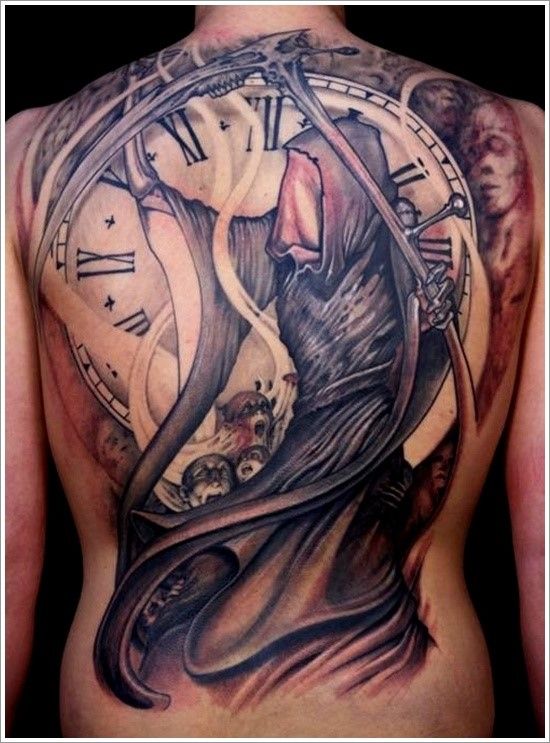
14. Grim Reaper with Hourglass
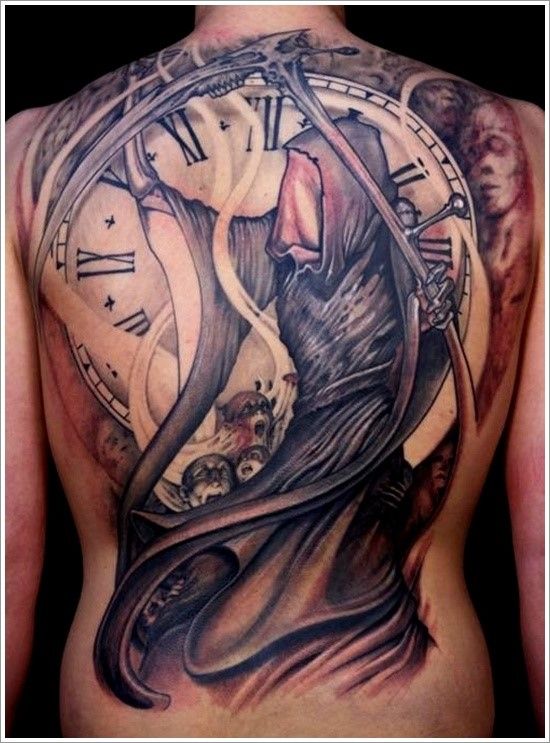
The grim reaper is a powerful symbol of mortality and the passage of time. It’s a dark, dramatic design.
Technical breakdown: Realism or blackwork works best. The reaper should be cloaked in heavy black, with the hourglass showing fine detail through negative space. Use a single needle for the hourglass’s fine lines and glass reflections, and bold blackwork for the cloak.
Placement & size: Full-back piece. The reaper stands tall, the hourglass at the base.
Pain note: Full-back means all spots—spine and ribs will hurt (7-9/10).
Healing time: Multi-session. 3-6 months full healing.
How to brief your artist: Bring reference images. Say: “I want a grim reaper in a dramatic pose. Heavy blackwork for the cloak, fine lines for the hourglass. A realistic style.”
Cost range: $1,500-$4,000.
Why it suits you: This solves the desire for a dark, philosophical piece.
Transition: If you want something more empowering, the Phoenix is a great choice.
15. Phoenix Rising from Ashes
The phoenix symbolizes rebirth, resilience, and new beginnings. It’s a powerful and beautiful design.
Technical breakdown: This design benefits from a mix of techniques. The flames should be bold blackwork with orange and red accents. The bird itself uses fine lines for feathers and dotwork for shading. The contrast between the dark ashes (bottom) and the bright, rising bird (top) is key.
Placement & size: Full-back piece. The ashes at your waist, the bird rising to your shoulders.
Pain note: Full-back, so expect intense moments (7-9/10).
Healing time: Color and heavy blackwork: 3-4 months.
How to brief your artist: Bring images of phoenixes. Say: “I want the phoenix rising up my back. Use blackwork for the flames, fine lines for the feathers. Red, orange, and gold accents.”
Cost range: $2,000-$5,000.
Why it suits you: This solves the desire for a design about overcoming adversity.
Transition: If you want something more technical, a 3D optical illusion is perfect.
16. 3D Optical Illusion

This design plays tricks on the eye. It looks like a hole, a tear, or a geometric impossibility in your skin.
Technical breakdown: This is all about shading and negative space. Your artist will create the illusion of depth by using dark shadows at the edges and light areas in the center. It requires a realism specialist who understands light and shadow.
Placement & size: Anywhere on your back. A hole in your spine looks particularly cool. Size it about 4-6 inches.
Pain note: The spine is sensitive (8-9/10).
Healing time: 2-3 weeks surface, 2-3 months full.
How to brief your artist: Bring images of 3D tattoos. Say: “I want an optical illusion that looks like a tear in my skin. Use shading to create the 3D effect. I want it to look hyper-realistic.”
Cost range: $800-$2,000.
Why it suits you: This solves the desire for a unique, conversation-starting design.
Transition: If you want a more traditional optical effect, a maze pattern is interesting.
17. Intricate Maze Pattern
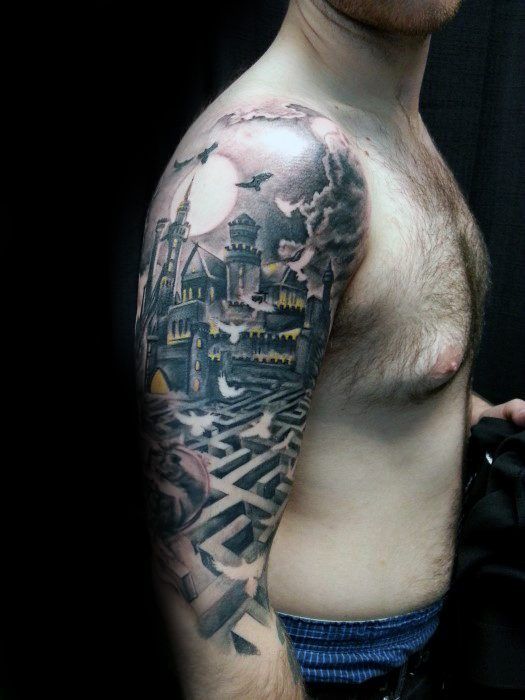
Mazes and labyrinths symbolize life’s journey and the search for meaning. They’re fascinating and complex.
Technical breakdown: This is fine line or dotwork. The lines need to be continuous and unbroken. Your artist will use a stencil to ensure the maze is accurate. Negative space between the lines is crucial for readability.
Placement & size: Round or square design, placed between the shoulder blades or down the spine. 6-8 inches.
Pain note: The spine is the worst (8-9/10). The fleshy parts (4-5/10).
Healing time: 2 weeks surface, 2-3 months full.
How to brief your artist: Bring a maze you designed or found. Say: “I want this maze in fine line work. No shading, just clean lines.”
Cost range: $500-$1,500.
Why it suits you: This solves the desire for a meaningful, puzzle-like design.
Transition: If you want something more cosmic, a galaxy or nebula is stunning.
18. Galaxy or Nebula Scene

Outer space designs are breathtaking. They’re colorful, abstract, and full of wonder.
Technical breakdown: Watercolor is the technique for this. Your artist will use diluted inks to create washes of color (purples, blues, pinks) that blend together. Dotwork can be used for stars. There are no outlines—it’s pure color and negative space.
Placement & size: Full-back piece. The galaxy expands across your shoulders, with a black hole or planet as the focal point.
Pain note: Full-back means all spots (7-9/10).
Healing time: Watercolor can heal differently—expect 2-3 weeks, 3-4 months full.
How to brief your artist: Bring images of space. Say: “I want a colorful nebula scene. Use watercolor techniques—blending purples, blues, and pinks. Add stars with dotwork. No outlines.”
Cost range: $1,800-$4,500.
Why it suits you: This solves the desire for a colorful, abstract, and awe-inspiring design.
Transition: If you want something more focused on one subject, the wolf is a great call.
19. Howling Wolf Moon Tattoo
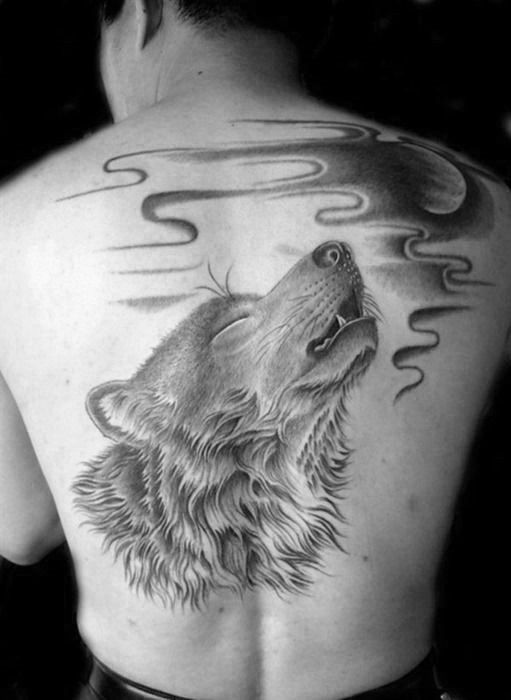
The wolf represents loyalty, strength, and intuition. Paired with a moon, it’s a powerful and atmospheric design.
Technical breakdown: Blackwork or realism. The wolf’s fur should be detailed, using fine lines and dotwork to create texture. The moon should be a bright focal point, perhaps using negative space or a light grey wash. The contrast between the dark wolf and the bright moon is what makes the design pop.
Placement & size: Upper back, centered. Wolf in the middle, moon above it. 8-10 inches.
Pain note: The spine (8-9/10) and shoulder blades (6-7/10).
Healing time: 2-3 weeks surface, 2-3 months full.
How to brief your artist: Bring a reference photo. Say: “I want a wolf howling at the moon. Use blackwork and dotwork for the fur. The moon should be negative space or light grey.”
Cost range: $800-$2,000.
Why it suits you: This solves the desire for a nature-inspired, masculine design with symbolic meaning.
Transition: If the wolf isn’t your animal, a bear is an imposing alternative.
20. Bear with Forest Background

The bear is a symbol of strength, courage, and introspection. It’s a powerful piece for any man.
Technical breakdown: This design often uses blackwork or woodcut style. Woodcut uses thick black lines to create texture and form, mimicking old engravings. The forest background (trees, pine needles) is made of fine lines, while the bear is bold. The contrast is visually striking.
Placement & size: Upper back. The bear in the center, the forest framing it. 8-10 inches.
Pain note: Spine (8-9/10), shoulder blades (6-7/10).
Healing time: 2-3 weeks surface, 2-3 months full.
How to brief your artist: Bring images. Say: “I want a bear in a forest. Use a woodcut style—bold lines for the bear, fine lines for the trees. Black and grey.”
Cost range: $800-$2,500.
Why it suits you: This solves the desire for a rugged, nature-based tattoo.
Transition: If you want to combine realism with nature, a deer in the woods is beautiful.
21. Deer in the Woods

This design is atmospheric and serene. It captures the quiet beauty of nature.
Technical breakdown: Realism with blackwork. The deer should be the focal point, rendered with fine lines and careful shading. The background (trees, mist) should be lighter, using dotwork or grey wash, to create depth. The deer’s antlers can be intricate, requiring a single needle.
Placement & size: Upper back or full-back. The deer in the center, trees fading into the background.
Pain note: Full-back means various pain levels (4-9/10).
Healing time: 2-3 weeks surface, 2-3 months full.
How to brief your artist: Bring reference photos. Say: “I want a deer in a misty forest. Use realism for the deer, lighter dotwork for the background. Black and grey.”
Cost range: $1,000-$3,000.
Why it suits you: This solves the desire for a peaceful, atmospheric design.
Transition: If you want to honor your Celtic roots, a Celtic knotwork design is perfect.
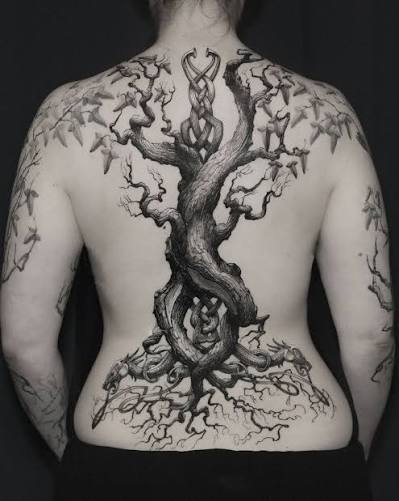
22. Celtic Knotwork Full-Back
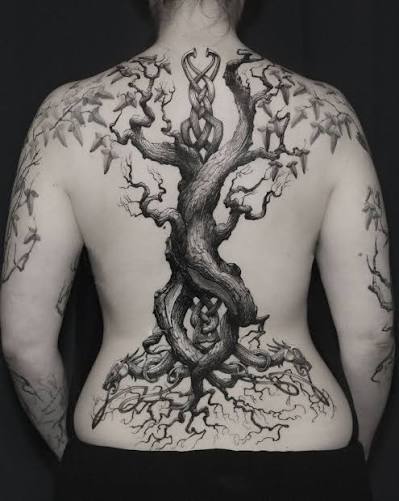
Celtic knotwork is intricate, symbolic, and endlessly fascinating. It represents the interconnectedness of life.
Technical breakdown: This is pure linework. Your artist will use a consistent line weight (maybe a 5-round liner) to create the continuous, interlocking patterns. There’s no shading—just clean, precise lines. The complexity of the design is in the knot itself, not the technique.
Placement & size: Full-back piece. The knotwork covers your entire back in a symmetrical pattern.
Pain note: Full-back means all areas (4-9/10). This is a very long, tedious session.
Healing time: Linework heals faster—2 weeks surface, 2 months full.
How to brief your artist: Bring Celtic knot references. Say: “I want a full-back Celtic knot design. Continuous lines, no breaks. I want it to be perfectly symmetrical.”
Cost range: $1,500-$4,000.
Why it suits you: This solves the desire for a culturally rich, geometric design.
Transition: Finally, if you want something totally unique, a biomechanical piece is the choice.
23. Biomechanical Spine
Biomechanical tattoos look like you’re part machine—gears, pistons, and wires visible beneath your skin. They’re stunning and hyper-detailed.
Technical breakdown: This requires a realism specialist who excels at metallic textures. The artist will use a single needle for fine details (wires, bolts) and blackwork with grey washes for the metallic shading. The illusion is created by having the “mechanical” parts look like they are embedded in your skin.
Placement & size: Down the spine. The mechanical parts follow the vertebrae. 4-6 inches wide.
Pain note: The spine is the most sensitive area (8-9/10).
Healing time: 2-3 weeks surface, 2-3 months full.
How to brief your artist: Bring images of biomechanical tattoos. Say: “I want a biomechanical piece down my spine. Use realism—the metal parts should look embedded in my skin. Single-needle for details.”
Cost range: $1,200-$3,000.
Why it suits you: This solves the desire for a futuristic, unique, and highly technical piece.
Best Placement Ideas for Back Tattoos
Here’s a quick summary to help you decide:
| Placement | Visibility | Pain Level (1-10) | Maintenance | Best For |
|---|---|---|---|---|
| Upper Back / Shoulder Blades | Moderate (shows with tank tops) | 4-6 | Easy to care for | First back tattoos, medium designs |
| Mid-Back / Between Shoulder Blades | Low (usually covered) | 5-7 | Tricky to moisturize solo | Vertical designs, script |
| Spine | Low (covered by shirts) | 8-9 | Hard to sleep on back | Thin, vertical designs |
| Lower Back | Low (covered by pants) | 5-7 | Waistbands can irritate | Symmetrical, horizontal designs |
| Full Back | Low (fully covered) | 4-9 (varies by area) | Requires help for aftercare | Epic, multi-session pieces |
Common Mistakes and How to Avoid Them
1. Sizing Too Small for Detail
- The Mistake: You want a photorealistic lion face, but you want it to be only 4 inches tall.
- Why It Fails: Ink spreads under the skin over time. Those tiny, beautiful details will blur into a blob within 5-10 years.
- The Fix: Go bigger. A back is a huge canvas. If you want detail, give the artist room to work. For realism, 8-10 inches minimum.
2. Ignoring Skin Aging
- The Mistake: Getting a trendy, hyper-realistic design without considering how your skin will change.
- Why It Fails: As you age, your skin loses elasticity and can sag. A design that doesn’t follow your muscle contours will look distorted.
- The Fix: Choose designs that flow with your anatomy. Bold traditional and blackwork designs age better than fine-line realism.
3. Skipping the Consultation
- The Mistake: Walking into a shop, picking a design off the wall, and getting it on your back.
- Why It Fails: Flash designs aren’t customized for your body. They might not flow with your spine or muscle shape.
- The Fix: Book a consultation. Let the artist see your back, discuss the flow, and create a custom stencil.
4. Not Budgeting for a Big Piece
- The Mistake: Thinking a full-back piece costs $500.
- Why It Fails: Good artists charge $150-$300+ per hour. A full-back piece takes 15-40+ hours.
- The Fix: Research costs. Save up. Don’t cheap out on something that’s permanent.
5. Copying Another Tattoo Exactly
- The Mistake: Showing your artist a photo of someone else’s tattoo and saying “copy this.”
- Why It Fails: That design was made for that person’s body. It won’t look right on yours.
- The Fix: Use references as inspiration. Say “I like the style of this” and let the artist create something unique.
6. Ignoring Aftercare
- The Mistake: Getting the tattoo and then ignoring it.
- Why It Fails: You’ll get infections, scarring, and faded ink.
- The Fix: Follow aftercare religiously. It’s not optional.
Tips for Success: How to Choose an Artist and Prepare
How to Judge a Portfolio
- Look for healed photos: Anyone can take a photo right after the tattoo. Look for photos of healed tattoos (3-6 months later).
- Check for line consistency: Are the lines smooth or shaky? A good artist has steady hands.
- Look at the shading: Is it smooth? Are there visible needle marks?
- Check their specialty: Don’t ask a bold traditional artist to do a fine-line realism piece. Look for someone who specializes in the style you want.
What to Bring to a Consultation
- Reference photos: Not just tattoos—photos of the animal, symbol, or scene you want.
- A size idea: Use a tape measure to show them the approximate size.
- Placement ideas: Show them exactly where you want it.
- A clear budget: Be upfront about what you want to spend.
- Questions: Ask about their experience with back tattoos, their hourly rate, and their availability.
How to Prepare for Your Appointment
- Eat a good meal: Tattooing releases adrenaline. Low blood sugar makes you dizzy.
- Stay hydrated: Drink water.
- Dress comfortably: Wear a loose shirt you can take off easily.
- Bring distractions: Headphones, a book, a phone charger.
- Get good sleep: Being tired makes pain worse.
Similar Variations: How to Modify Your Design
Here’s how each core idea can be adapted:
| Core Idea | Variation 1 | Variation 2 | Variation 3 |
|---|---|---|---|
| Lion | Lion head only | Lion with crown | Lion with clock |
| Dragon | Japanese dragon | Celtic dragon | Realistic dragon |
| Mandala | Dotwork mandala | Fine-line mandala | Mandala with animal face |
| Script | Calligraphy | Typewriter font | Gothic font |
| Wolf | Wolf head | Wolf pack | Wolf with moon |
| Cross | Celtic cross | Gothic cross | Simple line cross |
| Geometric | Polygon shapes | Sacred geometry | Cyber sigilism |
Aftercare Basics: What You Need to Know
Note: These are general guidelines. Always follow the specific aftercare sheet your artist gives you.
Days 1-3 (Fresh Tattoo)
- Keep it covered: Your artist will wrap it. Leave the wrap on for the recommended time (usually 2-24 hours).
- Wash gently: Use lukewarm water and a mild, fragrance-free soap (like unscented Castile soap). Pat it dry with a clean paper towel. Don’t rub.
- Moisturize: Apply a thin layer of tattoo-specific ointment (like Aquaphor or a product recommended by your artist). Don’t over-apply—you want it to breathe.
Days 4-14 (Peeling Stage)
- It will peel: This is normal. Don’t pick the flakes—you’ll pull out the ink.
- Switch to lotion: After a few days, switch from ointment to an unscented lotion (like Lubriderm). Keep it moisturized.
Weeks 2-6 (Healing)
- Avoid sun: UV rays fade ink. Keep it covered or use a high-SPF sunscreen.
- No swimming: No pools, oceans, or baths for at least 3-4 weeks. Showers are fine, but don’t soak.
- No gym: Sweat and tight clothing irritate the tattoo. Take at least 1-2 weeks off from heavy exercise.
Long-Term Care
- Sunscreen forever: Sun exposure will fade and blur your tattoo over time. Use SPF 50+ on it.
- Moisturize: Healthy skin keeps the tattoo looking vibrant.
Quick FAQ
How much does a back tattoo cost?
It varies massively. A small upper-back piece might cost $400-$1,200, while a full-back, highly detailed masterpiece can cost $1,500 to $8,000 or more. The price depends on the artist’s reputation, the design’s complexity, and the number of sessions required. Always ask for a quote during your consultation.
How long does a full back tattoo take to heal?
The surface skin heals in about 2-3 weeks. You’ll notice peeling and flaking. However, the deeper layers of skin take 3-6 months to fully heal. You’ll need to avoid direct sun, swimming, and heavy friction during this whole period.
What does a back tattoo feel like?
The upper back (muscle areas) feels like a dull ache, about 4-6 out of 10. The spine and ribs are much more intense—many describe a sharp, vibrating sensation, hitting 8-9 out of 10. The needle hitting bone creates a distinctly uncomfortable feeling.
How many sessions does a full back take?
Most full backs take 4-6 sessions or more. You’ll need to wait 3-6 weeks between sessions to let each section heal. A large realism piece could easily take 15-40+ hours total, spread over 6-12 months.
Your Journey Starts Here
Choosing a back tattoo is a significant decision. It’s a commitment of time, money, and pain. But it’s also an incredible opportunity to create a piece of art that’s uniquely yours—a design that moves with you, tells your story, and looks amazing.
Take your time. Don’t rush into a design. Research your artist. Look at their healed work. Ask questions. Think about how the design will look in 10, 20, or 30 years. Plan your budget and schedule.
The best back tattoos for men aren’t just about the design—they’re about the planning. When you find the right artist, the right design, and the right approach, you’ll walk away with something that truly represents you.
Ready to start your journey? Find a specialist whose portfolio speaks to you, book that consultation, and begin creating your best back tattoo for men today.