16 Phoenix Tattoo Feminine Thigh Ideas That Actually Work on Skin, Not Just on Paper
Thinking about a phoenix tattoo feminine thigh design but worried you’ll end up with something that looked amazing on Pinterest and blurry on your leg two years later? You’re asking the right question at the right time — before you book, not after.
So what makes a good phoenix tattoo feminine thigh design? The best ones use clean linework (the outlined edges of the design), balanced negative space (the untattooed skin left as part of the composition), and placement that follows the natural curve of the thigh instead of fighting it. Size matters too — most phoenix designs need at least 5 to 8 inches of space to keep detail from turning into a dark blob after healing.
Below, I’m breaking down 16 real design directions, plus the stuff most articles skip entirely: pain level by placement, realistic healing timelines, how to talk to your artist so you get what you actually want, and the mistakes that turn a good idea into a regret.
Why the Thigh Works So Well for Phoenix Designs
The thigh is one of the most forgiving canvases in tattooing, and there’s a real reason for that beyond “it looks good.” You’ve got a large, mostly flat muscle group with minimal bone interference, which means artists can work with bigger scale and more shading detail without worrying about distortion over joints. A phoenix — with its spread wings, layered feathers, and flame details — needs room to breathe. Cram it onto a forearm or ankle and you lose the visual drama. On the outer or front thigh, the design can wrap, curve, or spread out following the muscle line, which is part of why so many statement pieces end up here instead of smaller placements.
Fine-Line Phoenix Outline
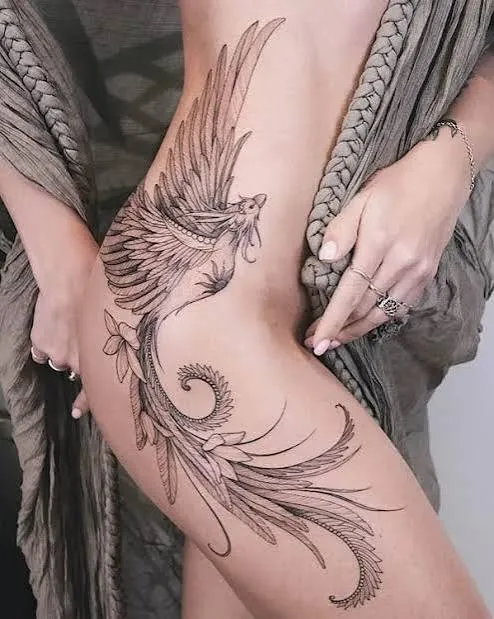
This version skips shading almost entirely and relies on a single, consistent line weight — usually done with a fine-line needle configuration — to render the phoenix’s silhouette, wing feathers, and tail plumes. It reads as elegant rather than aggressive, which is why it’s become the go-to for people who want the symbolism without heavy visual weight. Best placement is the front or outer thigh, sized around 6 to 9 inches so the feather details don’t merge together as the tattoo settles. Healing typically runs 2 to 3 weeks for the surface, though full settling under the skin can take longer. Bring your artist a reference image with visible feather separation, not just a silhouette — this helps them plan spacing before they even build the stencil. Pain is moderate here since the outer thigh has more padding, making it a solid first-tattoo option. This clean approach ages remarkably well since there’s no shading to fade unevenly.
Blackwork Phoenix Silhouette
Blackwork means the design is filled with solid, saturated black ink rather than outlined and shaded — think bold shapes instead of delicate lines. A blackwork phoenix leans into drama, showing the bird as a strong graphic silhouette against bare skin, often with sharp angular wings instead of soft rounded ones. This works best on the outer thigh where a larger canvas lets the shape stand out without crowding. Aim for 7 inches or larger; smaller sizes cause the solid black areas to blur together during healing. Ask your artist about saturation technique during your consultation — solid blackwork requires multiple passes and a slightly longer session than linework alone. Expect more discomfort than fine line, since dense ink saturation means more time under the needle. This style is bold and highly visible, so it’s worth thinking about workplace dress codes before committing. It transitions nicely into more detailed styles if you want to build onto it later.
Watercolor Phoenix in Flight
Watercolor-style tattooing uses soft color blends, blurred edges, and lighter saturation to mimic paint bleeding on paper — no hard outlines holding the color in place. Applied to a phoenix, this creates a soft, almost dreamlike bird mid-flight, often in oranges, reds, and yellows fading into pinks. This style is best suited to the front thigh where good lighting shows off the gradient work. Because color-heavy pieces fade faster than black ink over time, plan on a touch-up appointment within 12 to 18 months to keep the blend vibrant — this is a known tradeoff with color saturation, not a flaw in application. Bring color swatches, not just black-and-white references, so your artist can match tone intensity to your skin’s undertone. Pain runs moderate to high depending on how much color layering is involved. It’s a striking choice for a statement piece but less ideal as a first tattoo given the aftercare commitment.
Dotwork Phoenix with Mandala Accents
Dotwork builds shading and texture entirely from tiny individual dots instead of solid lines or blocks of color — it’s slower to tattoo but creates a soft, almost textured gradient effect. Pairing a phoenix with mandala-style dotwork accents around the wings or tail adds symmetry and a spiritual, ornamental feel without heavy color. This combination works well on the upper outer thigh, sized 6 to 8 inches to give the dot patterns room to form visible gradients rather than solid smudges. Tell your artist specifically that you want dotwork shading, not standard grayscale shading — they’re different techniques requiring different needle work. Healing tends to run slightly longer than linework, around 3 weeks, since dense dot clusters take more time to settle. Pain is moderate; the repetitive dot motion feels different from a continuous line but isn’t necessarily worse. This design ages gracefully since dotwork tends to hold its texture well over years.
Geometric Phoenix Thigh Piece
Geometric tattoos break the phoenix down into angular shapes, straight lines, and sometimes overlapping triangles or hexagons layered into the bird’s form. It’s a modern take that trades traditional curves for structure, often combined with fine-line detailing at the edges for contrast. The outer thigh, sized around 7 inches, gives enough flat space for the geometric lines to stay crisp and symmetrical. When briefing your artist, mention whether you want the geometry purely decorative or built into the anatomy of the wings and tail — this changes the whole composition. Healing runs standard, 2 to 3 weeks on the surface. Pain is moderate on this fleshier area. This style photographs well and reads as intentional and modern, appealing to people who want symbolism without looking overly traditional. It also combines nicely with the negative space technique covered a bit further down.
Phoenix Rising from Flames (Traditional Bold)
This is the classic version most people picture — bold black outlines, solid color fills in red, orange, and yellow, and heavier shading to create depth in the flames beneath the bird. Traditional style uses thicker line weight than fine line work, which actually helps the design hold up better over decades since bold lines resist blurring more than delicate ones. This works best as a larger piece, 8 inches or more, on the front or side thigh where the flame details have room to spread. Ask your artist about “solid fill saturation” during consultation so you understand how many sessions it might take. Pain tends to run higher here due to the extended shading and color work. This isn’t the most subtle choice, so think about visibility if your workplace has strict dress expectations. It’s an excellent option if you want something that reads clearly as a phoenix from across a room, not just up close.
Minimalist Single-Needle Phoenix
Single-needle tattooing uses one fine needle point to create extremely thin, delicate lines — it’s the technique behind most minimalist tattoo trends. A minimalist phoenix strips the design down to just the essential silhouette: a simple wing curve, a small flame accent, nothing else. This is ideal for the inner thigh or a smaller section of the outer thigh, sized 2 to 4 inches, for people who want symbolism without a large commitment. Because the lines are so thin, ask specifically whether your artist uses a single-needle configuration versus a slightly thicker liner — this affects how well the design holds up in 10 years. Pain is generally lower given the smaller scale and lighter linework, though inner thigh skin is more sensitive. This is a strong first-tattoo option and works well for matching tattoos with a sister or friend. Keep in mind single-needle work can blur faster than bolder lines, so touch-ups may come sooner.
Phoenix Feather Trail
Instead of showing the entire bird, this design focuses on a scattering of falling feathers, often rendered in fine line with subtle dotwork shading for texture, trailing diagonally across the thigh. It suggests the phoenix concept — transformation, rebirth — without needing a literal bird shape, which appeals to people who want subtlety. This works beautifully following the natural line of the outer thigh down toward the knee, typically 8 to 10 inches if it’s a full trail. Bring a photo showing the direction and spacing you want the feathers to fall — this is a detail many people forget to specify, and it changes the whole flow of the piece. Healing time matches standard fine-line work, about 2 to 3 weeks. Pain is on the lower end given the delicate technique. This design ages well since there’s less dense shading to fade unevenly, and it works whether you want something private or partially visible.
Phoenix with Floral Accents
Combining a phoenix with botanical elements — small blossoms, vines, or leaves worked into the tail feathers — softens the symbol and adds a personal, feminine layer to the design. Artists typically render the florals in fine line with light shading while keeping the phoenix’s core shape as the focal point. This combination needs a bit more room than a solo phoenix, around 7 to 9 inches, so the floral details don’t get lost. When briefing your artist, specify which flowers matter to you personally — birth month flowers or ones with personal meaning make the piece feel custom rather than generic. Healing is standard for fine-line and light shading combined, roughly 2 to 3 weeks. Pain is moderate on the outer thigh. This design suits people who want their phoenix to feel softer and more personal rather than purely symbolic of struggle or transformation, and it works well as a custom design built from scratch rather than a flash tattoo pulled straight from a wall.
Negative Space Phoenix
Negative space tattooing uses the untouched, natural skin itself as part of the image — instead of ink filling in the bird’s body, the surrounding black work or shading defines its shape by contrast. This creates a striking, almost illusion-like effect where the phoenix seems to glow against darker surrounding ink. It requires real skill to execute cleanly, so this is a case where portfolio review matters more than usual — look specifically for other negative space work, not just general blackwork. Best placement is the outer thigh with at least 7 inches of space to keep the contrast clear. Pain runs moderate to high given the surrounding solid ink work. Healing takes the standard 2 to 3 weeks, but the solid black sections may take slightly longer to settle evenly. This is a bold, conversation-starting choice, less suited to workplaces requiring high coverage, but strikingly original compared to standard phoenix designs.
Phoenix Wrapped Around Thigh
This design uses the cylindrical shape of the thigh itself as part of the composition, with the phoenix’s wings or tail wrapping partially around the leg rather than sitting flat on one side. It requires careful stencil planning since the image needs to look proportional from multiple angles, not just straight on. This only works as a larger piece, generally 9 inches or more, and is best done by an artist experienced specifically in wraparound limb compositions — ask to see healed examples of wraparound work in their portfolio, not just fresh photos. Healing takes the usual 2 to 3 weeks, though sitting and movement can feel slightly more uncomfortable during the healing window given the wrap placement. Pain is moderate to high due to the larger surface area covered in one or multiple sessions. This is a serious commitment piece, not ideal for a first tattoo, but stunning for someone ready for something architecturally ambitious.
Small Phoenix Side Thigh Tattoo
Not every phoenix needs to be a showpiece. A small side-thigh version, usually 3 to 5 inches, rendered in fine line with minimal shading, offers the symbolism in a low-commitment, easy-to-conceal format. This placement sits toward the outer edge of the thigh, easily hidden by most shorts or skirts, making it a favorite for first-timers or workplace-conscious clients. Bring a simple reference image and ask your artist to simplify further if needed — small tattoos lose detail fast, so less really is more here. Pain is generally lower given the smaller scale and shorter session time. Healing runs about 2 weeks for surface closure. This size holds up fine over the years as long as the linework isn’t overly intricate; fine details under 3 inches tend to blur faster, so keep the design simple if you’re going this small.
Phoenix and Moon Combination
Pairing a phoenix with a crescent or full moon creates a layered symbolic piece — rebirth alongside cycles and change — often rendered with the moon in solid blackwork or fine-line detail behind or beside the bird. This composition works well on the upper outer thigh, sized around 6 to 8 inches to give both elements clear visual space without crowding each other. Specify to your artist which element should be the visual anchor — moon or phoenix — since that decision changes the whole layout and sizing balance. Healing follows standard timelines, 2 to 3 weeks. Pain is moderate. This combination design is popular for meaningful, personal tattoos rather than purely decorative ones, and it transitions well into a matching tattoo concept if a friend wants the moon while you take the phoenix.
Colorful Japanese-Style Phoenix (Irezumi-Inspired)
Traditional Japanese tattoo art uses bold outlines, structured cloud or wave background elements, and rich, saturated color to build a phoenix — often called “Hō-ō” in this style — into a larger scene rather than an isolated figure. This is a highly technical style requiring an artist with specific experience in Japanese-influenced work, so portfolio research matters a lot here. It needs significant space, generally 9 to 12 inches, to accommodate the background elements properly. Ask your artist how they approach color saturation and long-term fading for large-scale color work, since bold reds and golds shift over time more noticeably than black ink. Pain runs higher given the extended session length typical of large color pieces. Healing can take longer to fully settle given the ink density. This is a serious, well-researched commitment piece rather than a casual weekend tattoo decision.
Phoenix Outline with Script Quote
Combining a simple fine-line phoenix outline with a short script quote — placed along the thigh curve or beneath the bird — adds a personal, literal layer of meaning to the symbolism. Font choice matters more than people expect; a thin, cursive script reads very differently than a blocky serif, so bring a specific font reference, not just the words. This works well at a medium size, 5 to 7 inches, on the outer thigh where the curve naturally supports a flowing script line. Healing is standard fine-line timing, about 2 to 3 weeks. Pain is moderate to low depending on total size. This is a popular choice for milestone tattoos — recovery, personal growth, a specific date — since it merges symbol and statement in one piece. Script tends to blur faster than block lettering over many years, so keep it a reasonable size rather than going tiny.
Realistic Shaded Phoenix Portrait
This is the most technically demanding version — a phoenix rendered with photorealistic shading, gradient work, and fine detail meant to look almost like a painted image rather than a graphic tattoo. It requires an artist specifically experienced in realism, since this technique relies heavily on smooth shading transitions that inexperienced hands struggle to execute cleanly. This design needs real space, 9 inches minimum, ideally on the front or outer thigh where light hits evenly. Ask to see multiple healed (not just fresh) realism pieces in the artist’s portfolio — healed results tell you far more about shading longevity than day-one photos. Pain runs on the higher end given extended shading sessions. Healing can take a bit longer to fully settle, given ink density. This is a striking, deeply detailed option, best suited for someone who has tattoos already and understands the aftercare commitment involved.
Best Placement Ideas
- Outer thigh — high visibility when you want it, easy to cover when you don’t, moderate pain due to fleshier tissue
- Front thigh — great for color work and larger pieces since it catches light evenly, moderate pain
- Inner thigh — more private placement, but more sensitive skin and slightly trickier healing due to friction from clothing
- Upper thigh near hip — good for wraparound or combination designs, moderate to higher pain near the hip bone
- Side thigh (smaller designs) — easiest to conceal, generally lower pain, ideal for first tattoos
Tips for Success
Before booking anything, spend real time reviewing an artist’s portfolio — specifically look for healed photos of similar work, not just fresh ink under studio lighting. Fresh tattoos always look sharp; healed ones show you the truth about how lines and shading actually hold up. Bring reference images that show the specific technique you want (fine line, dotwork, blackwork) rather than just a general “phoenix tattoo” search result. A good consultation should include a conversation about size relative to detail level, placement relative to your pain tolerance, and a realistic timeline if multiple sessions are needed. Ask whether the piece will be custom-drawn or adapted from an existing flash design — custom work costs more but ensures the proportions actually fit your body.
Common Mistakes and How to Avoid Them
- Going too small for the detail level — intricate feather work or shading needs real space; shrink the design’s complexity instead of just shrinking the size
- Choosing a placement that fights the design’s linework — a wraparound piece on a flat placement or a flowing script on a bony area often looks distorted
- Skipping aftercare instructions — every artist’s aftercare sheet is slightly different based on the ink and technique used; follow theirs, not a generic internet guide
- Copying a reference image exactly — small personal tweaks (a flower, an initial, a color shift) make the piece yours and avoid an identical match to someone else’s tattoo
- Booking a walk-in slot for a highly detailed custom design — complex pieces need consultation time; rushing this leads to compromises on composition
Similar Variations
Nearly every design above can be resized down for a first tattoo or scaled up into a statement piece later — many people start with a small fine-line phoenix outline and build onto it with color or shading in a future session. Color saturation can be dialed up for a bold traditional look or stripped back entirely for a monochrome blackwork version. Combining elements — feathers with florals, or a moon with a script quote — lets you personalize a fairly common symbol into something that reads as genuinely yours rather than a copy of a flash sheet design.
Aftercare Basics
General aftercare guidance includes keeping the area clean, avoiding direct sun exposure while healing, and steering clear of tight clothing that might rub against fresh ink on the thigh. Avoid soaking the tattoo in pools, baths, or open water until it’s fully healed. Always follow the specific aftercare sheet your artist provides, since ink type and technique can change their recommendations slightly. If you notice anything that concerns you during healing, consult a licensed dermatologist or your tattoo artist directly rather than relying on general internet advice.
Quick FAQ
How much does a phoenix thigh tattoo cost?
Cost varies widely by size, detail, and artist experience, but expect anywhere from $150 for a small minimalist piece to $800 or more for a large, detailed custom design across multiple sessions.
How painful is a phoenix tattoo on the thigh?
Pain tolerance is individual, but the thigh is generally considered a moderate-pain area since it’s fleshier than bony spots like the ribs or ankle — inner thigh and areas near the hip bone tend to feel more sensitive.
How long does healing take?
Surface healing typically takes 2 to 3 weeks, though full settling underneath the skin can take longer depending on size and ink density; always follow your artist’s specific aftercare instructions.
Will a phoenix tattoo fade over time?
All tattoos fade gradually with sun exposure and time, with color work generally fading faster than solid black linework; touch-ups every few years help keep detailed pieces looking sharp.
A phoenix tattoo feminine thigh design can be as bold or as subtle as you want it to be — the technique, placement, and size are really what separate a piece you’ll love for years from one you’ll want to cover up. Take the time to find an artist whose healed work actually backs up their fresh photos, and don’t be afraid to personalize a common symbol until it feels like it belongs to you specifically. Pain fades, healing finishes, but a well-planned phoenix tattoo feminine thigh piece is something you’ll be looking at for a very long time — make sure it’s built right the first time.