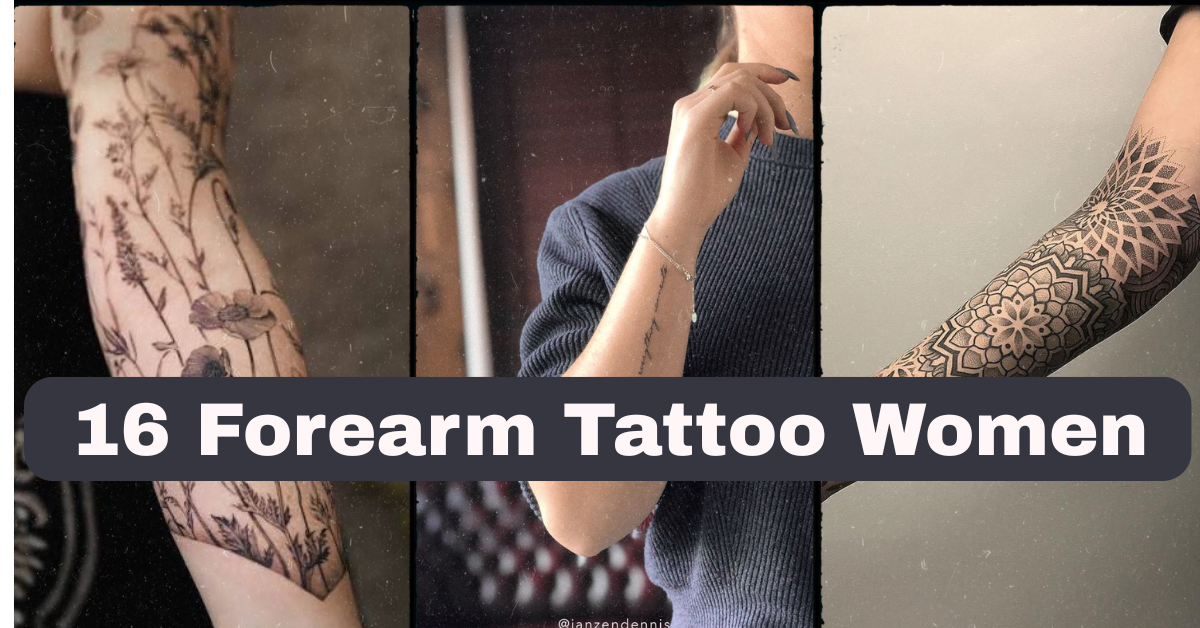
16 Forearm Tattoo Women: A Real Guide to Design, Placement, and What to Expect
Nervous about picking a forearm tattoo you’ll regret in five years? You’re not alone, and honestly, that hesitation is a good sign — it means you’re thinking this through instead of just walking into the first shop you see.
So what are the best forearm tattoo ideas for women? Fine-line florals, blackwork botanicals, dotwork mandalas, and minimalist script tend to work best on the forearm because the flat, visible skin surface holds detail well and the area heals faster than curvier body parts. The right choice depends on how much visibility, pain, and upkeep you’re actually ready for.
I’ve spent a good chunk of time hanging around studios, watching consultations, and asking artists dumb questions so you don’t have to. Below, I’ll walk you through 16 specific design directions, plus the placement tradeoffs, pain levels, and booking tips most articles skip entirely.
Why the Forearm Works So Well for Detailed Designs
The forearm is one of the most forgiving canvases on the body. It’s mostly flat, which means linework stays even instead of warping around curves like it does on ribs or hips. There’s also enough surface area to go big without crowding the design, but enough visibility that you can actually show it off if you want to. That combination — flat skin, decent size, and easy visibility — is why so many artists recommend it to first-timers and collectors alike. It’s also one of the more predictable areas for healing, since it’s not a joint that bends constantly like the elbow or wrist crease.
Fine-Line Floral Vine
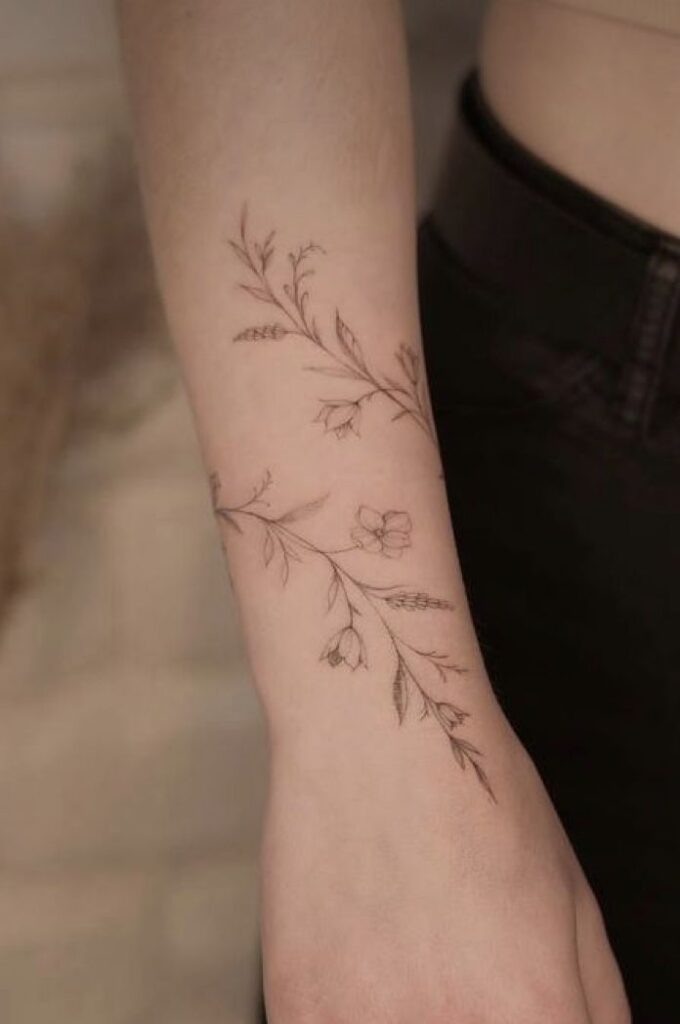
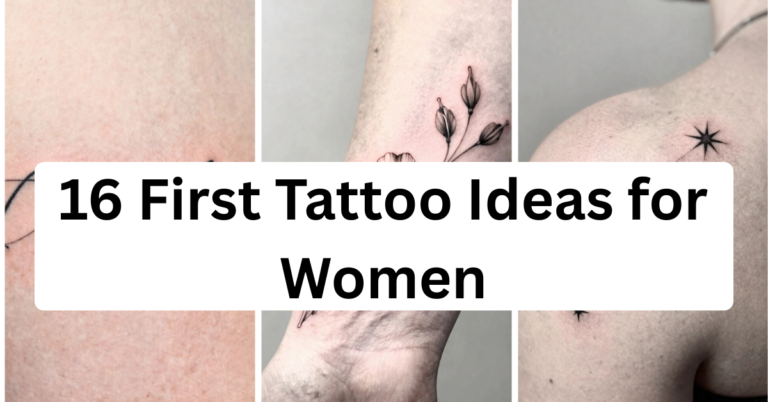
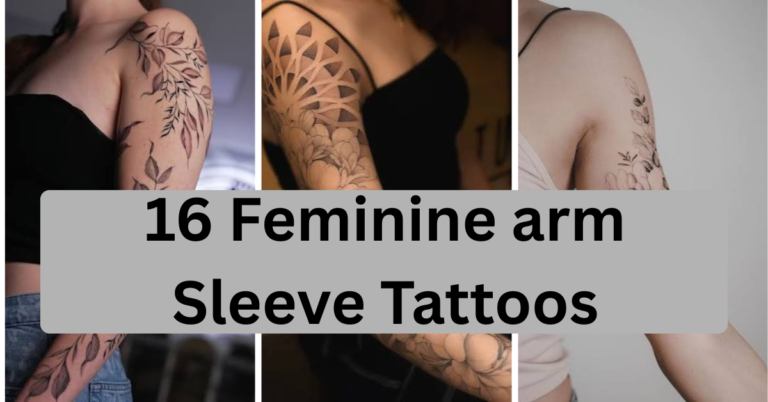
A fine-line vine running along the inner or outer forearm uses thin, consistent needle strokes — usually a single needle or a small round needle grouping — to create delicate stems, leaves, and small blossoms. The line weight stays under a millimeter throughout, which gives it that “drawn with a pen” look rather than a bold graphic one. Best placed running vertically from wrist to elbow, sized around 6 to 10 inches long. Lighter skin tones show the fine detail more clearly, though a skilled artist can adjust density for deeper tones. Healing typically runs 2 to 3 weeks. Bring a botanical reference photo with clear stem direction so your artist can map it to your arm’s natural shape. Pain is moderate — the inner forearm has less padding than the outer arm, so expect more sensation there. Great as a first tattoo since it’s low-commitment and easy to extend later.
Blackwork Botanical Sleeve Panel
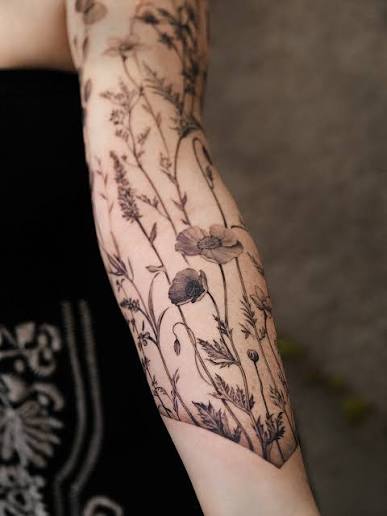
Blackwork uses solid black ink with no shading gradient, relying on bold negative space (the untouched skin left blank to form part of the image) to create contrast. A botanical blackwork panel on the forearm might show leaves or floral silhouettes filled solid, with the white skin doing the work of defining veins or petal edges. This reads as more graphic and confident than fine-line work, and it photographs well from a distance. Ideal size is 4 to 8 inches, placed on the outer forearm where the flat muscle keeps the black fill even. Healing runs about 3 weeks since solid black areas can scab more than thin lines. Ask your artist about saturation — solid blackwork needs even ink deposit or it can look patchy once healed. Pain is moderate to high due to the extended shading time. This style ages well and rarely needs touch-ups compared to fine line.
Dotwork Mandala Forearm Piece
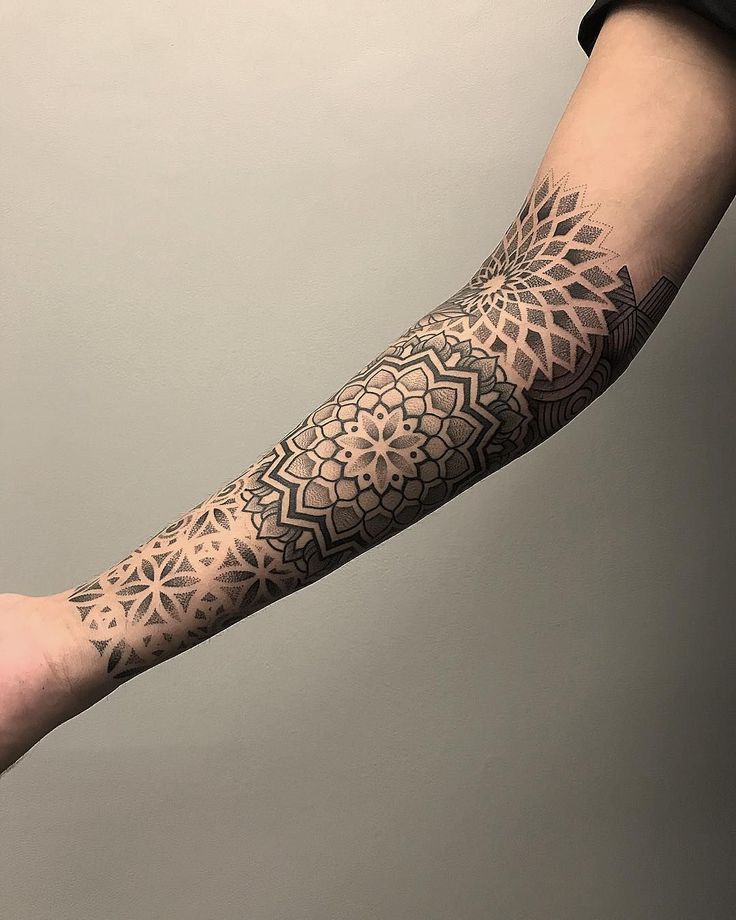
Dotwork builds an image entirely from individual ink dots instead of continuous lines, creating gradients and texture through dot density rather than shading. A mandala — a circular, symmetrical pattern — done in dotwork on the forearm creates a soft, almost embroidered texture that’s genuinely different from anything linework can achieve. This takes real patience from the artist, so expect longer sessions. Best placed centered on the outer forearm where the circular symmetry has room to breathe, typically 3 to 5 inches in diameter. Healing takes 3 to 4 weeks since dense dotwork stresses more skin surface. Request a stencil trial before the session so you can check the mandala sits straight against your arm’s natural curve. Pain tends to run higher than fine line because of the repetitive needle contact. This one’s a strong pick if you want something that feels more like art than a symbol.
Minimalist Single-Line Script
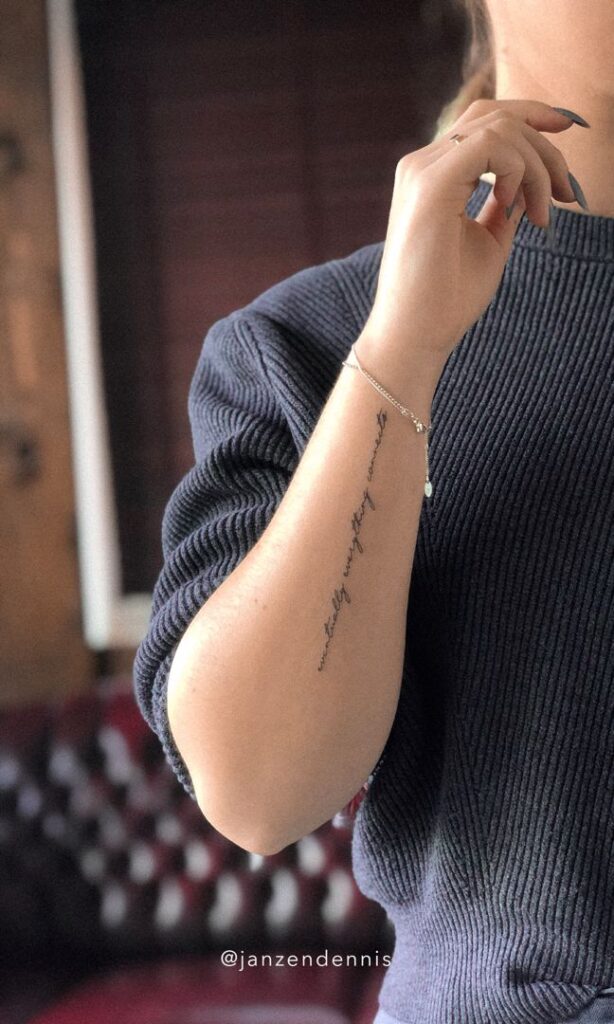
Single-line script tattoos use one continuous, unbroken line to spell out a word or short phrase, often in a handwriting-style font. There’s no shading, no color, just clean linework at a consistent thin weight. Placed along the inner forearm running toward the wrist, this style stays legible even at small sizes — around 3 to 6 inches long. Skin with visible texture or scarring can slightly distort thin script, so mention any skin concerns during your consultation. Healing is quick, usually under 2 weeks, since there’s minimal ink saturation. A useful tip: ask your artist to write the phrase by hand first so the spacing looks natural rather than digitally perfect. Pain is lower here compared to shaded work, making it a solid first-tattoo option. It’s also popular for matching tattoos between friends or family members.
Watercolor-Style Wildflower Bouquet
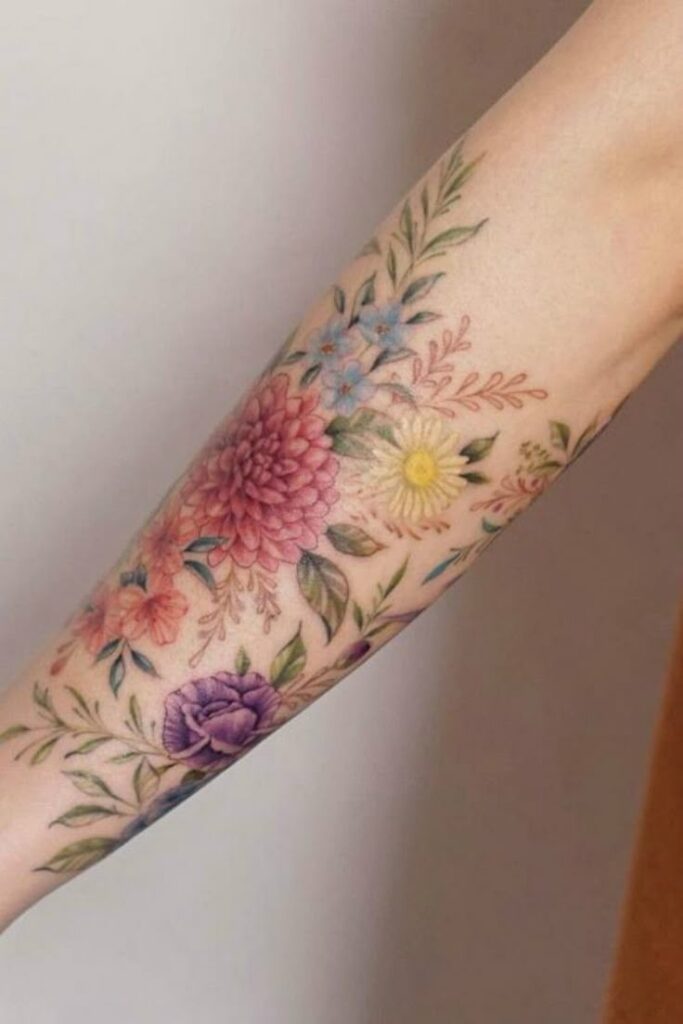
Watercolor tattoos mimic paint bleeding on paper, using soft color gradients without hard black outlines. A wildflower bouquet in this style might blend soft pinks, purples, and greens with intentionally uneven edges. This is a harder technique to execute well since the color needs to fade convincingly rather than looking like a smudge. Best placed on the outer forearm with 5 to 7 inches of space to let the color blend properly. Healing takes 3 weeks, and color-heavy work often needs a touch-up within the first year as pigment settles. Look specifically for a portfolio with healed photos, not just fresh ink, since watercolor can fade unevenly if the artist lacks experience. Pain is moderate. This isn’t the best choice for a first tattoo if you’re worried about upkeep, since color retention varies more than black ink.
Negative Space Moon Phases
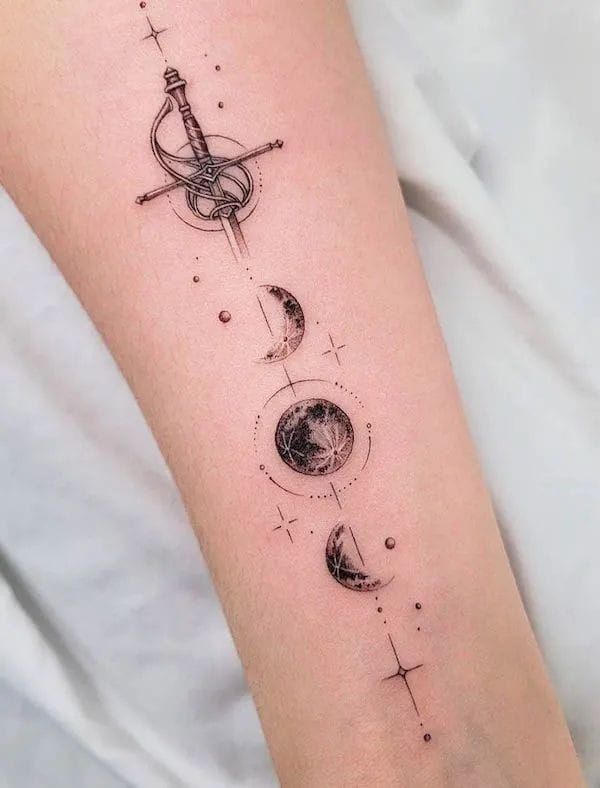
This design uses the moon’s phases — new, crescent, half, full — as a horizontal row of small linework circles, where negative space (the un-inked skin) forms the lit portion of each moon against a solid dark background. It’s a clever use of contrast that reads clearly even from a distance. Best placed as a horizontal band across the outer forearm, sized 4 to 6 inches wide. Healing runs about 2 to 3 weeks. When briefing your artist, specify how many phases you want and whether you want the moons evenly spaced or clustered toward one end. Pain is moderate given the solid black fill sections. This design works well as a symbolic piece — tracking a personal cycle, a pregnancy, or simply an aesthetic preference for lunar imagery. It also holds up nicely over time since the bold contrast doesn’t rely on fine detail to stay legible.
Fine-Line Portrait Miniature
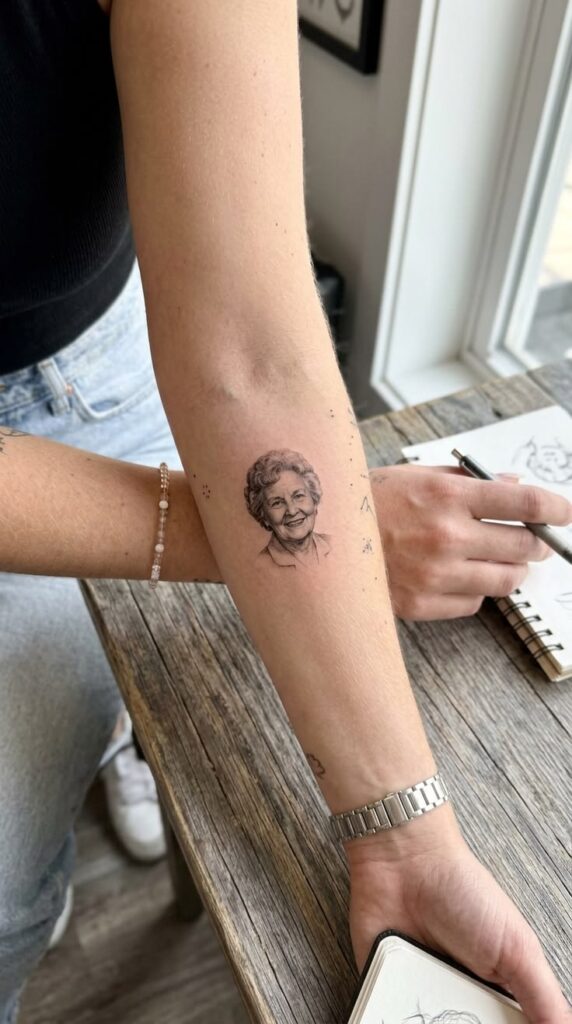
A small-scale portrait — a pet, a person, or even a self-portrait styled minimally — uses fine-line technique with subtle single-needle shading to suggest depth without heavy black fill. This is genuinely one of the harder styles to pull off small, since facial features need precise proportion. Keep it at least 3 inches tall; anything smaller risks losing detail as it heals and settles. Place it on the outer forearm where skin is flattest for the artist to work accurately. Healing takes about 3 weeks. Bring multiple reference photos from different angles, not just one flattering shot, so the artist has enough information to work from. Pain is moderate. This is not a great first-tattoo pick if you’re nervous about mistakes, since portrait work has less room for artist error than abstract designs.
Geometric Line Forearm Band
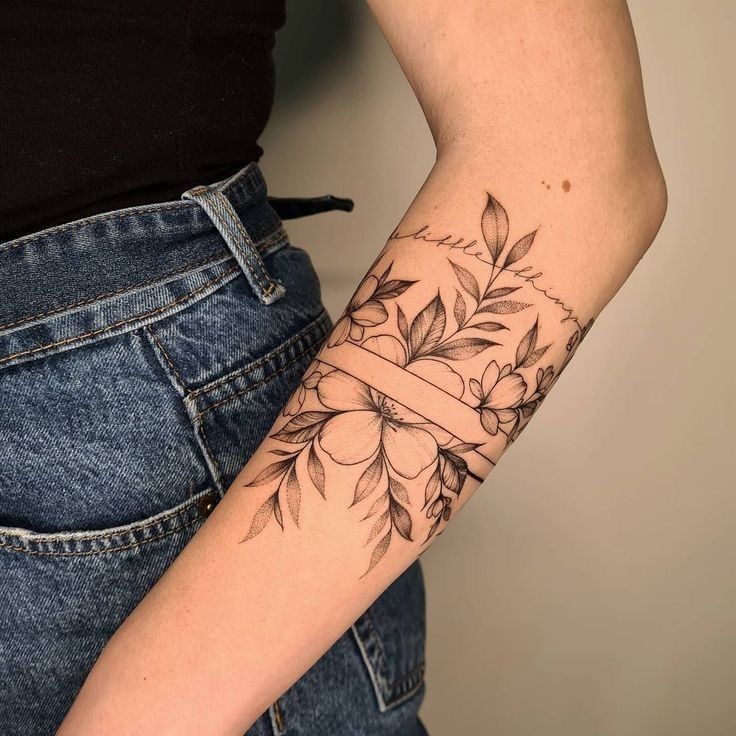
A geometric band wraps thin, straight, and angled lines around the forearm in a repeating pattern — think triangles, hexagons, or interlocking shapes. The appeal here is precision: every angle needs to line up, which is why an artist with a steady hand and possibly a ruler-guided stencil matters more than usual. Placed as a continuous band around the mid-forearm, typically 2 to 4 inches wide. Healing is quick, around 2 weeks, since the design uses thin uniform lines without heavy shading. Ask your artist to test the stencil while your arm is both straight and bent, since geometric patterns can look slightly off if they’re not adjusted for your arm’s resting position. Pain is on the lower end. This one works particularly well for workplace settings since a long sleeve fully conceals it.
Single-Needle Constellation Map
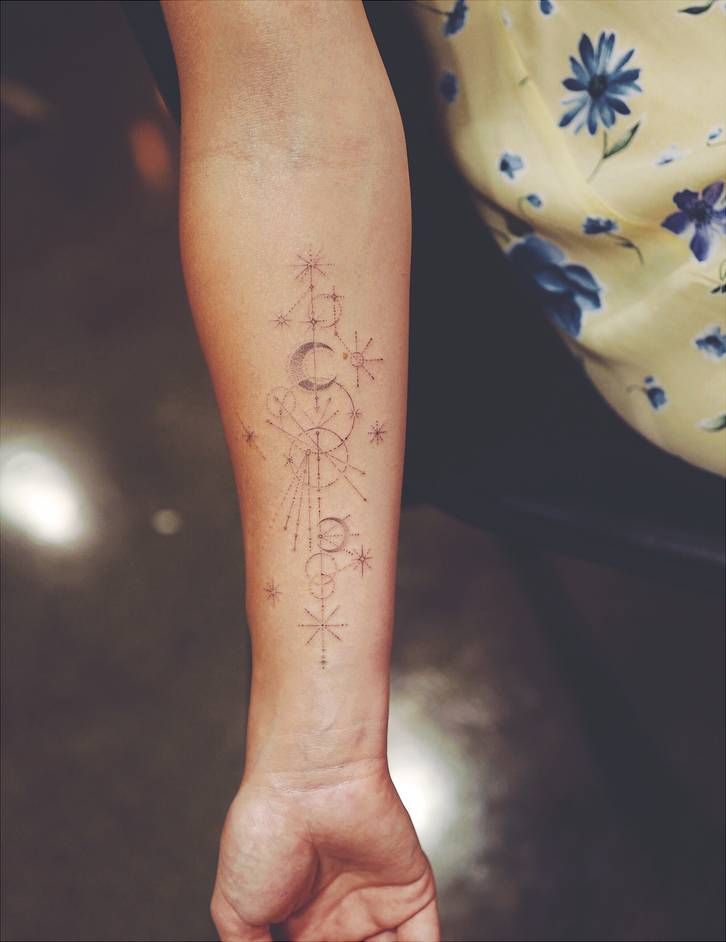
Using an actual single needle (rather than a grouped needle cluster) allows for extremely thin, precise dots and lines — ideal for recreating a specific constellation or star map from a meaningful date. The dots representing stars stay small and sharp, connected by faint straight lines. Best placed on the inner forearm where the subtlety suits a more private, meaningful tattoo. Size can be compact, around 3 to 5 inches. Healing takes about 2 weeks given the minimal ink saturation. Bring the exact date and location so your artist can generate an accurate star chart rather than guessing at a generic pattern. Pain is lower than most styles on this list since the needle barely breaks the surface repeatedly. This is a strong choice if you want deep personal meaning without visual boldness.
Bold Traditional Rose
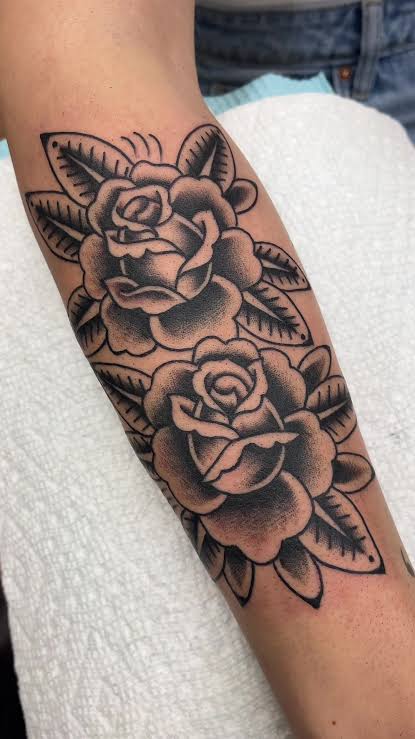
Unlike the fine-line florals above, a bold traditional rose uses thick black outlines, solid color fill (usually red or deep pink), and minimal fine detail — a style rooted in old American traditional tattooing. The bold lines mean this design ages noticeably better over decades since thick lines blur less than fine ones as skin changes. Best placed on the outer forearm with at least 4 to 6 inches of space for the rose and its leaves. Healing takes 3 weeks due to heavier ink saturation. When briefing your artist, ask about their traditional flash portfolio specifically, since this style has its own visual rules that differ from fine-line florals. Pain runs moderate to high because of the solid color work. This is a solid pick if you want something that visibly reads as “tattoo” from across a room rather than something subtle.
Sacred Geometry Linework
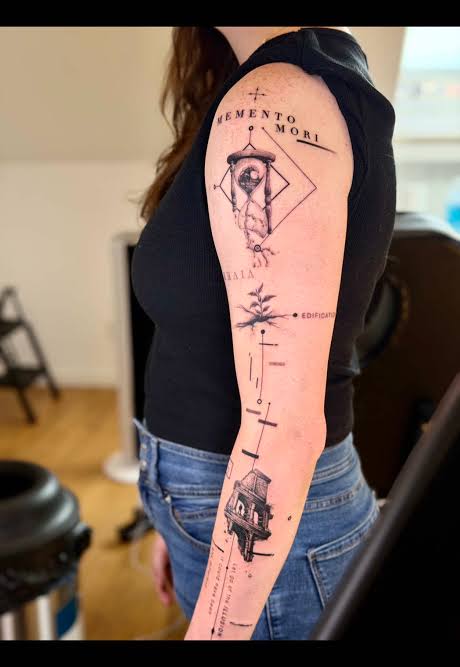
Sacred geometry designs use precise, symmetrical shapes — like overlapping circles or interlocking polygons — often based on patterns found in nature or mathematics. The linework stays thin and uniform, similar to fine-line technique, but the composition relies heavily on exact symmetry rather than organic curves. Placement works well centered on the outer forearm, sized 4 to 6 inches so the pattern has room to stay crisp. Healing takes about 2 to 3 weeks. A practical tip: ask to see the stencil applied and step back to check symmetry before the needle touches your skin, since even small measurement errors are obvious in geometric work. Pain is moderate. This design suits people drawn to symbolism and mathematical precision rather than florals or realism, and it ages well since there’s no shading to fade unevenly.
Nature Landscape Fine Line
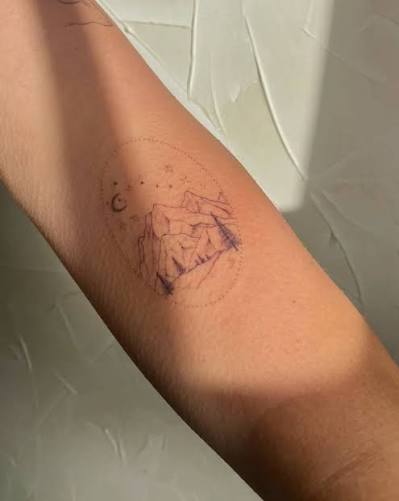
A tiny mountain range, forest line, or horizon scene rendered in fine-line technique creates a quiet, scenic tattoo that reads almost like a pencil sketch. Shading, if used at all, stays minimal — mostly achieved through line density rather than solid black fill. Best placed running horizontally along the outer forearm, sized 3 to 5 inches wide to keep the scene legible without overcrowding detail. Healing runs about 2 weeks. Bring a specific photo of the actual location if it’s personal, like a mountain you hiked or a hometown skyline, so the artist can simplify it accurately rather than guessing at proportions. Pain is on the lower side given the thin, minimal shading. This design works especially well as a first tattoo since it’s subtle, meaningful, and easy to keep small.
Script Quote in Cursive
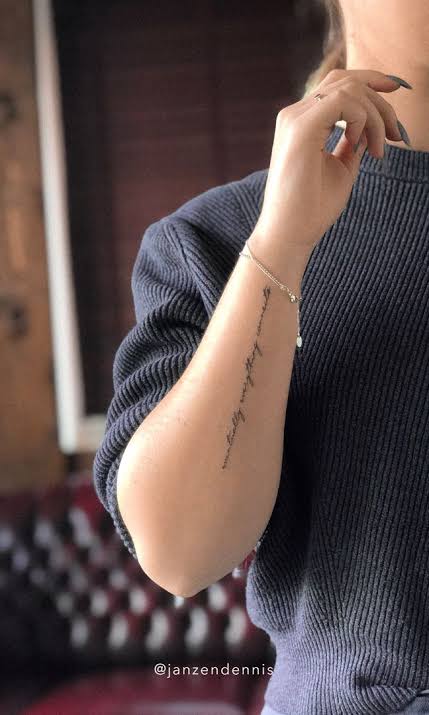
A short quote or word in cursive script uses varying line weight — thicker on downstrokes, thinner on upstrokes — to mimic handwriting rather than typed text. This is different from single-line script because it has intentional weight variation for a more calligraphic look. Best placed running along the forearm from wrist toward elbow, keeping it under 6 inches to maintain legibility. Healing takes about 2 weeks. Ask your artist to show you a few font options mocked up on your actual skin tone and arm shape before committing, since script that looks great on paper doesn’t always translate directly to a curved surface. Pain is lower to moderate. This is one of the most requested matching-tattoo styles for friend groups, since a shared word or phrase feels personal without needing identical imagery.
Animal Silhouette Blackwork
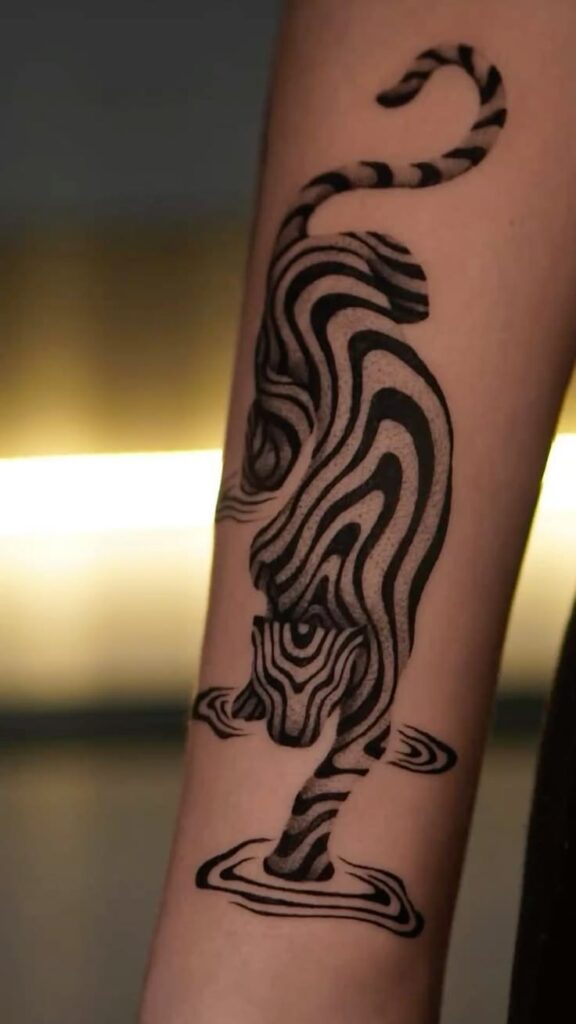
A solid black silhouette — a bird in flight, a fox, a wolf — uses no internal detail at all, relying entirely on the outline shape to communicate the animal. This is blackwork at its simplest, and that simplicity is exactly the appeal: it reads instantly and ages better than detailed work since there’s no fine linework to blur over time. Best placed on the outer forearm, sized 3 to 5 inches so the silhouette stays recognizable. Healing takes about 2 to 3 weeks given the solid ink fill. Bring a clean, high-contrast reference image so the artist can trace an accurate outline rather than reconstructing details from a blurry photo. Pain is moderate due to the shading time on solid black areas. This design works well for people wanting bold symbolism without much visual complexity.
Abstract Brushstroke Design
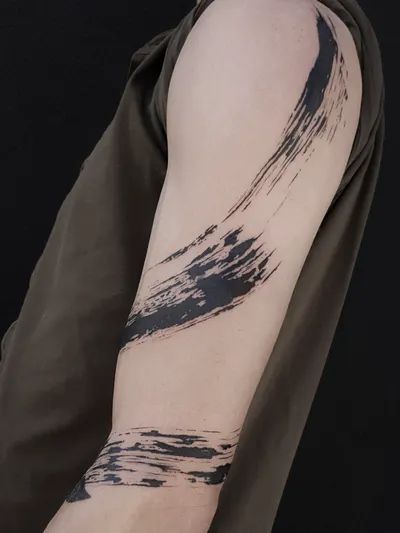
This style mimics the look of a paintbrush stroke — thick in the middle, tapering at both ends — using solid black ink with deliberately uneven edges to look hand-painted rather than machine-precise. It’s a departure from rigid linework and reads as more artistic and modern. Best placed diagonally across the outer forearm, sized 4 to 7 inches to let the brushstroke’s natural taper show. Healing takes about 2 to 3 weeks. A useful tip: ask your artist to freehand the final stencil rather than using a rigid digital print, since the whole point is organic imperfection. Pain is moderate. This works well for someone who wants a tattoo that feels artistic and open to interpretation rather than symbolic or literal.
Matching Symbol Set
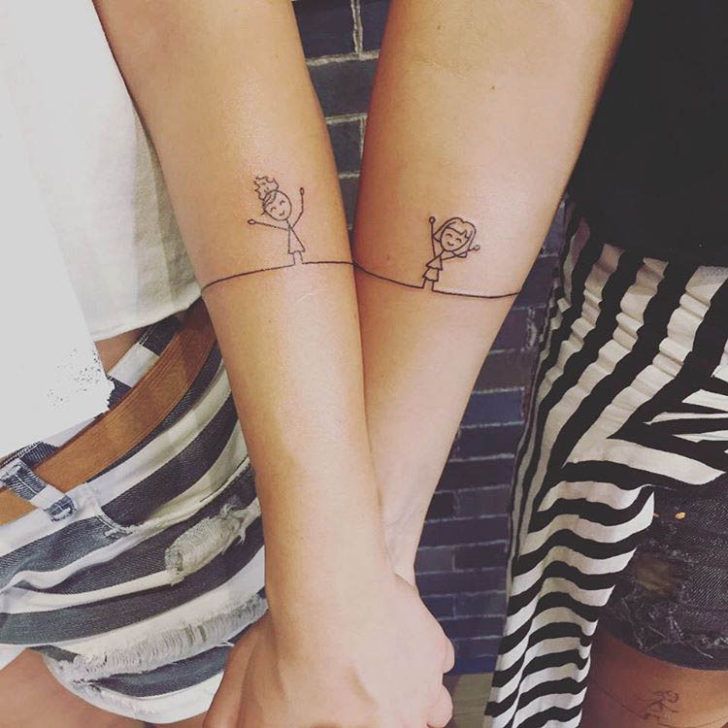
Small, simple icons — stars, hearts, initials, tiny shapes — placed in a cluster or scattered along the forearm work particularly well for matching tattoos between friends, sisters, or partners. Each icon is usually done in fine-line or single-needle technique, kept under an inch each, with no shading. Best placed on the inner forearm near the wrist for a subtle, easy-to-conceal cluster. Healing takes about 2 weeks given the minimal ink used. When booking, confirm with your group whether you’re doing walk-in flash designs or a custom arrangement, since pricing and wait times differ significantly between the two. Pain is on the lower end. This is genuinely one of the easiest “first tattoo” categories since the commitment is small, the cost is lower, and the emotional payoff of a shared design is high.
Best Placement Ideas
Where you put a forearm tattoo changes everything from how much it hurts to how often you’ll need to cover it up.
- Outer forearm — most visible, least painful, easiest for the artist to work on flat skin
- Inner forearm — more private, slightly more sensitive due to thinner skin, good for meaningful or subtle pieces
- Wrist-to-elbow placement — best for vertical designs like vines or script, but requires more sessions if the piece is large
- Wrapping the forearm — good for bands or patterns, but check the design in both a bent and straight arm position before finalizing
- Near the elbow crease — generally more sensitive and prone to faster fading due to constant movement; best avoided for fine detail
Tips for Success
Finding the right artist matters more than finding the perfect design idea. Start by looking at an artist’s healed work, not just fresh photos taken right after the session — healed tattoos show you how lines actually settle into skin. Check whether their portfolio leans toward custom design or flash (pre-drawn designs used as-is), since not every artist who’s great at bold traditional work will be equally skilled at fine-line detail. During your consultation, ask direct questions: what needle configuration will they use, how many sessions they expect, and what your realistic touch-up timeline looks like. A good consultation should feel collaborative, not rushed.
Common Mistakes and How to Avoid Them
A lot of regret comes from a handful of repeatable errors, not bad luck.
- Going too small for detailed work — fine-line portraits or dense botanical scenes lose clarity if sized under 3 inches
- Ignoring placement geometry — a design meant for a flat surface can distort badly if placed over a joint or curve without adjustment
- Skipping aftercare instructions — this is one of the biggest factors in how clean a tattoo heals
- Copying a design exactly from an image online — personalizing even small elements avoids the “stock tattoo” look and respects the original artist’s work
- Choosing an artist based on price alone — a cheaper session often costs more later in corrective work
Similar Variations
Nearly every idea on this list can shift dramatically with a few small changes. A fine-line floral vine can be recolored with soft watercolor washes for a completely different mood. A blackwork silhouette can shrink down to wrist size for a subtler statement or scale up to a full sleeve panel for more visual weight. Script can switch from cursive to a bold block-letter traditional style for a completely different tone. Even matching symbol sets can be personalized per person while keeping one shared unifying element, like the same line weight or a repeated shape.
Fine Line vs. Blackwork vs. Dotwork
Fine line — thin, single-needle or small-needle-grouping technique producing delicate, low-saturation linework with minimal shading; ages softly over time and suits detailed, subtle designs.
Blackwork — solid black ink fill with sharp edges and no shading gradient; relies on negative space for detail and tends to hold up well over decades due to high ink saturation.
Dotwork — built entirely from individual dots to create texture and gradient without continuous lines; takes longer to complete and often reads as more delicate and textured than blackwork.
Aftercare Basics
Every artist should send you home with a specific aftercare sheet, and that sheet should always take priority over generic advice found online. In general terms, keep the area clean, avoid direct sun exposure while healing, and avoid soaking it in water for the first couple of weeks. Don’t pick at any peeling skin, and avoid tight clothing that rubs against the fresh tattoo. If you notice anything that seems unusual during healing, check with your artist or a licensed dermatologist rather than guessing based on internet forums.
Quick FAQ
How much does a forearm tattoo typically cost?
Cost varies widely by size, detail, and artist experience, but simple fine-line pieces often start in the low hundreds, while larger blackwork or color pieces can run several hundred to over a thousand dollars depending on session length.
How painful is a forearm tattoo?
Pain tolerance is different for everyone, but the forearm is generally considered a lower-to-moderate pain zone compared to bony areas like the ribs or ankle, since it has more muscle and fat padding.
How long does a forearm tattoo take to heal?
Most forearm tattoos heal within 2 to 3 weeks on the surface, though full healing beneath the skin can take longer. Always follow your artist’s specific aftercare instructions.
Will a forearm tattoo fade or need touch-ups?
All tattoos fade gradually over years due to sun exposure and natural skin aging. Bold linework and solid blackwork tend to hold their shape longer than fine, thin lines or color-heavy pieces.
Choosing from these 16 forearm tattoo ideas for women really comes down to how much detail, visibility, and long-term commitment feels right for you. Take your time picking both the design and the artist — a rushed decision on either front is the most common source of regret. Whatever direction you land on, a licensed professional can help translate the idea into something that actually fits your skin, your lifestyle, and the story you want to carry with you.