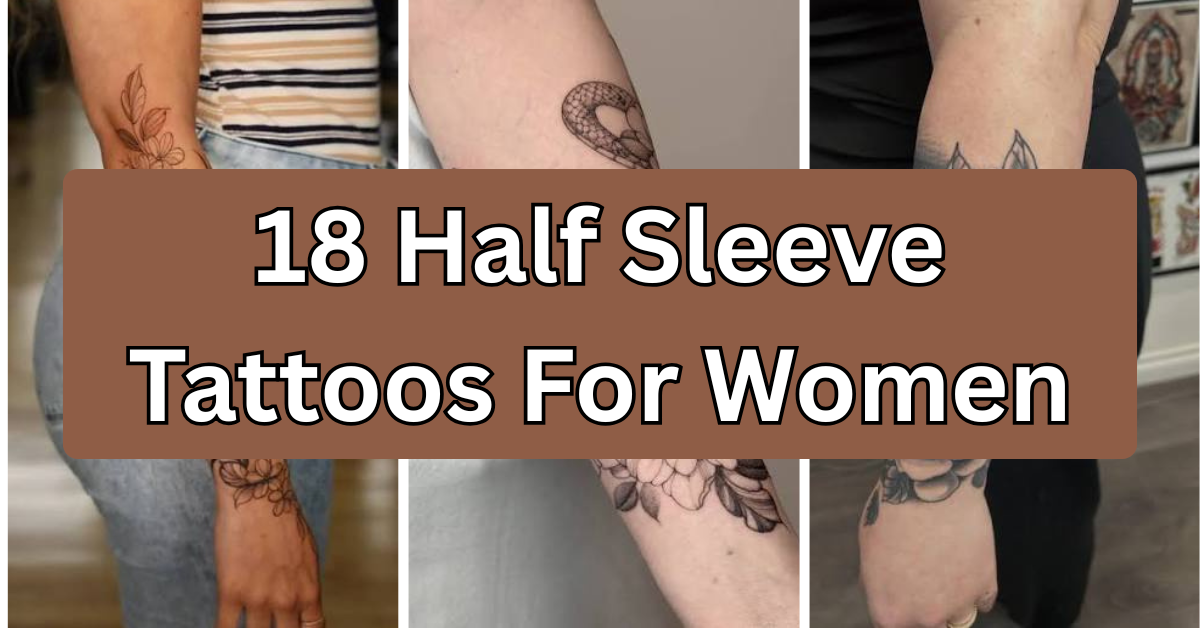
18 Half Sleeve Tattoos For Women
Nervous about committing to a piece of art that’s going to sit on your arm for the rest of your life? That’s a fair worry, and it’s exactly why half sleeve tattoos for women deserve more than a quick scroll through a Pinterest board before you book an appointment.
So what are the best half sleeve tattoos for women? The strongest options are fine-line botanicals, blackwork florals, dotwork mandalas, and neo-traditional wildlife pieces, since they balance detail with skin longevity and cover the bicep-to-elbow or elbow-to-wrist zone without feeling cramped. Composition matters more than the specific image — good negative space and consistent line weight keep the design readable even after a decade of natural fading.
Below, I’m walking through eighteen specific design directions, plus the placement logic, pain expectations, healing timelines, and artist-briefing details that most roundups skip entirely. By the end, you’ll know exactly what to bring to a consultation and what questions to ask before you sit down.
Why Half Sleeve Tattoos Are Having a Moment
A half sleeve gives an artist real room to work — usually the space between the shoulder and elbow, or elbow to wrist — which means a design can breathe instead of getting squeezed into a postage-stamp shape. That extra canvas lets a tattooer use varied line weight, layered shading, and actual negative space (the untattooed skin left intentionally blank to create contrast) instead of cramming everything into solid black. For women specifically, half sleeves have become popular because they’re flexible: you can go bold and cover most of the arm, or leave open skin between elements for a lighter, airier look that still reads as a cohesive piece from a distance.
Before we get into specific designs, it helps to know the difference between a few techniques you’ll see repeated throughout this list:
Fine line — thin, single-pass linework done with a small needle grouping, often 1–3 needles, producing delicate outlines with minimal shading.
Bold traditional — thick, uniform outlines (sometimes called “bold will hold” line weight) paired with flat, saturated color; ages better than fine line but reads heavier on the skin.
Blackwork — solid black fill or heavy patterning used to create graphic, high-contrast shapes; relies on negative space for detail.
Dotwork — shading and texture built entirely from small dots instead of solid lines, giving a soft, stippled gradient effect.
Single needle — a specific fine-line technique using one needle for extremely thin, almost pencil-like lines; delicate but prone to faster fading if not sized correctly.
Keep these terms in mind as you read — I’ll reference them throughout so you know exactly what to ask your artist for.
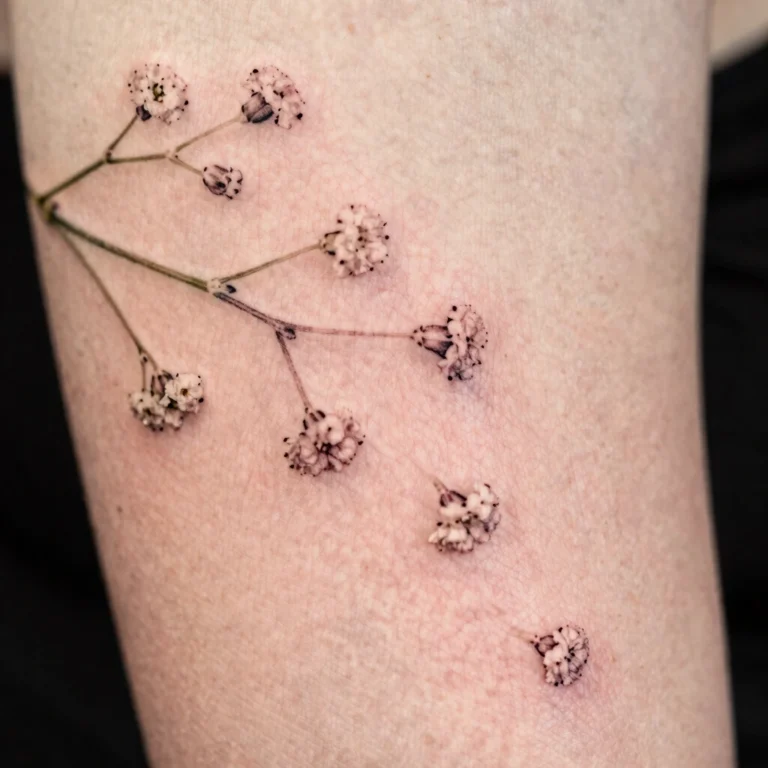
1. Fine-Line Botanical Half Sleeve

This design uses thin, consistent linework to trace stems, leaves, and small blossoms climbing from the elbow toward the shoulder, usually left uncolored or with a faint gray wash for depth. The appeal is subtlety — it reads as elegant rather than heavy, and the open negative space between branches keeps the whole arm from feeling cluttered. Best placed on the outer forearm and upper arm where skin is relatively flat, since fine lines can blur on curved or bony areas over time. Expect a healing period of two to three weeks. Bring reference photos of specific plants you like (not just “florals”) so your artist can sketch something custom instead of pulling a generic stencil. Pain is generally moderate, with the inner elbow crease being the most sensitive spot in this composition. It’s a solid first-tattoo choice and stays workplace-discreet with a long sleeve. From here, adding color takes this in a completely different direction.
2. Blackwork Floral Half Sleeve
Where the fine-line version stays airy, blackwork florals go bold — solid black petals, thick stems, and heavy contrast with almost no shading gradient. The visual weight comes from negative space rather than fine detail; the untattooed skin between flowers does the work that shading would in a softer style. This holds up remarkably well over decades since solid black saturation fades more slowly than thin gray-wash lines. Ideal for the upper arm and shoulder cap, where there’s enough flat surface for large shapes. Healing typically runs three to four weeks because of the denser ink saturation. Ask your artist about “packing” the black solidly in one session versus multiple passes, since patchy saturation is one of the most common blackwork mistakes. Pain tends to run higher here due to sustained needle time on the same area. This style suits people who want a statement piece rather than something quiet. Dotwork brings a softer version of this same boldness.
3. Dotwork Mandala Half Sleeve

Dotwork builds shading and pattern entirely from small, individually placed dots rather than solid lines, creating a soft, almost textile-like gradient. A mandala half sleeve typically centers a large circular pattern on the upper arm or elbow, radiating outward with smaller geometric motifs. It’s incredibly detailed but also one of the more time-intensive styles to tattoo, often requiring multiple sessions. Best suited to flatter areas like the outer bicep, since curved surfaces can distort the symmetry of the pattern. Healing takes three to four weeks, and touch-ups are common since fine dot spacing can lose crispness faster than bold linework. Bring a symmetrical reference image and ask specifically for “dotwork shading,” not just “black and gray,” so your artist knows the technique you want. Expect noticeable discomfort — the repetitive dot pattern on bony areas like the elbow can be more taxing than continuous linework. This design works beautifully for symbolic or spiritual meaning. Geometric line work offers a cleaner, more minimal alternative.
4. Geometric Line Half Sleeve
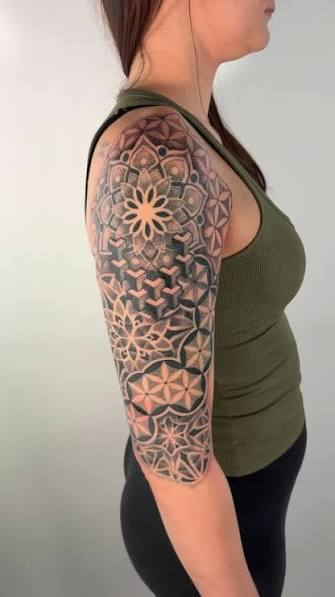
This design relies on precise, uniform linework arranged into triangles, hexagons, or interlocking shapes, sometimes wrapping the arm in a continuous pattern. Line weight needs to stay consistent throughout, since geometric work shows imperfect symmetry more obviously than organic florals do. Placement on the forearm works well because the natural curve can actually enhance the geometry rather than distort it. Size should be planned in one sitting with your artist using a wrapped paper stencil — geometric patterns are hard to “wing” freehand. Healing runs about two weeks since there’s minimal shading to protect. Pain is moderate to high on the wrist-facing side of the forearm, where skin sits closer to bone. This style ages exceptionally well because thick, deliberate lines hold their shape for years. It suits people who want something modern and clean rather than decorative. From sharp geometry, we move to something intentionally left unfinished-looking.
5. Negative Space Floral Half Sleeve
Instead of filling in every petal, this approach uses the natural skin tone as part of the design — the flower’s outline is tattooed in black, but the interior is left blank, letting your skin do double duty as the “color.” It’s a striking technique because the contrast between solid black outline and bare skin creates visual pop without heavy shading. This works best on lighter to medium skin tones, where the contrast reads clearly; on deeper skin tones, an artist may need to adjust line thickness to maintain visibility. Best placed on the upper arm where there’s room for the design to stand alone rather than overlapping with other elements. Healing takes about two weeks. Ask your artist to show you healed photos of negative space work specifically, since it looks different immediately after tattooing versus once fully settled. Pain is moderate. This is a great low-commitment entry into blackwork before going bolder. Neo-traditional designs bring color into the mix next.
6. Neo-Traditional Wildlife Half Sleeve
Neo-traditional combines the bold outlines of classic American traditional tattoos with more realistic shading and a wider color palette — think a fox, owl, or wolf rendered with thick black contour lines and rich, saturated color fills. The shading here uses smooth gradients rather than flat color blocks, giving depth without going fully photorealistic. This style needs real space, so the upper arm and shoulder are ideal; cramming it onto the forearm alone often loses detail. Expect three to four weeks of healing, with color pieces sometimes needing a touch-up session after initial fading settles around the six-month mark. Bring multiple reference images of the animal from different angles so your artist can build a custom pose instead of copying one photo directly. Pain runs moderate to high given the shading time involved. This works well as a meaningful, symbolic centerpiece for a sleeve. Japanese-inspired work offers a related but distinct visual language.
7. Japanese-Inspired Half Sleeve
Traditional Japanese tattooing (irezumi) uses bold outlines, flowing composition, and motifs like koi, cherry blossoms, or waves arranged to follow the natural shape of the arm rather than sitting in isolated boxes. Background elements — wind bars, cloud shapes — connect the whole piece into one continuous scene instead of separate images. This requires an artist experienced specifically in this style, since composition and flow matter as much as the individual motifs. Best done as a full half sleeve rather than a partial piece, since the visual language depends on continuous movement up the arm. Healing takes three to four weeks due to color and shading density. Ask to see an artist’s portfolio of full sleeves, not just single flash pieces, to judge whether they can handle large-scale composition. Pain is moderate to high across multiple sessions. This suits people ready for a bigger commitment, both in time and cost. Sketch-style tattoos offer a more casual, illustrative alternative.
8. Sketch-Style Half Sleeve
This technique deliberately mimics pencil or pen sketch marks — visible crosshatching, slightly irregular line weight, and an unfinished, hand-drawn quality that reads as artistic rather than polished. It’s a distinct look from clean traditional work because the “imperfection” is the point. Works well on the outer forearm where the sketch lines have room to spread naturally. Because the linework is intentionally varied, healing can look a little uneven at first before settling around two to three weeks. Bring examples of actual pencil sketches or line art (not photographs) so your artist understands the aesthetic you’re after — this is a common miscommunication point. Pain is moderate, similar to standard fine-line work. This suits people who want something that feels more like wearable art than a traditional tattoo motif. It’s also a strong choice for a first tattoo since it’s forgiving of minor asymmetry. Celestial themes take this illustrative feel in a different direction.
9. Celestial and Astrology Half Sleeve
Moons, stars, constellations, and zodiac symbols get combined here using a mix of fine line for star maps and small dotwork clusters for shading nebulas or shadow effects. The composition typically flows from shoulder to elbow, using open negative space to represent “night sky” rather than filling every inch. Best placed on the upper arm where the curve mimics the natural arc of a horizon line, giving the design a more dynamic feel. Healing takes about two to three weeks given the mix of fine line and light dot shading. Ask your artist to plan star placement using your actual birth chart or a specific date if the design has personal meaning — this personalizes what’s otherwise a common motif. Pain is moderate. This works well for meaningful, low-key symbolism that doesn’t scream for attention. It’s popular for matching tattoos between friends or family using different constellations. Ocean-themed work offers similar symbolism with a different visual texture.
10. Ocean Wave Half Sleeve
Wave designs typically use bold blackwork lines for the wave’s crest combined with fine-line detail or light shading for foam texture, sometimes incorporating Japanese-style curling water shapes. The composition usually flows along the natural curve of the forearm or bicep, using the arm’s shape to suggest motion. Best suited to the outer arm where there’s a long, unbroken stretch of skin for the wave to travel across. Healing runs two to three weeks. When briefing your artist, specify whether you want a realistic wave or a stylized, graphic one — these require very different line techniques and it’s a common source of miscommunication. Pain is moderate on fleshier parts of the upper arm, higher near the elbow. This design suits people with a connection to the ocean, surfing, or a specific coastal memory. It ages well since the bold outline holds its shape for years. Abstract blackwork takes a less literal approach to shape and movement.
11. Abstract Blackwork Half Sleeve
This design skips recognizable imagery altogether in favor of flowing black shapes, splatters, or brushstroke-style marks that wrap the arm like a piece of graphic art. The technique relies heavily on saturation control — solid black in some areas, softer gray wash in others — to create depth without any literal subject matter. Works well on any part of the arm since there’s no “correct” orientation the way there is with florals or animals. Healing takes three to four weeks due to the density of solid black sections. Ask your artist to sketch directly on your arm before tattooing (a technique called freehand mapping) so the abstract shapes actually follow your muscle and bone structure. Pain runs moderate to high in heavily saturated areas. This suits people who want a bold visual statement without specific symbolism attached. It also camouflages well over faded older tattoos. Snake and floral combinations bring symbolism back into a similarly bold format.
12. Feminine Snake and Floral Half Sleeve
Snakes wrapped through floral linework are a classic half sleeve motif because the long, curving body naturally follows the arm’s shape from shoulder to wrist. The scales are usually rendered in fine dotwork or small linework, while the surrounding flowers can be left as bold outlines or filled with light color. This contrast — textured snake body against cleaner floral lines — is what gives the piece visual depth. Best placed running along the outer arm where the snake’s length has room to move naturally. Healing takes three weeks given the mixed shading techniques. Bring reference images showing scale texture specifically, since “snake tattoo” alone gives an artist very little to work with. Pain is moderate to high, especially where detailed scale work sits over the elbow. This design carries symbolism around transformation and resilience for many women who choose it. Vintage botanical illustration offers a softer, more antique aesthetic.
13. Vintage Botanical Illustration Half Sleeve
Modeled after old scientific plant illustrations, this style uses fine, slightly varied line weight and minimal shading — sometimes just cross-hatching — to mimic the look of a hand-drawn field guide page. Labels or small script accents are sometimes added in tiny lettering beside each plant. This works best on the forearm, where the flatter surface keeps small text and delicate lines legible. Healing takes about two weeks given the light ink saturation. Bring an actual vintage botanical print as reference rather than a modern floral design — the aesthetic depends on that old-illustration quality. Pain is moderate, similar to other fine-line work. This suits people who want something intellectual and quiet rather than bold. It also works well as smaller matching pieces between family members using different meaningful plants. Mixed media designs combine several of these approaches into one sleeve.
14. Mixed Media Half Sleeve
Rather than sticking to one technique, this design blends fine line, blackwork, and light dotwork shading within the same piece — for example, fine-line flowers next to a solid blackwork moon and dotwork-shaded clouds. Making this work visually requires careful planning so the different textures complement rather than compete with each other. This is best suited to a full shoulder-to-elbow layout, giving each technique its own section rather than overlapping messily. Healing takes three to four weeks since different ink densities heal at slightly different rates. This absolutely requires a custom design consultation rather than a walk-in flash piece, since combining techniques needs an artist who can plan the whole composition upfront. Pain varies by section, generally moderate to high overall. This suits people who’ve collected a few small tattoo ideas and want them unified into one cohesive sleeve. Ornamental filigree work offers a more uniform, pattern-based alternative.
15. Ornamental Lace and Filigree Half Sleeve
This design uses fine, intricate linework to mimic lace or metalwork patterns, often wrapping fully around the arm like a sleeve of fabric. The technique demands extremely consistent line weight since any wobble breaks the illusion of symmetry. Best suited to the forearm, where the design can wrap the full circumference for a cohesive look from any angle. Healing takes two to three weeks. Because symmetry is critical, ask your artist to create a full wraparound stencil and check it from multiple angles on your arm before tattooing begins — this catches spacing issues before they’re permanent. Pain is moderate, running higher on the inner arm where skin is thinner. This design suits people drawn to intricate detail over bold imagery, and it photographs beautifully in both short and long sleeves. It’s a strong choice for a special-occasion or milestone tattoo. Watercolor-style work takes a completely different, painterly approach.
16. Watercolor-Style Half Sleeve
This style mimics the soft bleed and color blending of a watercolor painting, using diluted color saturation and soft edges instead of hard black outlines. It’s a striking effect initially, but it’s worth knowing upfront that watercolor pieces tend to fade faster than solid linework since there’s often no bold outline anchoring the color in place. Best placed on the upper arm where skin is flatter and less prone to friction that can accelerate fading. Healing takes three weeks. Ask your artist directly about their experience with color retention techniques for this style, and expect that a touch-up in a few years is realistic, not just possible. Pain is moderate. This suits people who want something visually soft and artistic, understanding the longer-term maintenance tradeoff. It works well combined with an animal or floral subject anchored by thin black linework underneath.
17. Single-Needle Script and Symbol Half Sleeve
This design pairs extremely thin single-needle linework — meaning literally one needle creates each line — with meaningful words, dates, or small symbols scattered across the arm. The delicate quality is the whole appeal, but it also means this style is the most prone to fading and blurring over time compared to bolder techniques. Best placed on the upper, flatter part of the arm rather than joints, where movement and friction speed up fading. Healing takes about two weeks. Ask specifically what needle size your artist plans to use, since “single needle” can vary slightly between studios. Pain is generally lower here than bolder styles, since the pass is quick and shallow. This suits people who want something quiet and personal, though it may need a touch-up sooner than bolder linework. Combining it with slightly bolder elements, as in our next idea, helps it age more gracefully.
18. Combination Statement Half Sleeve
This final idea isn’t one motif but a strategy: combining two or three of the styles above — say, bold blackwork florals anchored by fine-line detail and a single dotwork-shaded element — into one intentional composition rather than a scattered collection. The key is hierarchy: one technique should lead, with others supporting it, rather than competing for attention. This works across the whole half sleeve, using the natural break points of shoulder, bicep, and elbow to separate sections visually. Healing takes three to four weeks given the varied techniques involved. This absolutely calls for a custom design session with one artist who can plan proportion and flow across the entire arm, rather than piecing together separate flash designs later. Pain varies by section but trends moderate to high overall. This suits people ready for a true signature piece rather than a single quick tattoo, and it’s often built across multiple sessions over months.
Best Placement Ideas
- Upper arm/shoulder cap — least painful, easiest to hide with a t-shirt, best for bold blackwork or large focal pieces.
- Outer forearm — moderate pain, highly visible, ideal for fine-line and geometric designs that benefit from a flatter surface.
- Inner arm/elbow crease — more sensitive due to thinner skin and joint movement, generally avoided for delicate fine-line work.
- Full shoulder-to-elbow wrap — best for composition-heavy designs like Japanese-inspired or mixed media pieces that need room to flow.
- Wrist-adjacent forearm — higher pain due to proximity to bone, good for small accent details rather than large shading.
Tips for Success
Look for an artist whose portfolio shows multiple healed photos, not just fresh ink — healed results tell you far more about how lines and saturation actually hold up. Check that their portfolio consistently shows the specific technique you want; an artist who’s excellent at bold traditional work isn’t automatically skilled at fine line, and vice versa. Bring reference images that show composition and technique, not just subject matter, and be upfront about your pain tolerance and schedule, since a full half sleeve is rarely a one-session tattoo. A solid consultation should include a discussion of stencil placement on your actual arm, sizing relative to your body, and a realistic session count and cost estimate before any needle touches skin.
Common Mistakes and How to Avoid Them
- Sizing too small for the detail level — intricate dotwork or fine line needs enough space to stay legible as it ages; cramming detailed work into a small area causes blurring within a few years.
- Choosing a placement that fights the linework — wraparound patterns need a full-wrap stencil check; flat designs on heavily curved areas can distort.
- Skipping the aftercare instructions — inconsistent care in the first two weeks is one of the most common causes of patchy healing and touch-up need.
- Copying a reference design exactly — a good artist should adapt proportions and flow to your specific arm shape rather than pasting on a stencil built for someone else.
Similar Variations
Nearly every idea above can be resized down to a quarter sleeve, recolored from black-and-gray to muted color, or combined with another technique on this list for a more custom result. A dotwork mandala can shrink to fit just the shoulder cap; a fine-line botanical can expand into a full sleeve by adding vines down the forearm. Think of these eighteen ideas as starting points for a conversation with your artist, not a finished order.
Aftercare Basics
General aftercare typically involves keeping the tattoo clean, moisturized with a fragrance-free product, and protected from sun exposure and soaking (pools, baths) for the first few weeks. Avoid picking at any peeling skin, since this can pull ink out unevenly. Every studio provides a specific aftercare sheet tailored to their products and your skin — always follow that over generic internet advice, and check in with your artist or a dermatologist if you notice anything that seems outside normal healing.
Quick FAQ
How much does a half sleeve tattoo cost?
Costs vary widely by region, artist experience, and design complexity, but most half sleeves range from a few hundred dollars for a simple single-session piece to well over a thousand for detailed, multi-session color work. Always get a direct quote from your artist based on your specific design.
How painful is a half sleeve tattoo?
Pain varies by individual and by placement — fleshier areas like the outer upper arm tend to be more tolerable than bony spots near the elbow or wrist. Session length also affects discomfort, since larger designs mean more continuous needle time.
How long does a half sleeve take to heal?
Most half sleeves take two to four weeks for surface healing, though full color settling and any needed touch-ups can extend that timeline. Individual healing speed varies, so always follow your artist’s specific aftercare guidance.
Will a half sleeve tattoo fade over time?
All tattoos fade gradually with sun exposure and skin aging, but bold linework and solid saturation tend to hold their shape longer than fine, single-needle detail. A touch-up every several years is common and not a sign anything went wrong.
Choosing from these half sleeve tattoos for women really comes down to matching the technique to how you actually want the piece to look in ten years, not just tomorrow. Talk through placement, sizing, and technique honestly with a licensed professional artist, ask to see healed work, and don’t rush a decision that’s meant to last.