15 Sunflower Thigh Tattoo Ideas That Actually Hold Up Over Time
Nervous about picking a sunflower thigh tattoo you’ll still love in ten years? You’re not alone — thigh pieces are a big commitment because of the space they take up, and a design that looks great as a sketch doesn’t always translate well once it’s shaded and healed on skin. I’ve spent enough time hanging around tattoo studios watching consultations to know exactly where sunflower designs tend to succeed and where they quietly fall apart.
So what are the best sunflower thigh tattoo ideas? Fine-line single blooms, blackwork silhouettes, and dotwork-shaded sunflowers work best on the thigh because the flat, fleshy surface handles detailed shading and larger scale better than bony areas. Vine wraps and field-style pieces also age well here since the thigh gives artists room to build depth without cramming linework.
Below, I’ll walk through fifteen specific design directions, plus the placement math, pain expectations, healing timeline, and the exact questions to ask your artist before you sit down for the needle.
Why the Thigh Works So Well for Sunflower Designs
The thigh is one of the most forgiving canvases in tattooing, and that’s not an accident. It’s got a decent layer of fat and muscle, a mostly flat surface, and enough real estate to let a sunflower’s layered petals and detailed center actually breathe. Unlike a wrist or ankle piece where an artist has to compress everything into a tight space, the thigh lets sunflower designs keep their natural proportions — the flower can look like a flower instead of a cramped approximation of one. It’s also easy to keep covered for work environments while still being simple to show off in shorts or a swimsuit when you want to.
Fine-Line Single Sunflower Outline
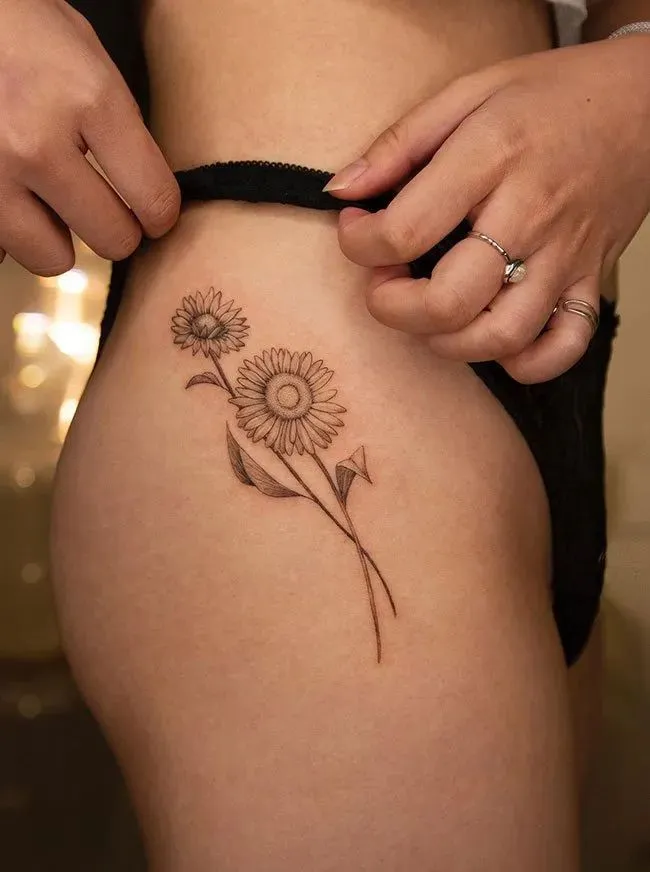
This is the minimalist route — a single sunflower rendered in thin, consistent linework with little to no shading. The artist uses a fine liner needle (usually a 1-3RL configuration) to keep every petal outline crisp and even. There’s no fill, so the design relies entirely on line weight and petal spacing to read clearly. Best placed on the outer or upper thigh at roughly 3-5 inches so the linework doesn’t blur together over time. Skin with visible texture or stretch marks can distort thin lines slightly, so ask your artist about line thickness adjustments during the consult. Pain is moderate here since the outer thigh has more padding than most spots. This design suits first-timers and workplace settings well, and it ages cleanly since there’s minimal ink saturation to fade unevenly.
Bold Traditional Sunflower with Bee
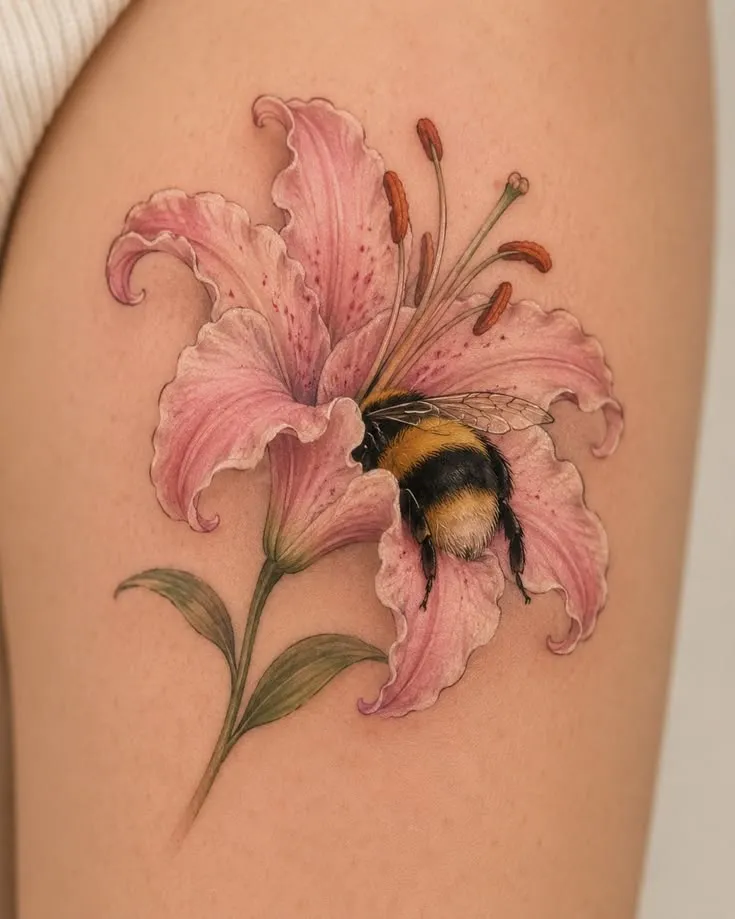
Bold traditional leans on thick black outlines, solid color fill, and a limited palette — usually yellow, orange, and green with black shading for depth. Adding a bee brings movement and a little visual storytelling without cluttering the composition. This style needs more surface area, so plan on 4-6 inches placed on the upper outer thigh where the skin is flattest. The solid color fill holds up better on flatter skin, so mention any scarring or looser skin in that area during your consultation. Pain tends to run moderate to high during the color-packing stage, since repeated passes over the same area increase sensitivity. This is a strong choice for anyone who wants a design that stays legible and bold-looking even after a decade, since traditional linework is built to resist blurring.
Blackwork Sunflower Silhouette
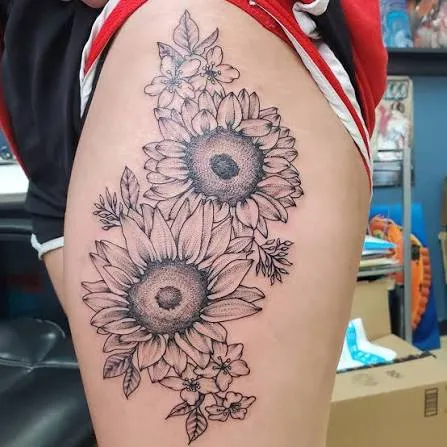
Blackwork uses solid black ink with no color at all, relying on negative space (the untouched skin left visible within the design) to create the petal shapes and texture. It’s a graphic, high-contrast look that reads more like a bold silhouette than a botanical illustration. This works well on the front or side of the thigh at 4-7 inches, since the larger scale lets the negative space pockets stay visible instead of closing up into a blob. Ask your artist to show you saturation examples from their portfolio — solid black work that isn’t packed evenly can look patchy once healed. Pain is on the higher end because of the dense ink coverage. It’s a great option if you want something bold but don’t want the upkeep that color pieces sometimes need.
Dotwork Shaded Sunflower
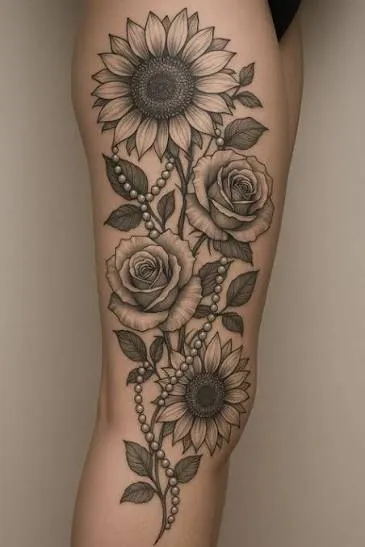
Dotwork builds shading and texture entirely from small individual dots instead of solid lines or blocks of color. It takes longer in the chair, but it creates a soft, almost stippled gradient effect that solid shading can’t replicate. This technique shines on a sunflower’s center disk, where the texture of the seed pattern can be built dot by dot for a realistic look. Place it on the front thigh at 4-6 inches so the dot gradient has room to transition smoothly. Bring high-resolution reference photos of sunflower centers specifically — this is where most of the technical work happens. Pain is moderate but the session tends to run long, which adds up over time. Dotwork ages gracefully since the dots fade more evenly than solid shading blocks.
Watercolor-Style Sunflower Splash
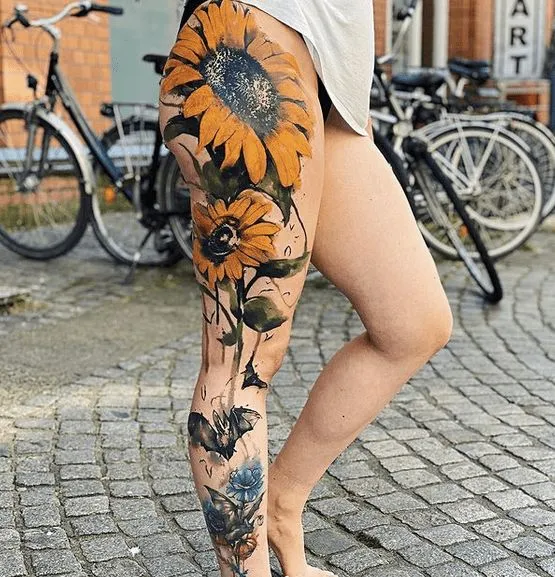
This design mimics loose watercolor painting with soft color bleeds around a more defined sunflower outline, usually black or dark brown. The “splash” areas use lighter saturation and blended color transitions rather than solid fill. It looks striking fresh but is worth knowing upfront: the softer, lower-saturation areas fade faster than solid work, according to general tattoo industry consensus, so touch-ups are more likely down the line. Best on the outer thigh at 5+ inches to give the color bleed room to spread naturally. Ask your artist directly how they handle long-term fading on watercolor pieces before booking. Pain is moderate. This style suits people who want something artistic and less traditional, but it’s not the best pick if you want a truly low-maintenance tattoo.
Sunflower and Moon Combo
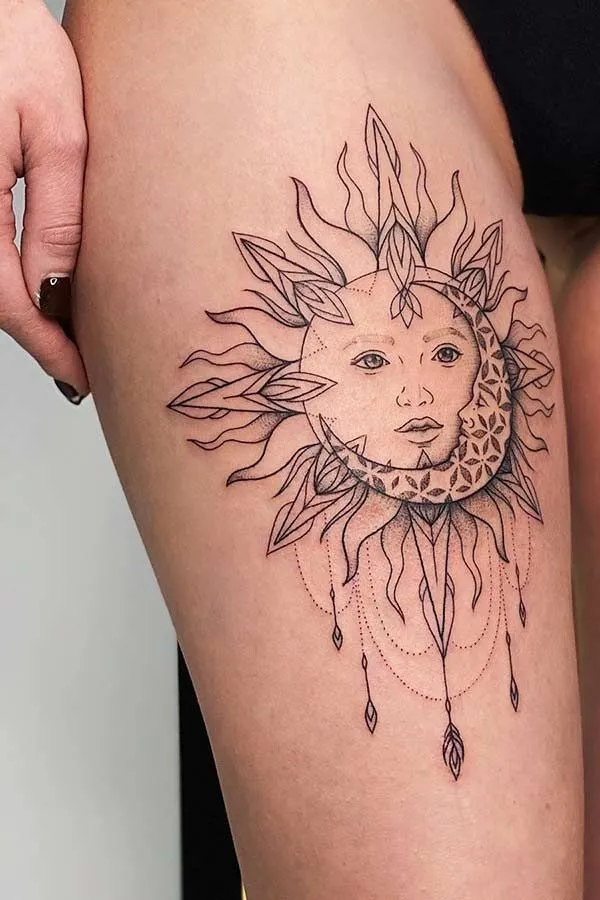
Pairing a sunflower with a crescent or full moon creates a day-meets-night visual contrast that reads as more symbolic than a flower alone. The moon is usually rendered in either fine line or light dotwork shading to keep it from overpowering the flower. This combo works well vertically along the outer thigh, running from hip toward the knee, at about 6-8 inches total. Vertical placement like this elongates the leg visually, which is worth mentioning to your artist if that’s a look you want. Pain stays moderate since you’re mostly on fleshy areas. This pairing is popular for people who want personal meaning attached to the piece — growth, cycles, or resilience — rather than just decoration.
Realistic 3D Sunflower Portrait
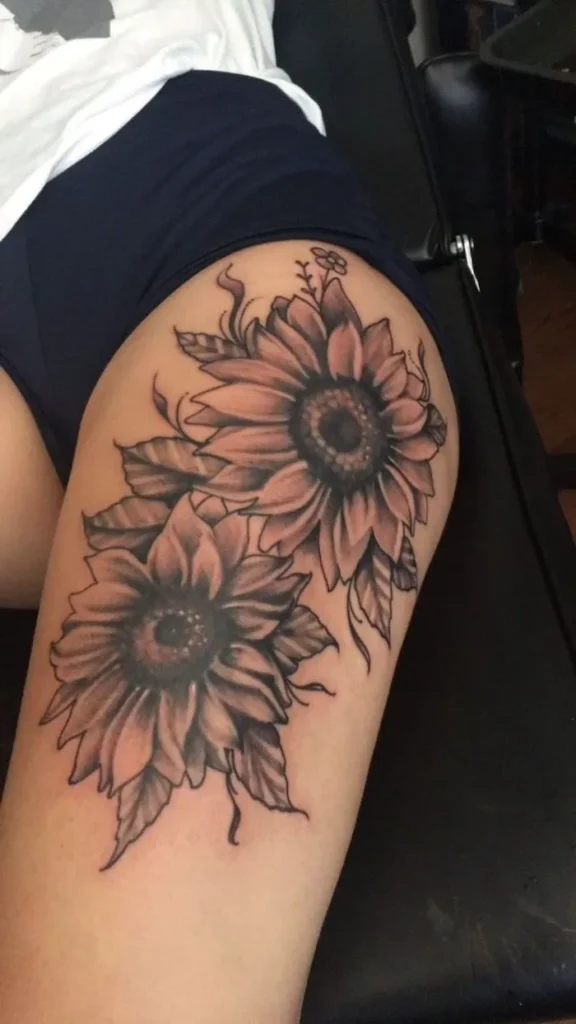
Realism-style sunflowers use heavy shading gradients, sometimes with color, to mimic an actual photograph of a flower — complete with shadow depth and light reflection on the petals. This is the most technically demanding style on this list and requires an artist who specializes specifically in realism work, not just floral flash designs. Needs a bigger canvas, ideally 6+ inches on the front or outer thigh, since detail gets lost at smaller scale. Bring multiple close-up reference photos from different angles, not just one image. Pain runs moderate to high due to longer shading sessions. This is a strong statement piece but requires touch-ups more often than simpler linework as shading softens over the years.
Sunflower Vine Wrap Around Thigh
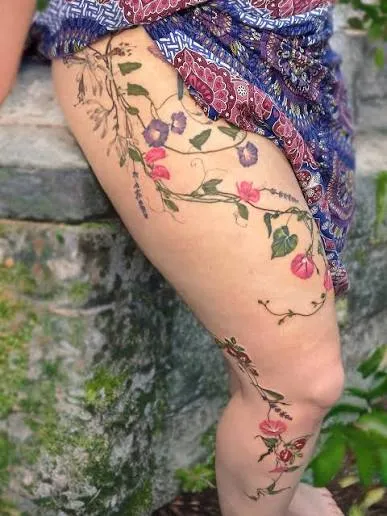
A vine wrap takes a sunflower (or several) and threads it along a curling vine that follows the natural curve of the thigh, sometimes wrapping partially around the leg. This uses the body’s shape as part of the composition instead of fighting against it. Best suited to the outer or front thigh, running 8-12 inches for a full wrap effect. Because it follows body contour, ask your artist to sketch the placement directly on your leg before tattooing so the flow looks natural standing and sitting. Pain increases slightly toward the inner thigh if the wrap extends that far, since that skin is thinner. This design works great as a statement piece and tends to age well since the vine’s linework holds its shape over time.
Negative Space Sunflower
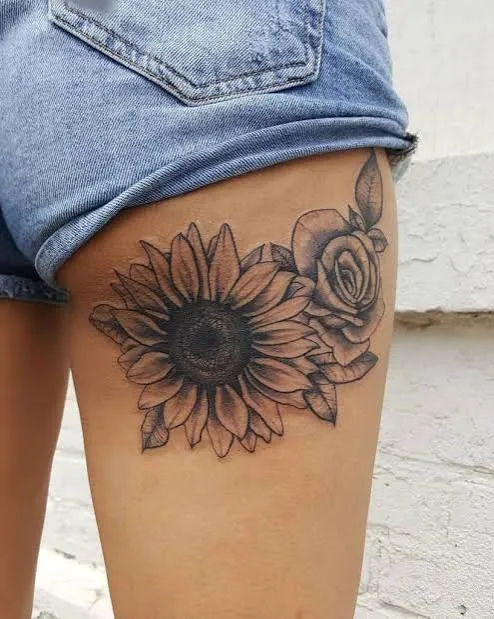
Negative space designs use the untouched natural skin tone to form parts of the image rather than ink. In this case, black or dark shading surrounds the sunflower’s petal shapes, so the flower itself is defined by what’s not inked. This creates a striking, almost illusion-like effect. Works best on lighter skin tones where the contrast between shaded and unshaded areas reads clearly — ask your artist honestly whether your skin tone will show the desired contrast, since this style depends heavily on that. Place on the front thigh at 5+ inches. Pain is moderate to high due to dense surrounding shading. This is a distinctive option for someone who’s already got a few tattoos and wants something more conceptual.
Sunflower Field Thigh Piece
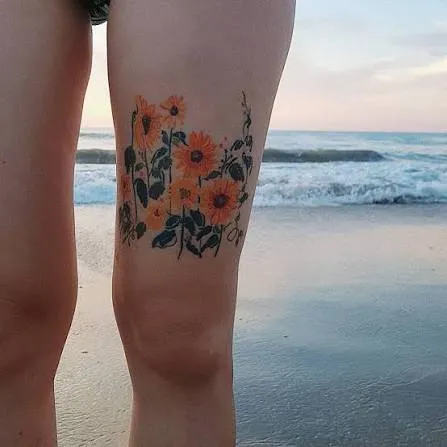
Instead of one flower, this design covers a larger portion of the thigh with a small field of sunflowers at varying sizes and angles, sometimes fading into simple line silhouettes in the background for depth. It’s essentially a landscape scene using the flower as the subject. This needs real space — think 8+ inches — so it’s typically placed running down the outer thigh. Because of the size, sessions are often split into two sittings; ask your artist about their touch-up policy upfront since larger pieces heal in stages. Pain builds as session length increases. This is a strong choice for a first big tattoo if you already know you want a statement piece rather than something small and subtle.
Sunflower with Script Quote

Combining a sunflower with a short line of script text personalizes the design with a word, name, or phrase, usually placed either above or curving beneath the flower. Script needs clean, consistent line weight to stay legible for years, so this is a design where a fine-line specialist matters more than the sunflower itself. Best placed on the upper thigh at 4-6 inches so the text has enough length to stay readable at full size. Bring your quote already finalized and ask the artist to test the font size on paper first — script that’s too small tends to blur within a few years. Pain is moderate. This works well for meaningful, story-driven tattoos rather than purely decorative ones.
Geometric Sunflower Mandala

This design blends a sunflower’s petal structure with mandala-style geometric patterning — symmetrical lines, dots, and shapes radiating outward from the flower’s center. It requires precise linework and often combines fine line technique with dotwork for texture. Symmetry is everything here, so placement on a flat section of the front or outer thigh (5-7 inches) gives the best result since curved areas can distort the pattern. Ask to see the stencil placed and centered before the artist starts — small alignment errors are very noticeable in symmetrical work. Pain is moderate. This suits people drawn to spiritual or meditative symbolism paired with a natural motif.
Small Cluster of Mini Sunflowers
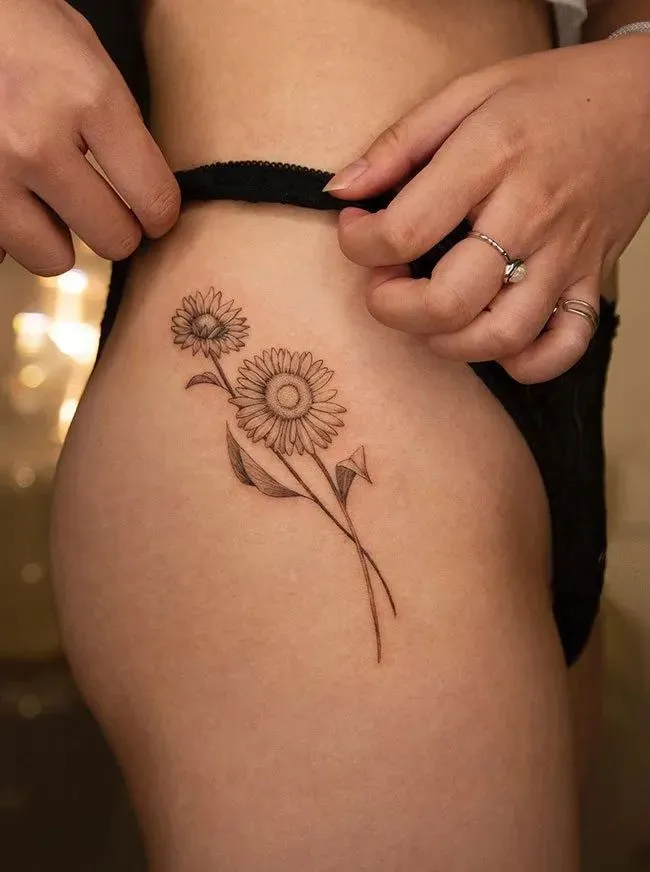
Rather than one large bloom, this groups three to five small sunflowers together, usually in fine line or light dotwork, scattered in a loose cluster. It’s a softer, more casual approach that doesn’t demand the same commitment as a large single piece. Works well on the upper thigh near the hip at just 2-4 inches total. Because the flowers are small, ask specifically about needle size — thinner needles hold small detail better long-term. Pain is lower than most designs on this list since sessions are shorter and less repetitive. This is a solid pick for a first tattoo or for anyone wanting a matching design with a friend or family member.
Sunflower and Sun/Rays Combo
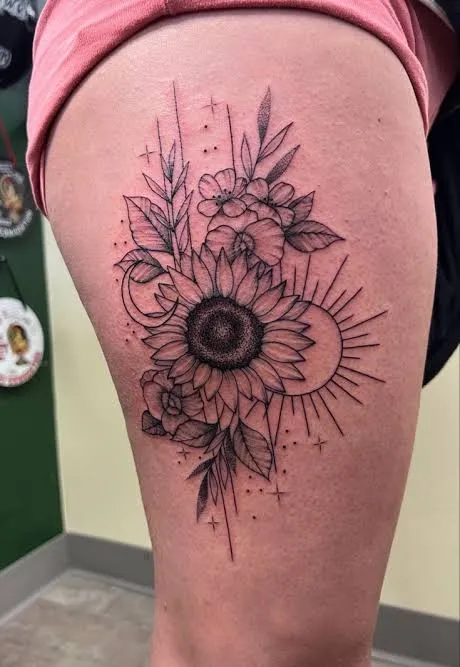
Adding sunburst rays behind or around the sunflower reinforces the “sun” theme and adds visual energy to an otherwise simple bloom. Rays are usually done in fine line or light blackwork, radiating outward in a fairly loose, hand-drawn style rather than perfectly geometric lines. Best on the front thigh at 5-6 inches so the rays have room to spread without feeling cramped. If you want a specific ray pattern, bring a clear reference — vague direction here tends to produce inconsistent spacing. Pain is moderate. This combo works nicely as a bold single-thigh piece for someone who wants more visual impact without adding color.
Chiaroscuro Illustrative Sunflower with Shading
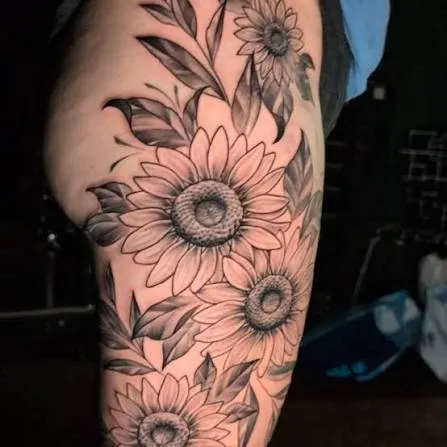
This style borrows from illustrative art, using strong contrast between deep black shading and untouched skin to create dramatic depth — similar to how chiaroscuro painting uses light and shadow. It’s darker and moodier than a standard botanical tattoo. Needs a larger space, around 6-8 inches, placed on the outer or front thigh where shading gradients can transition smoothly. Ask your artist specifically about their shading technique — whether they use a whip shading approach or packed solid black — since this affects both healing time and final texture. Pain runs moderate to high due to shading density. This is a striking option for someone wanting a sunflower design that reads as fine art rather than a typical flash piece.
Best Placement Ideas
- Outer thigh — highly visible when wearing shorts, moderate pain, good for larger detailed pieces
- Front thigh — flattest surface for symmetrical or geometric designs, easy for touch-ups since it’s easy to see and reach
- Upper thigh near hip — easier to conceal for work settings, slightly more sensitive skin
- Inner thigh — most private placement, but generally more painful and harder to keep the area still during tattooing
- Back of thigh — good for larger wrap designs, but harder for the wearer to see and monitor during healing
Tips for Success
Look for an artist whose portfolio specifically shows floral or botanical work, not just their general style. A blackwork specialist and a fine-line specialist approach the same sunflower completely differently, so match the artist to the specific technique you want. During your consultation, ask to see healed photos of past sunflower pieces, not just fresh ink — fresh tattoos always look sharp, but healed results tell you how the linework and shading actually hold up. Bring at least two or three reference images and be upfront about your pain tolerance and available healing time, since some designs require multiple sessions.
Common Mistakes and How to Avoid Them
- Going too small for detailed shading — dotwork and realism need enough space to hold texture; shrinking these designs below 4 inches often causes detail to blur together within a few years
- Placing a symmetrical design over a curved or bony area — geometric and mandala-style sunflowers distort badly on uneven surfaces
- Skipping the aftercare instructions given by your artist — improper care during the first two weeks is one of the most common causes of patchy healing and color loss
- Copying a design exactly without personalizing it — a slightly resized element, added detail, or color adjustment makes the piece genuinely yours and avoids an identical match with someone else’s tattoo
Similar Variations
Almost every design above can be adjusted. A bold traditional sunflower can be scaled down and rendered in fine line for a subtler version. A blackwork silhouette can be recolored into a traditional yellow-and-green palette if you want more warmth. Vine wraps and field pieces can be shortened into a single cluster if a full wrap feels like too much commitment right now. Combining elements — say, a dotwork center with fine-line petals — is also common and lets you customize a flash design (a pre-drawn tattoo template) into something more personal without starting from scratch.
Technique Definitions: Fine Line vs. Blackwork
- Fine line — thin, delicate outlines with minimal or no shading, created using smaller needle groupings; best for subtle, detailed designs that age with less ink spread
- Blackwork — solid black ink applied in bold shapes or dense shading, often using negative space for contrast; best for high-impact, graphic designs that hold up well over time
Aftercare Basics
Keep the tattoo clean and lightly moisturized during the first two weeks, and avoid direct sun exposure, swimming, and tight clothing rubbing against the area while it heals. Most healing timelines run around two to three weeks for the surface to close, though full healing underneath can take longer depending on the design’s size and depth. Always follow the specific aftercare sheet your artist provides, since products and routines can vary by studio, and check in with a licensed professional or dermatologist if you notice unusual redness, swelling, or irritation that doesn’t improve.
Quick FAQ
How much does a sunflower thigh tattoo cost?
Costs vary widely by size, detail, and artist experience, but expect anywhere from $150 for a small single-session piece to $800 or more for a large, detailed design requiring multiple sittings.
How painful is a thigh tattoo?
Pain tolerance varies by individual, but the outer and front thigh are generally considered less sensitive than the inner thigh due to the amount of muscle and fat padding in the area.
How long does healing take?
Surface healing typically takes two to three weeks, though this depends on design size and individual skin, so always follow your artist’s specific aftercare guidance.
Will the design fade over time?
All tattoos fade gradually with sun exposure and skin aging, but solid linework and blackwork tend to hold their shape longer than soft color gradients like watercolor styles.
Final Thoughts
Choosing the right sunflower thigh tattoo really comes down to matching the design’s technical demands with a placement that can support it — and being honest with yourself about pain tolerance, healing time, and long-term upkeep. The thigh gives you room to go bold or keep things minimal, but the best results always come from a design chosen with real thought, not just a quick scroll through inspiration photos.
Take your time picking an artist whose portfolio actually matches the style you want, ask the questions that matter before you sit down, and trust that a well-planned sunflower thigh tattoo can genuinely be something you’re proud to wear for the rest of your life.