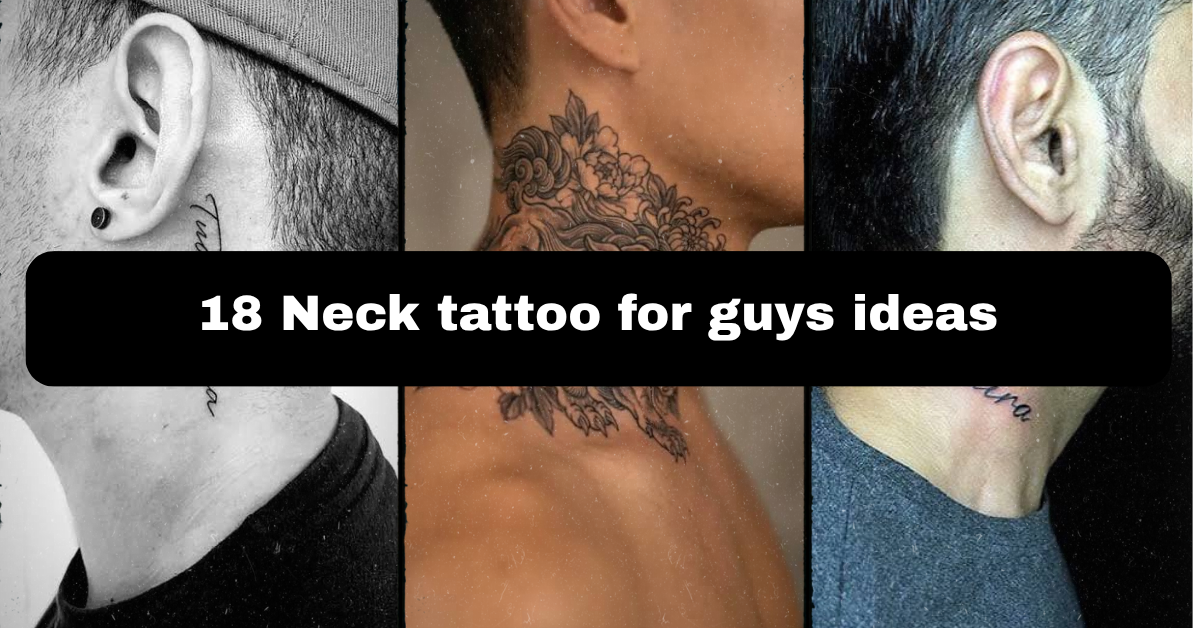
18 Neck Tattoo Ideas for Guys That Actually Hold Up Over Time
Nervous about picking a neck tattoo design you’ll regret in five years? You’re not alone. The neck is one of the most visible, most permanent-feeling spots on the body, and getting it wrong isn’t just a style mistake — it’s something you’ll see every time you look in the mirror.
So what are the best neck tattoo ideas for guys? Fine-line lettering, blackwork bands, small dotwork symbols, and bold traditional pieces top the list because they scale well to the neck’s curved, thin skin and hold their shape as they age. Placement matters just as much as the design itself.
Stick around, because I’m going to walk you through placement tradeoffs, realistic pain levels, what these designs cost, how to brief your artist so you don’t end up with a stencil that looks nothing like what you wanted, and the mistakes that trip up almost every first-timer.
Why Neck Tattoos Work Differently Than Everywhere Else on Your Body
The neck isn’t like your arm or your calf. The skin here is thinner, it moves constantly when you talk, swallow, or turn your head, and it’s got less fat underneath to cushion the needle. That changes how a design should be built. A style that looks great on a thigh — heavy shading, lots of fine gradients — can blur or migrate on the neck over time because the skin stretches differently. That’s why the strongest neck tattoos usually lean on clean linework, solid blackwork, or well-placed dotwork rather than photorealistic shading. I’ve watched artists turn down neck requests that were “too busy” for the space, and honestly, that’s good advice. Simpler geometry survives here. Let’s get into the specific designs that actually work.
Fine-Line Script Lettering Along the Side Neck
Fine-line script uses a thin, consistent needle line — usually a single needle or a small liner — to create lettering that looks handwritten rather than stamped. No shading, no bold fill, just clean strokes that follow the curve of the neck from behind the ear down toward the collarbone. This works best in a 2 to 5 inch strip along the side of the neck, avoiding the front throat area where skin moves the most during swallowing.
Bring your artist a printed reference of the exact font or handwriting style you want, not just a screenshot of someone else’s finished tattoo. Side-neck placement stings, since it’s close to bone and cartilage, but it’s more tolerable than the front. This spot is easy to cover with a collar for work, and it ages well because there’s no shading to blur — just crisp line weight that stays sharp for years with a touch-up every so often.
Blackwork Tribal-Inspired Bands
Blackwork means solid black ink packed in tight, with no gradient or shading — just bold, saturated shapes. A tribal-inspired band wraps partially or fully around the side or back of the neck, using geometric curves and sharp points instead of traditional shading transitions. The visual impact comes from contrast: solid black against bare skin, with negative space (the untattooed skin left visible) doing a lot of the design work.
This suits guys who want something bold without lettering or imagery. Size can range from a 1-inch accent to a full wraparound band, though full wraps take multiple sessions. Skin tone matters less here than with colored ink, since black holds saturation well across most tones. Expect more discomfort than fine-line work because the artist is packing more ink into the same area. It’s a strong option for a first tattoo if you want visual weight without committing to a story-driven piece.
Small Dotwork Geometric Symbol Behind the Ear
Dotwork builds an image using thousands of tiny dots instead of solid lines or fill, which creates a soft, textured look even in geometric designs. A small dotwork symbol — a triangle, a simple mandala fragment, or an abstract shape — works well tucked behind the ear where it stays mostly hidden but peeks out with certain haircuts.
Keep it under 1.5 inches; dotwork loses definition if it’s too small, since the dots need room to form a pattern the eye can read. Ask your artist whether they use a single needle or a specialized dotwork machine, since technique affects how crisp the final piece looks. This spot is notably sensitive — thin skin, close to bone — so expect a sharper sensation than most neck placements. It’s a great low-visibility option for workplaces with strict appearance policies, and it transitions into a longer sleeve down the neck later if you want to expand.
Bold Traditional Skull on the Side Neck
Traditional tattooing uses thick, confident outlines, limited color palettes (often black, red, and yellow), and bold shading blocks rather than fine gradients. A traditional skull design on the side neck leans into that heritage style — thick black linework defining the shape, solid shading for depth, and minimal fine detail so it reads clearly even from a distance.
This design needs real size to work, generally 3 inches or larger, because traditional linework loses its punch when shrunk down too far. Side neck placement, from jaw to collarbone, gives enough flat space for the design to sit properly. Pain runs moderate to high given the bone proximity and the amount of shading involved. This isn’t the most subtle choice — it’s visible in most collars — so it suits guys who are comfortable with visible ink at work or who work in less conservative environments.
Nape Lettering for a Hidden Statement
The nape — the back of the neck, right where a haircut fades in — is one of the most private tattoo spots on the body. A short phrase, a name, or a single word in fine-line script sits naturally along this curve. Because hair typically covers it, this placement gives you a meaningful tattoo without daily visibility.
Keep lettering to one or two lines and under 4 inches wide so it doesn’t stretch onto the sides of the neck where skin behaves differently. Bring a written mock-up showing letter spacing, since curved surfaces distort straight-line text if the stencil isn’t adjusted properly. Pain here is moderate — it’s fleshier than the side neck but still close to the spine. This is a popular choice for guys who want a personal tattoo that only shows up with short haircuts or pulled-back hair.
Single-Needle Portrait Micro-Tattoo
Single-needle work uses the smallest available needle to create extremely thin, delicate lines — thinner than standard fine-line — which allows for tiny, detailed portraits or faces at a small scale. On the neck, this usually means a coin-sized or smaller portrait placed along the side or just below the ear.
This is a technically demanding style, so portfolio-checking matters more here than with any other design on this list. Look specifically for healed photos of single-needle portrait work, not just fresh ink, since single-needle detail can fade or blur faster than bolder linework as skin ages. Discomfort is high in concentrated bursts given the needle’s precision and the bony areas involved. This isn’t the best first-tattoo choice — it’s better suited to someone who already understands healing and touch-up realities.
Negative Space Geometric Pattern
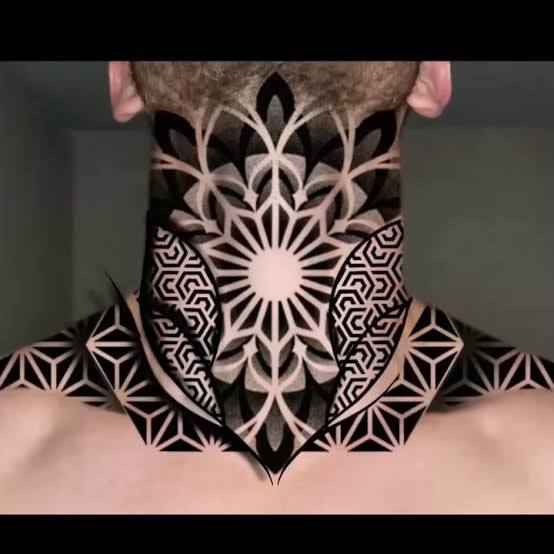
Negative space design flips the usual approach — instead of ink forming the image, the untattooed skin forms part of the picture, while surrounding blackwork defines the shape. On the neck, this often looks like a solid black patch with a geometric shape, like a diamond or triangle, left bare inside it.
This works well as a 2 to 3 inch accent on the side neck. The key technical challenge is contrast: your artist needs strong, even blackwork surrounding the negative space, or the “gap” won’t read clearly once healed. Ask to see the artist’s line-edge work up close — clean edges are what make negative space pop instead of looking like an unfinished patch. Pain is comparable to standard blackwork. This design suits guys who want something visually striking and modern without lettering, imagery, or a literal symbol.
Religious Cross in Solid Blackwork
A blackwork cross keeps things simple: solid black fill, straight or subtly tapered lines, and no shading gradient. Placed along the side neck or just below the ear, a cross in this style reads clearly at any size, which is part of why it’s stayed a popular choice across generations of tattoo clients.
A 2 to 3 inch cross gives enough room for slight detail, like a thin outline or small accent lines, without needing shading. Ask your artist about line weight specifically — thicker lines age better on the neck since fine lines can soften faster in areas with more movement and sun exposure. Pain sits in the moderate range. This design works for nearly any context, including conservative workplaces, if placed on the nape rather than the visible side.
Minimalist Symbol or Icon
Minimalist tattoos strip a concept down to its simplest visual form — a single mountain outline, a small arrow, a basic wave — using consistent thin-to-medium line weight and zero shading. On the neck, a minimalist icon works best small, generally under 2 inches, placed behind the ear or along the upper side neck.
The actionable tip here: bring a simplified black-and-white sketch, not a photo. Minimalist design lives or dies on the artist correctly interpreting which lines matter and which can be cut. Pain is moderate given the placement options typically chosen for this style. This is one of the most beginner-friendly designs on the list — low commitment, quick healing, and easy to explain if someone asks about it at work.
Bold Blackwork Animal on the Throat
Throat placement (the front-center area) is the most visible and, generally, the most sensitive part of the neck to tattoo, due to thin skin and constant movement. A bold blackwork animal — a panther head, a wolf silhouette — uses thick outlines and solid black fill to stay legible despite the skin’s movement.
This needs real size, usually 3 inches or more, and a simplified design since throat skin doesn’t hold fine detail as well as flatter areas. Expect higher discomfort here than almost anywhere else on this list. This is a serious commitment — one of the most visible tattoo placements on the entire body — so it suits guys who are fully comfortable with permanent, highly visible ink and have thought through how it affects professional settings.
Small Symbol Behind the Ear
This spot deserves its own mention beyond the dotwork example above, because it works with almost any style — fine line, small blackwork, or single needle. A small anchor, star, or initial behind the ear stays under 1 inch typically, since the area itself is small and curved.
Ask your artist about stencil placement before the needle touches skin; behind-the-ear curves distort designs more than flat skin, so a proper stencil fitting session matters. Pain runs moderate to high due to cartilage proximity. This is one of the most work-friendly neck placements available, since most hairstyles and collars cover it completely.
Bold Japanese-Style Wave Motif
Traditional Japanese tattooing (sometimes called Irezumi-influenced work) uses bold outlines, structured shading blocks, and flowing composition lines to depict waves, wind, or water. A wave motif along the side neck uses this same structured approach — thick defining lines with directional shading to suggest movement.
This design needs space, ideally 3 to 5 inches, to let the flowing lines actually read as waves rather than abstract shapes. Bring reference images specifically labeled Japanese traditional style so your artist understands you want structured shading, not photorealistic water. Pain is moderate to high given the shading involved. This suits guys who already have or plan to build a larger Japanese-style piece extending onto the chest or shoulder.
Chain-Link or Jewelry-Style Linework
This design mimics the look of a necklace or chain sitting against the skin, using consistent-width linework — usually fine to medium — that wraps horizontally across the front-lower neck or collarbone line. It’s a clever concept because it uses the neck’s natural horizontal lines to its advantage.
Keep the design following your neck’s natural curve rather than a rigid straight line; ask your artist to trace a temporary stencil while you’re sitting upright so the placement looks natural once your head returns to a normal position. Pain in this front-lower zone is moderate. This design reads as subtle and stylish rather than heavy, making it approachable for a first tattoo.
Small Constellation on the Nape
A cluster of small dots connected by thin lines, representing stars, works beautifully on the nape because the design doesn’t need much width — just enough curve to suggest a night sky fragment. This combines dotwork for the “stars” with fine-line work for the connecting lines.
Stick to a 2 to 3 inch cluster. Ask your artist whether they’re using true dotwork stippling or simple small dots made with a liner — the texture differs slightly, and it’s worth knowing which technique you’re getting. Pain is moderate on the nape. This is a meaningful but private option, great for guys who want personal symbolism (a birth date’s star pattern, for example) without visibility.
Side Neck Rose in Blackwork
A blackwork rose skips traditional red-and-green coloring in favor of solid black petals and stem, defined through line weight variation and selective solid fill rather than color saturation. This creates a graphic, high-contrast look that ages differently than colored tattoos — black holds its saturation longer than most colored ink as skin changes over the years.
A rose needs at least 2.5 to 3 inches to keep petal detail readable. Ask your artist how they’ll handle line weight on the petal edges, since thinner lines here can blur faster given the neck’s movement. Pain is moderate to high depending on exact placement. This design works well as a standalone piece or as an anchor point for a larger side-neck composition added later.
Fine-Line Compass or Arrow
A simple compass or arrow, rendered in fine-line work with minimal or no shading, symbolizes direction or a personal journey without needing text. This sits well on the side neck or just below the ear at a small scale, generally 1.5 to 2.5 inches.
The practical tip: request a “test stencil” placement and take a photo before committing, especially on curved neck skin where symmetry is easy to get wrong. Pain is moderate. This is a solid first-tattoo option — simple, symbolic, and easy to build around later if you want to add more pieces nearby.
Bold Name or Date Lettering
Unlike fine-line script, this uses thicker, blockier lettering — sometimes with a slight drop shadow or bold serif style — for a name, date, or short word that’s meant to be seen, not hidden. This typically sits on the side neck at 2 to 4 inches wide.
Bold lettering holds up better over time than thin script in high-movement areas, since thicker lines resist blurring longer. Bring a printed mock-up in the exact size you want tattooed, since bold lettering that looks right on paper can look oversized or cramped once wrapped around neck skin. Pain is moderate to high. This is a highly visible choice, so it’s worth thinking through workplace visibility before booking.
Full Side-Neck Bold Blackwork Piece
This is the biggest commitment on the list: a large-scale blackwork design — often combining a central image with pattern or geometric fill — that covers most of the side neck from jaw to collarbone. It typically takes multiple sessions given the size and the amount of solid black fill required.
Because of the size, this almost always requires a custom design rather than a walk-in flash tattoo (a pre-drawn design pulled straight from a shop’s book). Discuss session count and total cost upfront, since large blackwork pieces cost significantly more than the smaller designs above. Pain across multiple sessions adds up, and healing time between sessions matters. This suits guys who already have neck or chest tattoos and want to connect existing pieces into one larger composition.
Best Placement Ideas
- Nape (back of neck): Lowest visibility, easiest to hide with hair, moderate pain, good for lettering and small symbols.
- Behind the ear: Very low visibility, higher pain due to cartilage, best for small designs under 1.5 inches.
- Side neck (jaw to collarbone): High visibility, moderate to high pain, works for most styles including bold blackwork and traditional.
- Front/throat: Highest visibility, highest general discomfort reported by clients, best reserved for guys fully committed to visible ink.
- Lower neck/collarbone edge: Moderate visibility (easy to cover with certain collars), moderate pain, good for horizontal designs like chain-link linework.
Definition List: Know Your Techniques Before You Book
Fine line vs. bold traditional — Fine line uses thin, delicate needle work with little to no shading, producing a soft, minimal look. Bold traditional uses thick outlines and solid color or shading blocks, producing a graphic, high-contrast look that tends to hold its shape longer on skin that moves a lot, like the neck.
Blackwork vs. dotwork — Blackwork relies on solid, saturated black fill and clean linework with no gradient. Dotwork builds shading and texture using clusters of small dots instead of solid fill, creating a softer, more textured visual even in black-only designs.
Single needle vs. standard fine line — Single needle uses the thinnest possible needle configuration for extremely delicate detail, often used in micro-portraits. Standard fine line uses a slightly thicker needle grouping, offering more durability over time with a similar minimal aesthetic.
Tips for Success
Look for an artist whose portfolio shows multiple healed photos of neck tattoos specifically, not just fresh ink — healed results tell you how their linework and shading actually hold up. Ask about their experience with your chosen technique by name (blackwork, dotwork, fine line) rather than just showing a picture and asking “can you do this.” Bring reference images, but also bring a clear idea of your non-negotiables: size, placement, and how visible you want it day-to-day. A good consultation includes discussion of stencil placement, sizing on your specific neck shape, and realistic session count for larger designs.
Common Mistakes and How to Avoid Them
- Going too small for detailed styles. Dotwork and portrait work need enough space for the technique to read clearly — shrinking them too far causes the design to blur together.
- Picking bold designs for delicate placements, or vice versa. A thick traditional piece looks out of place squeezed into a spot meant for fine-line work, and fine details struggle in high-movement zones.
- Skipping the aftercare instructions. Neck skin moves constantly, which makes proper aftercare more important, not less.
- Copying a design exactly from a photo. A good artist will adjust proportions and line weight to fit your specific neck shape and skin — a direct copy often looks off once it’s actually on your body.
- Not asking about touch-ups upfront. Fine-line and single-needle work in particular may need a touch-up session after the initial healing period.
Similar Variations
Most of these designs scale up or down for a different feel. A small dotwork symbol behind the ear can expand into a larger nape piece. A fine-line compass can be recolored with a single accent tone for subtle contrast, though color holds differently than solid black over time. Bold traditional pieces can be combined with blackwork bands to connect a neck design into a shoulder or chest piece down the road. Chain-link linework pairs naturally with a small pendant-style symbol added later.
Aftercare Basics
General aftercare guidance includes keeping the tattoo clean, avoiding direct sun exposure while healing, and avoiding tight collars or rough fabric rubbing against fresh ink. Healing time varies by individual and by design size, but most neck tattoos move through initial surface healing within a couple of weeks, with full settling taking longer. Always follow the specific aftercare sheet your artist provides, since products and timelines can vary between studios. If you notice anything that seems unusual during healing, check with a licensed dermatologist rather than guessing.
Quick FAQ
How much does a neck tattoo cost?
Cost depends heavily on size, detail, and the artist’s rate, but small designs (behind the ear, small nape pieces) often start in the low hundreds, while larger blackwork or multi-session pieces cost significantly more. Always get a quote during consultation rather than assuming a flat rate.
Do neck tattoos hurt more than other spots?
Many people report the neck as more sensitive than fleshier areas like the outer arm, largely due to thin skin and bone proximity, but pain tolerance varies a lot person to person. Bony areas like the side neck and behind the ear tend to feel more intense than the nape.
How long does healing take?
Surface healing for most neck tattoos generally falls within a couple of weeks, though this varies by individual, design size, and aftercare habits. Full settling under the skin can take longer, and following your artist’s aftercare sheet closely matters here more than on many other body parts.
Will a neck tattoo fade or blur over time?
Bolder linework and solid blackwork tend to hold their shape longer than very fine or delicate line work, especially in a high-movement area like the neck. Touch-ups after the first year or two are common for maintaining sharpness, particularly with fine-line and single-needle designs.
Final Thoughts
A neck tattoo is one of the more visible, more personal decisions you can make with ink, but that doesn’t mean it has to be a gamble. Whether you’re drawn to a quiet nape symbol only you and your barber will see, or a bold side-neck piece that makes a statement every day, the technique, placement, and artist you choose matter just as much as the design itself. Take your time, ask real questions, and check healed portfolio work before you sit in the chair.
At the end of the day, the best neck tattoo for guys is the one that fits your life, your pain tolerance, and your long-term comfort with visibility — not just the coolest reference photo you found at 1 a.m. Talk to a licensed professional, be honest about what you want day-to-day, and you’ll walk out with something that actually holds up on your skin for years to come.