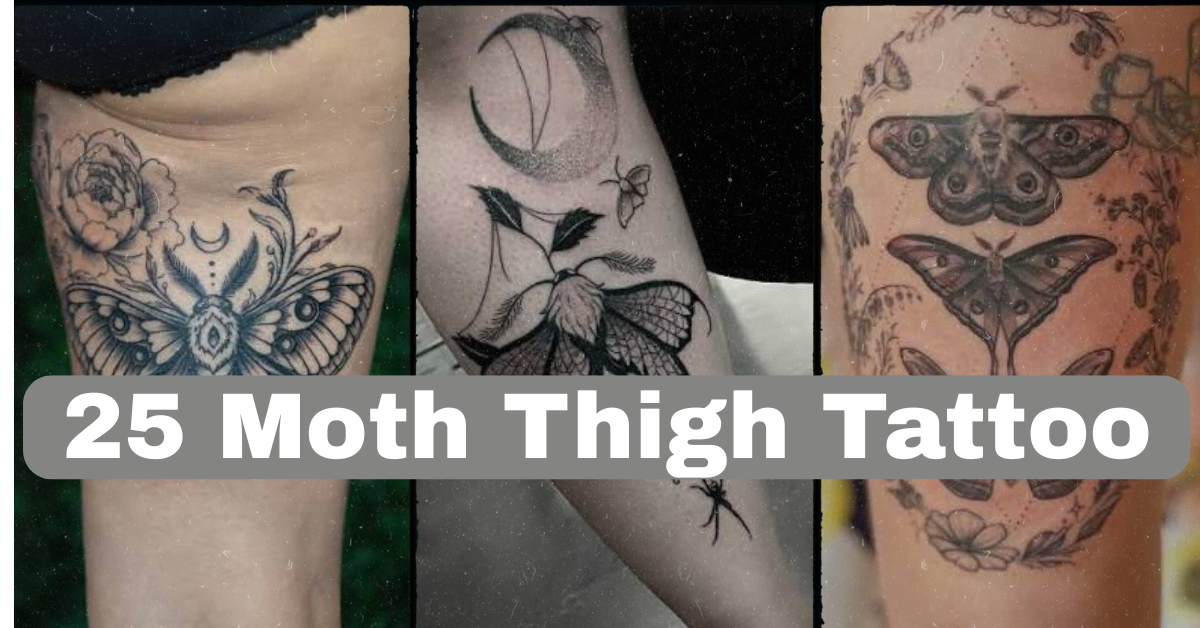
25 Moth Thigh Tattoo Ideas That Actually Hold Up Over Time
Nervous about picking a moth thigh tattoo you’ll still love in five years? You’re not alone, and honestly, that worry is a good sign. It means you’re taking this seriously instead of just screenshotting the first pretty bug you saw on Pinterest. I’ve spent enough time around tattoo studios watching consultations happen to know that the difference between a design you love forever and one you cover up later usually comes down to a few decisions made before the needle ever touches skin.
So what are the best moth thigh tattoo ideas? Fine-line luna moths, blackwork death’s-head moths, and dotwork moth-and-moon combinations work especially well on the thigh, since the flat, roomy skin surface holds detail and shading better than almost anywhere else on the body. Symmetrical wing designs also age more evenly here than on curved or high-movement areas like the ribs or ankle.
Stick around, because I’m going to walk you through 25 distinct moth designs, plus the placement tradeoffs, pain honesty, real cost ranges, and exactly how to brief an artist so you don’t leave the consultation with a design that’s technically fine but not actually yours.
Why Moths Work So Well as a Thigh Tattoo Subject
Moths get overshadowed by butterflies in tattoo culture, which is honestly a shame, because they’re better suited to serious ink work. A moth’s wing pattern is naturally symmetrical, geometric, and full of contrast between light and dark sections, which gives an artist a lot to work with technically, whether that’s fine line, blackwork, or dotwork. They also carry heavier symbolism than butterflies do; moths are drawn to light in darkness, they’re associated with transformation, intuition, and moving through difficult periods rather than just “pretty” seasonal change. And practically speaking, the thigh is one of the best canvases on the body for this kind of design. It’s a large, mostly flat surface with minimal joint movement, which means linework stays crisp and shading doesn’t distort the way it might on a wrist or ankle.
1. Fine-Line Luna Moth Tattoo
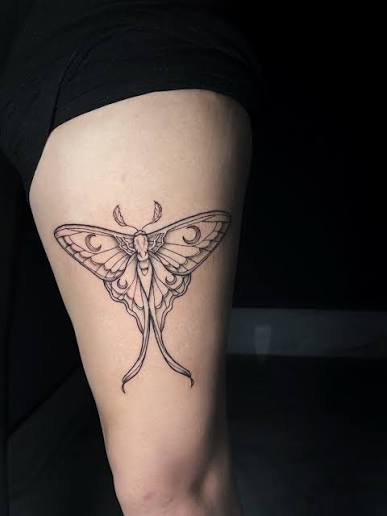
The luna moth is probably the most requested moth design, and for good reason. Its long, trailing wing tails and pale, near-translucent wings translate beautifully into fine line work, where the artist uses a single thin, consistent needle line instead of shading to build the whole image. On the thigh, you’ve got the space to let those wing tails stretch out without cramping the composition. Best placement is the outer or front thigh, sized around 4 to 6 inches so the wing veins stay legible instead of blurring together as the tattoo ages. Pain-wise, the outer thigh is one of the more comfortable spots on the body since there’s more muscle and fat padding over bone. Tip: bring your artist a reference photo of an actual luna moth specimen, not just a cartoon version, so the vein structure reads accurately. This one works well as a first tattoo since the linework is simple to heal and doesn’t demand color touch-ups. Next, let’s look at what happens when you push that same subject into heavier shading.
2. Blackwork Death’s-Head Moth Tattoo
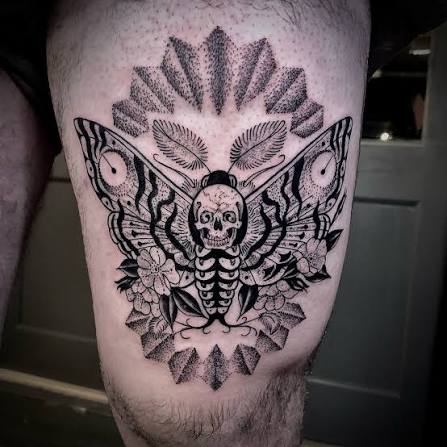
If fine line feels too delicate for what you’re going for, blackwork is the other end of the spectrum. This technique fills large sections of the design in solid black ink rather than outlining them, which makes the death’s-head moth’s skull-marked thorax genuinely striking rather than just spooky for its own sake. On the thigh, this design does best sized larger, around 6 to 9 inches, because solid black areas need room to breathe or they read as a blob instead of a wing. Place it on the front or side thigh where the skin is flattest. Pain tends to run a bit higher here since heavy black saturation means more repeated passes over the same skin. Tip: ask your artist about their saturation technique specifically, some pack black in tighter for a denser, more permanent-looking block, which matters a lot for how this ages. This is less of a first-tattoo choice and more for someone who already knows they want bold, high-commitment ink. From here, let’s soften things back down with a technique built entirely out of dots.
3. Dotwork Moth and Moon Tattoo
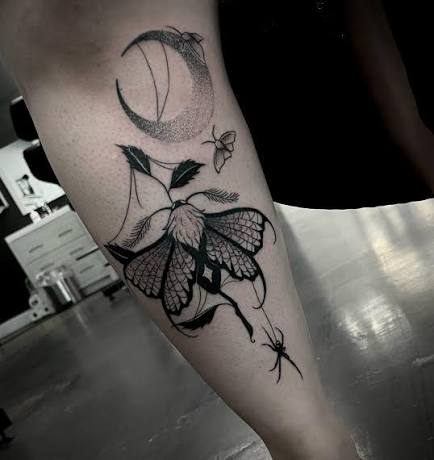
Dotwork builds an image out of thousands of tiny individual dots instead of solid lines or fills, which creates a soft, almost stippled gradient effect. Pairing a moth with a crescent or full moon in this style is one of the more popular symbolic combinations right now, since it visually reinforces the “drawn to light” meaning without needing any text. The gradient dotwork creates on the moon’s surface gives real depth without looking like traditional shading. This design suits the upper outer thigh at 5 to 7 inches, giving the moon enough space to sit apart from the wingtips instead of crowding them. Dotwork tends to feel similar to fine line pain-wise, more of a buzzing sensation than sharp pain, though it can take longer in the chair since the dots are applied individually. Tip: ask to see healed dotwork photos in your artist’s portfolio specifically, not just fresh photos, since dot spacing that looks fine on day one can blur if it’s packed too loosely. Now let’s talk about a version of this same idea with almost no linework at all.
4. Negative Space Moth Tattoo
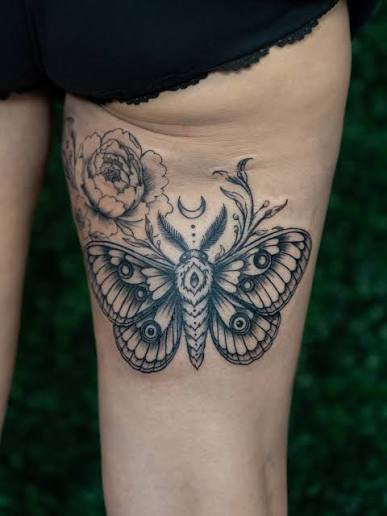
Negative space tattooing uses the untouched skin itself as part of the image, letting the moth’s shape emerge from what’s not inked rather than what is. Typically this means a solid black or heavily shaded background with the moth’s silhouette left bare, or vice versa, a solid moth shape with delicate negative-space vein lines cut through it. It’s a striking, modern-looking technique but genuinely one of the harder ones to execute well, so portfolio-checking matters more here than almost anywhere else on this list. Best on the outer thigh at 5 to 8 inches where there’s enough flat space for the contrast to read clearly from a distance. Pain is comparable to blackwork since it usually involves solid black fill around the design. Tip: ask specifically how the artist plans to keep the negative space lines crisp during healing, since swelling can distort thin untouched channels in the first week. This design ages best on skin that doesn’t stretch much, which the thigh generally satisfies. Let’s move to a moth style that leans fully into color instead of contrast.
5. Watercolor Moth Tattoo
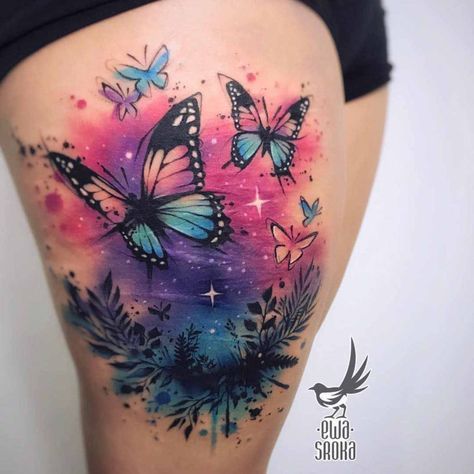
Watercolor tattooing mimics the soft bleeds and color washes of an actual watercolor painting, layering translucent color that fades at the edges instead of stopping at a hard outline. On a moth, this usually means a fine-line or blackwork body and wing structure with loose, splashy color washes layered behind or through the wings. It’s genuinely beautiful fresh out of the chair, but it’s worth knowing upfront that color-heavy designs generally need more touch-up sessions over the years than pure linework does, since color pigment tends to soften faster than black ink. Best placed on the front or outer thigh at 5 to 7 inches for room to let the color bleed naturally. Pain is roughly similar to blackwork given the color saturation involved. Tip: ask your artist which pigments they use and how those specific colors have held up in their own healed work, portfolios lie less than promises do. This is a bolder, more visible choice, so think about workplace visibility before booking. Next, a design built for two people instead of one.
6. Matching Fine-Line Moth Tattoos for Friends
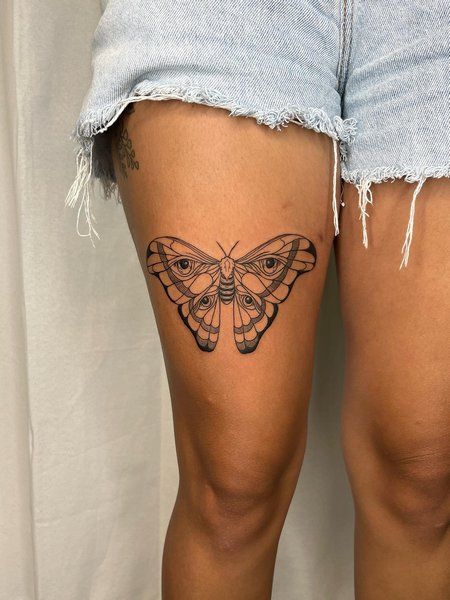
Matching tattoos work best when they’re simple enough to survive two different bodies, two different healing processes, and two different pain tolerances without looking mismatched five years later. A small fine-line moth, around 2 to 3 inches, on the same spot on each person’s thigh, is a low-risk, high-meaning option. Keep the linework identical between both tattoos but let each person choose their own placement side (left or right thigh) if that feels more personal. Front outer thigh works well for visibility if you want it seen, or the inner thigh if you’d rather keep it private. Pain on the outer thigh runs lower than most people expect. Tip: get both tattoos done in the same session with the same artist if possible, so the line weight actually matches instead of drifting between two different hands. This is an easy first-tattoo option for both people involved since the design and commitment level are both low-stakes. Now let’s look at a moth paired with something a little more personal than a symbol.
7. Moth and Wildflower Botanical Tattoo
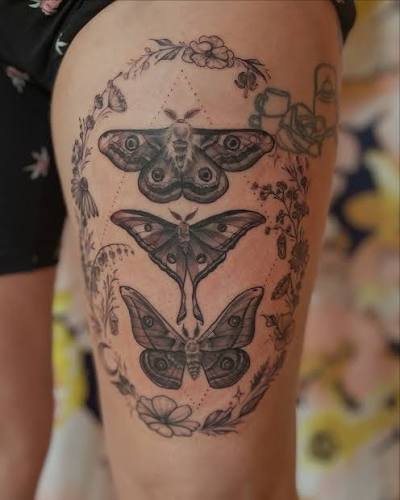
Combining a moth with botanical elements, small wildflowers, sprigs of lavender, or delicate leaf clusters softens the design and gives it a more personal, less purely symbolic feel. This works especially well in fine line or a mix of fine line with light single-needle shading, where the flowers are illustrated with the same delicate weight as the moth’s antennae. Placement on the outer or front thigh at 4 to 6 inches gives enough room for the botanical elements to wrap naturally around the wing shape without overcrowding it. This is a comfortable placement pain-wise. Tip: if the flowers mean something specific to you, a birth flower, something from a memory, tell your artist that story directly instead of just naming the flower, since it often changes how they compose the piece. This design suits workplace settings well since it reads as decorative rather than heavy. It also works beautifully as a first tattoo. Let’s shift toward something with sharper geometric structure next.
8. Geometric Moth Tattoo
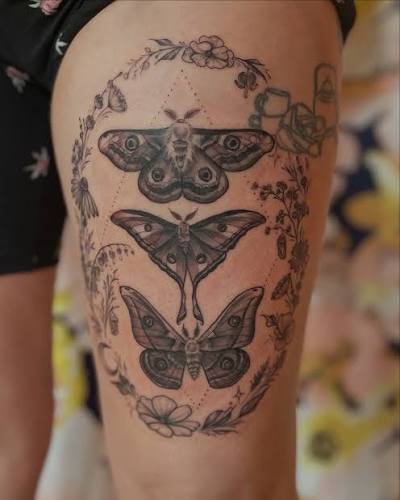
A geometric moth tattoo overlays or replaces parts of the natural wing pattern with clean geometric shapes, triangles, hexagons, or straight-line paneling, giving the design a more architectural, intentional feel. This is usually done in fine line or single-needle work, where precision matters more than almost any other style on this list, since crooked geometric lines are much more noticeable than slightly imperfect organic ones. Best on a flat section of the front or outer thigh, sized 4 to 6 inches so the geometric panels stay proportional. Pain here is standard for fine line placement on this part of the leg. Tip: ask your artist if they use a straightedge stencil tool for the geometric sections rather than freehanding them, precision tools genuinely matter for this style. This design tends to age very well since there’s no shading gradient to soften or blur over time, just clean lines. It’s a strong choice for someone who wants symbolism without anything that reads as overtly “spiritual.” Next, a design that takes the moth into full realism.
9. Realistic Moth Tattoo
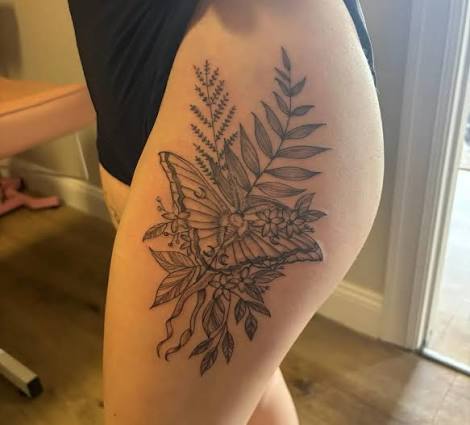
Realism style aims to replicate an actual photograph of a moth, down to the texture of the wing scales, the gradient shading across the thorax, and the fine detail of the antennae. This is one of the more technically demanding styles on this list and requires real shading skill, not just outline work, so this is a design where artist selection matters enormously. Best placed on the front or outer thigh at 5 to 8 inches, giving enough surface area for the shading gradients to render properly. This style tends to be more time-intensive in the chair given the shading detail involved. Tip: look specifically for portfolio photos of healed realism work, not just fresh ink, since shading is the element most likely to soften over the years if it’s not applied correctly the first time. This isn’t typically a first-tattoo choice given the cost and skill level required, but it’s one of the most visually striking options if you’re ready for it. Let’s contrast that with a much simpler silhouette version.
10. Minimalist Moth Silhouette Tattoo
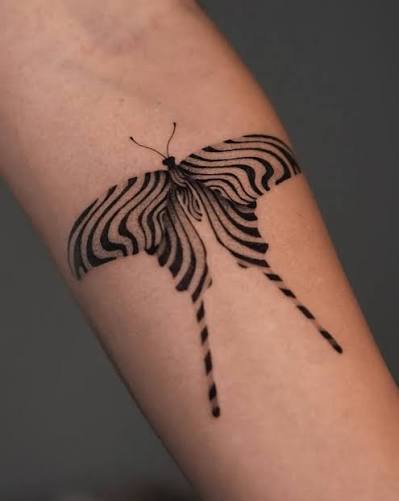
Sometimes the most effective moth tattoo is also the simplest: a clean, solid or single-line silhouette with no internal detail at all. This minimalist approach relies entirely on shape and proportion rather than technique variety, and it’s genuinely one of the most forgiving designs to heal and age well over time. A 2 to 4 inch silhouette on the front, outer, or even inner thigh works depending on how visible you want it. This is about as low-pain as thigh tattoos get. Tip: ask your artist to slightly exaggerate the wing curve when sketching, since an overly geometric or stiff outline can start to look like clip art rather than an intentional design. This is one of the best first-tattoo options on this entire list, both for pain tolerance and for cost. It also ages exceptionally well since there’s no fine detail to blur or fade unevenly. Now let’s add a celestial layer to that same simplicity.
11. Moth and Star Cluster Tattoo
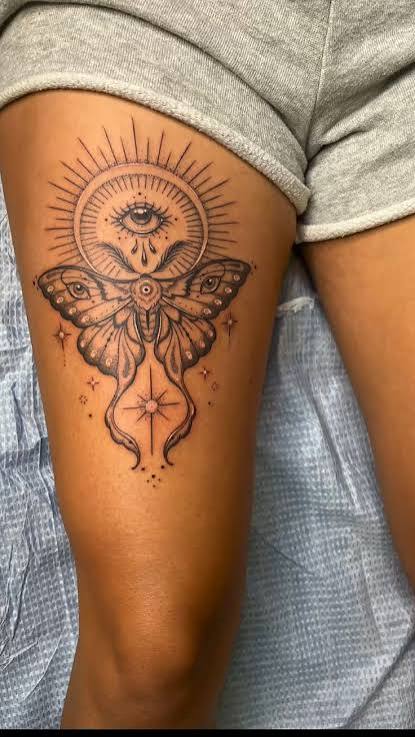
Pairing a moth with a small scattering of stars, either fine-line dot stars or tiny five-point outlines, builds on the “drawn to light” symbolism in a subtler way than a full moon does. This design usually keeps the moth itself fairly simple, single-needle or fine line, while the stars are scattered loosely around and behind the wings rather than in a rigid pattern. Best at 4 to 6 inches on the outer thigh, where there’s room for the stars to trail without feeling cramped against the moth’s body. Pain is on the lower end given the fine, light needlework involved. Tip: ask your artist to vary the star sizes rather than making them uniform, it reads as more natural and less like a printed pattern. This design is workplace-friendly and works well as a first tattoo. It also pairs nicely as a coordinated (not identical) matching design with a partner or sibling. Let’s look at what happens when you push the symbolism further into memento mori territory.
12. Moth and Skull Memento Mori Tattoo
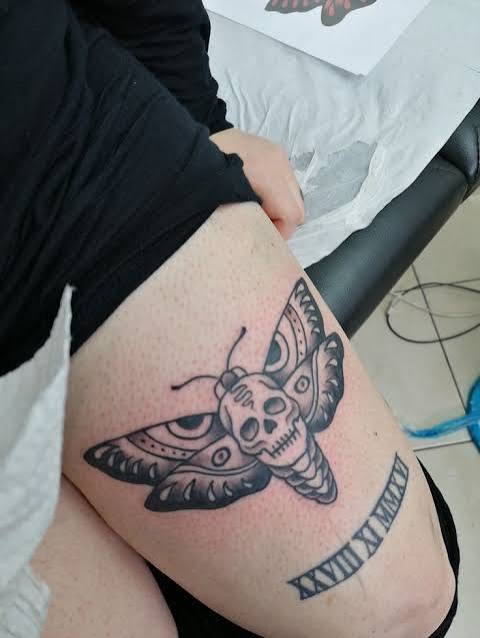
Combining a moth with a small skull leans into a heavier, more explicitly memento mori theme, a reminder of mortality and transformation rather than pure decoration. This works well in blackwork or dotwork, where the skull’s shading contrasts against the moth’s more delicate wing linework. Best sized 5 to 7 inches on the front or outer thigh to give both elements enough individual space. Because this design typically involves more shading and black saturation around the skull, expect it to run on the higher end of the pain scale for this placement. Tip: be specific with your artist about how literal or stylized you want the skull, an anatomically accurate skull reads very differently than a simplified, rounded one. This is a bolder design better suited to someone who already has ink and understands the visibility tradeoffs of thigh placement in swimwear or shorts. Next, let’s bring the moth into a more ornamental, decorative frame.
13. Ornamental Mandala Moth Tattoo
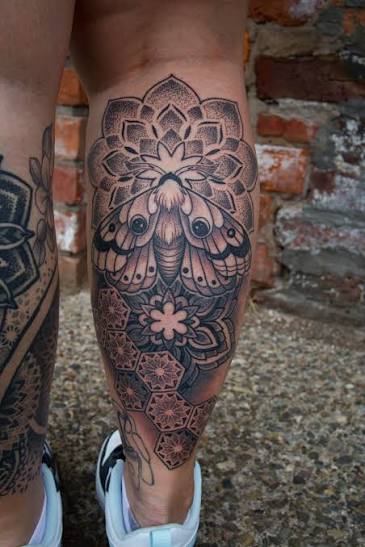
An ornamental moth design layers mandala-style patterning, symmetrical dots, swirls, and geometric framing, into or around the wings, essentially treating the moth as the centerpiece of a larger decorative composition. This is almost always done in fine line or dotwork given the precision the patterning requires. Sized larger, around 6 to 9 inches, this design suits the front or outer thigh where the full pattern has room to sit symmetrically. Pain runs moderate given the amount of detailed needlework across a wider area. Tip: ask your artist to sketch the mandala framing slightly asymmetrically on purpose, perfectly mirrored patterns are genuinely difficult to execute by hand and slight, intentional variation often looks more polished than a failed attempt at perfect symmetry. This is a statement piece, not a subtle one, so think through workplace visibility before booking. It’s not typically a first-tattoo pick given its size and detail level. Let’s scale things back down with a tiny, single-needle version.
14. Tiny Single-Needle Moth Tattoo
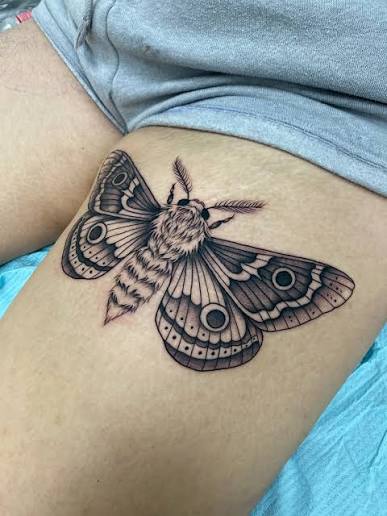
Single-needle work uses the finest needle configuration available, producing extremely thin, delicate lines that suit very small designs particularly well. A tiny moth, under 2 inches, tucked on the inner or upper thigh is one of the most private, low-commitment options on this list. Because the design is so small, detail has to be simplified, think a basic wing outline and a few interior lines rather than full vein structure. This is a comfortable, quick placement pain-wise given the short time in the chair. Tip: keep the design simple by intention rather than trying to cram in the same level of detail as a 6-inch piece, overly ambitious tiny tattoos tend to blur into a smudge within a few years. This is an excellent, low-cost first tattoo and works well as a private, meaningful piece rather than a visible statement. It also makes a good matching option since small size keeps cost and pain low for both people. Now let’s look at a bolder alternative in the American traditional style.
15. Bold Traditional Moth Tattoo
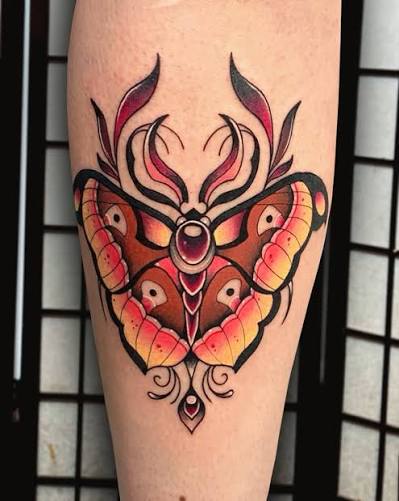
American traditional style uses thick, bold outlines, a limited but saturated color palette, usually black, red, and yellow, and minimal shading, prioritizing longevity over fine detail. A traditional moth trades realism for graphic punch, thick linework, and flat color fills that are specifically known for aging well over decades, which is part of why the style has stuck around this long. Best at 4 to 6 inches on the outer thigh where the bold lines have room to stay separated from each other. Pain is moderate, comparable to blackwork given the outline weight and color saturation. Tip: trust your traditional artist’s proportions over your own reference photo if they suggest adjustments, thick linework requires specific spacing to avoid muddying together as it heals. This is a strong workplace-friendly option once healed, since the graphic style reads as intentional rather than delicate. It also holds up better over decades than most fine line work. Next, let’s look at combining that same boldness with sacred geometry.
16. Sacred Geometry Moth Tattoo
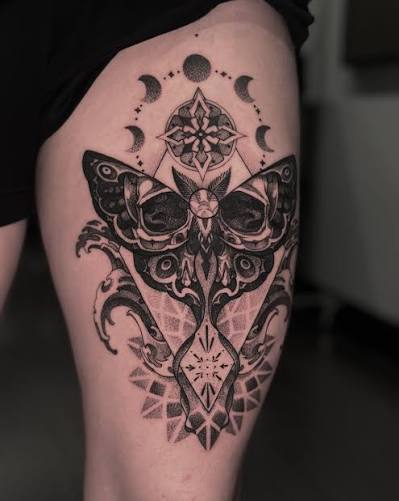
This design integrates sacred geometry elements, think interlocking triangles forming a subtle Flower of Life pattern or a geometric frame, directly into the moth’s wing structure. It’s typically done in fine line or single-needle work to keep the geometric precision crisp. Sized 5 to 7 inches, this suits the front or outer thigh where a flat surface keeps the geometric lines straight and evenly spaced. Pain is standard for fine line placement in this area. Tip: ask your artist whether they’ll use a laser-stencil or hand-drawn guide for the geometric elements, precision genuinely matters more here than in almost any other style since a warped triangle stands out immediately. This design carries deeper symbolic meaning for some people around balance and interconnectedness, so it’s worth being ready to explain that meaning if asked, since it does draw questions. It’s not the easiest first tattoo given the precision demands, but it ages beautifully. Let’s look at a softer alternative using Japanese-inspired linework instead.
17. Japanese-Style Moth and Wave Tattoo
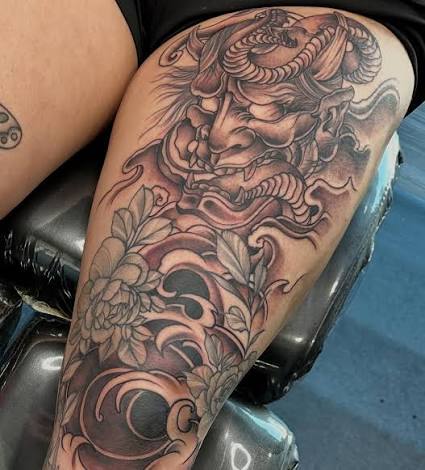
Borrowing composition principles from traditional Japanese tattooing, this design pairs a moth with flowing wave or wind linework in the background, using bold outlines and directional shading to suggest movement. This isn’t a literal Japanese irezumi piece, it’s a Western fine-line or blackwork interpretation borrowing composition ideas, so be upfront with your artist about wanting an homage rather than a traditional replica. Best sized 6 to 8 inches on the outer thigh to give the flowing background lines room to move around the moth. Pain runs moderate to higher given the background shading involved. Tip: bring reference images that clearly separate “the moth I want” from “the flow style I want,” combining two references reduces miscommunication significantly. This is a bold, visible piece best suited to someone who already has some ink experience. Next, let’s bring things back to something small and celestial.
18. Moth and Crescent Moon Outline Tattoo
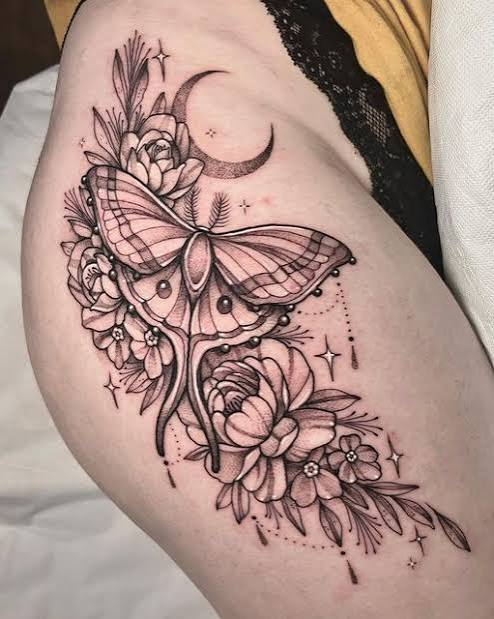
A simplified pairing of just a moth outline and a small crescent moon, done in clean fine line with no shading or fill at all, is one of the more universally flattering combinations on this list. It reads clearly at almost any size and doesn’t rely on heavy technique to look intentional. Works well from 3 to 6 inches depending on preference, on the front, outer, or inner thigh. Pain is low to moderate depending on final size. Tip: ask your artist to slightly offset the moon from the moth’s wingtip rather than centering it directly above, off-center compositions tend to look more natural and less like clip art. This is one of the easiest first-tattoo choices on the entire list and works well for workplace visibility since it’s simple enough to read as understated rather than dramatic. It’s also a solid matching design option. Now let’s look at a version built entirely from wing texture instead of a full body.
19. Detailed Moth Wing Fragment Tattoo
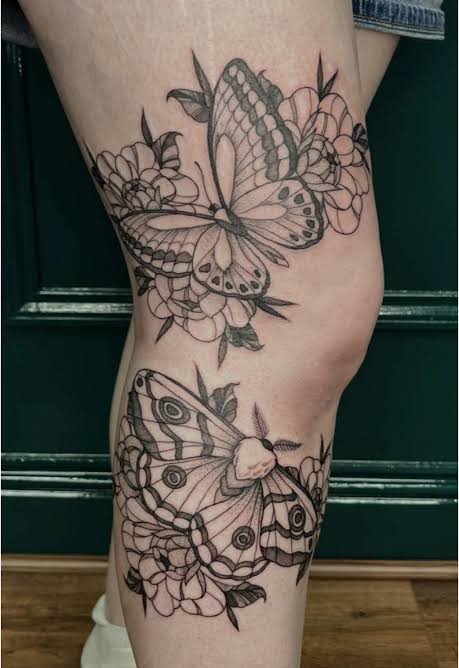
Instead of a full moth, this design focuses on just a single wing, rendered in close, textured detail, essentially treating the wing itself as an abstract piece of art rather than part of a recognizable creature. This works particularly well in fine line combined with light stippling to suggest the wing’s scale texture. Sized 4 to 6 inches, this suits the outer or front thigh where the wing shape can sit at a natural diagonal angle. Pain is comparable to standard fine line work in this area. Tip: ask to see close-up texture work specifically in your artist’s portfolio, wing scale detail is a skill some fine-line artists specialize in and others don’t touch much at all. This design appeals to people who want the aesthetic of a moth without the more literal, sometimes polarizing full-insect look. It’s workplace-appropriate and reads as more abstract art than symbolic tattoo. Let’s move into a design that leans into a darker color palette.
20. Deep Blue and Black Gradient Moth Tattoo
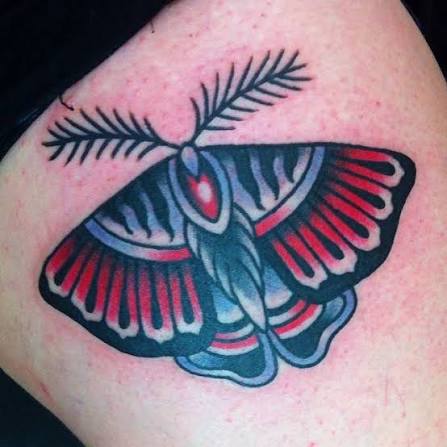
This design uses a limited, moody color palette, deep indigo blues blending into black, to create a gradient effect across the wings rather than the bright multicolor approach of a full watercolor piece. It’s typically done with color shading techniques layered over a blackwork or fine-line base. Best at 5 to 7 inches on the front or outer thigh where the gradient has room to shift gradually rather than banding. Pain is moderate to higher given the color and shading combined. Tip: ask specifically how the artist blends color transitions, some use a whip-shading technique for smoother gradients, which matters for how evenly this heals and ages. This design is striking but more visible and higher-commitment, so think through cost and touch-up expectations before booking. It’s not usually a first-tattoo pick given the technique layering involved, but it’s one of the more visually rich options here. Next, a moth built from delicate lace-like patterning.
21. Lace-Pattern Moth Tattoo
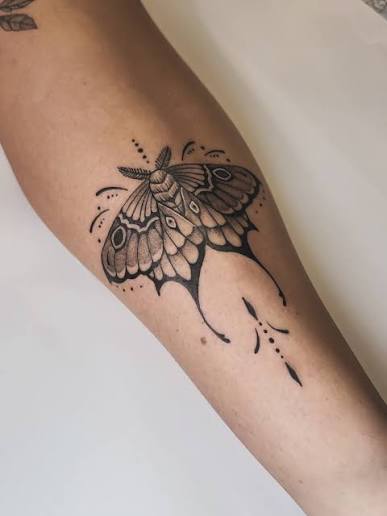
This design treats the moth’s wings like delicate lace fabric, replacing solid shading with intricate, interconnected linework patterns that mimic embroidery or lace trim. It’s exclusively a fine-line or single-needle technique given how much precision the interlocking pattern requires. Sized 4 to 6 inches, this works best on the front or outer thigh where the flat surface keeps the pattern from distorting. Pain is standard for detailed fine-line work at this size. Tip: ask your artist for a printed stencil preview before the session starts, lace patterning has almost no room for freehand improvisation without risking asymmetry. This is a more feminine-leaning aesthetic choice that reads well in professional settings since it’s intricate but not dark or heavy in subject matter. It’s a moderately good first-tattoo option for someone specifically drawn to detailed patternwork rather than bold statement pieces. Let’s look at combining the moth with a meaningful short phrase next.
22. Moth with Small Script Tattoo
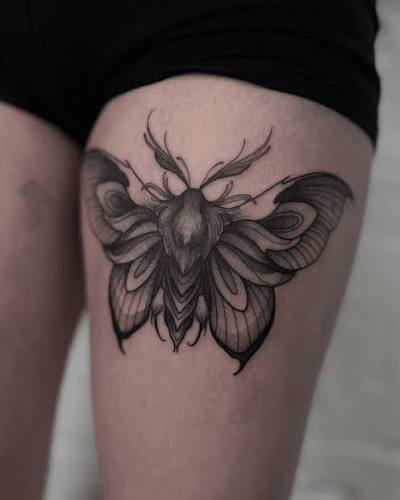
Pairing a moth with a short word or phrase in fine-line script adds a personal, specific layer of meaning without needing an entirely separate tattoo. Keep the script brief, a single word rather than a full sentence, since long script tends to blur and lose legibility on skin over time far faster than illustration does. Best placed alongside or beneath the moth at 4 to 6 inches total on the outer thigh. Pain is standard for fine line in this area. Tip: ask your artist to slightly increase the line weight on script specifically, since thin script fades and blurs faster than thin illustration lines do, a font that looks great on paper isn’t automatically the right choice for skin. This design suits people who want something more personal and specific than a purely symbolic image. It’s workplace-appropriate if the phrase itself is discreet. Now, one more design idea built around symmetry and reflection.
23. Mirror Symmetry Double-Wing Moth Tattoo
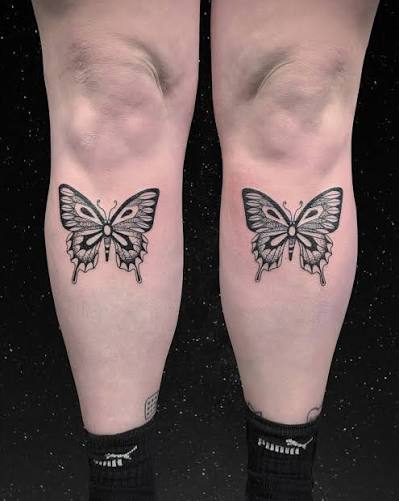
This design treats the moth as a perfectly mirrored, almost kaleidoscopic composition, duplicating and reflecting wing elements outward from a central body line to create a more abstract, pattern-heavy image than a naturalistic moth. It’s usually done in fine line or dotwork, where precision in the mirroring matters enormously, an uneven mirror throws off the entire piece. Best sized larger, 6 to 8 inches, on the front or outer thigh for the flat, symmetrical canvas it needs. Pain runs moderate given the size and detail. Tip: ask to see the stencil from directly above the leg before the tattoo begins, checking symmetry on a flat photo is much easier than trying to judge it after the needle starts. This is a striking, artistic statement piece rather than a subtle one, so factor visibility into your placement decision. It’s not the ideal first tattoo given its complexity, but it’s a strong choice for a second or third piece.
24. Moth Emerging from Cracked Chrysalis Tattoo

This design captures a specific moment, the moth partially emerged from its chrysalis, rather than the finished insect alone, which leans hard into transformation symbolism in a more literal, illustrative way. It combines fine-line detail on the moth with slightly heavier shading or blackwork on the cracked chrysalis shell for contrast. Best at 5 to 7 inches on the front or outer thigh to fit both elements without crowding. Pain is moderate given the mixed shading and linework involved. Tip: be specific with your artist about how much of the chrysalis you want visible, some designs show just a fragment, others show most of the shell, and that changes the composition significantly. This design resonates with people marking a specific life change or recovery period, and it’s worth thinking about whether you want that story visible or private before choosing placement. It’s a meaningful but more involved second-tattoo pick. Last on the list, let’s close with the boldest, most graphic version.
25. Bold Blackwork Moth with Full Wingspan Tattoo
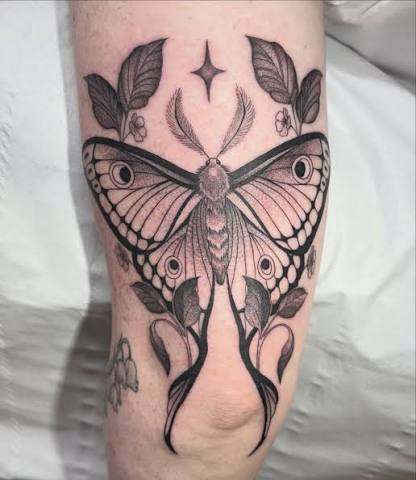
Closing out the list with the most dramatic option: a large-scale blackwork moth shown with its wings fully spread, rendered in heavy black saturation with sharp, deliberate negative-space highlights carved out of the wing pattern for contrast. This is a statement piece, sized 8 inches or larger, that genuinely needs the thigh’s surface area to work; it would look cramped almost anywhere else on the body. Pain runs on the higher end given the saturation and session length required. Tip: expect this design to take multiple sessions rather than one sitting, ask your artist to walk you through their session-spacing plan before you book so you know what the full timeline and cost actually look like. This isn’t a first-tattoo pick, it’s for someone who’s confident in both the design and the artist relationship. Done well, though, it’s one of the most visually powerful moth designs you can put on skin.
Best Placement Ideas
- Outer thigh — the most versatile spot for moth tattoos; flat, low-movement, and works for both small and large designs. Moderate visibility depending on clothing.
- Front thigh — best for larger, symmetrical pieces since it offers the widest flat surface. More visible in shorts or swimwear.
- Inner thigh — better for smaller, more private designs; skin here can be more sensitive, and the tattoo stays mostly hidden.
- Upper thigh near the hip — good middle ground for medium designs; slightly more visible when seated or in swimwear than the outer thigh.
- Back of the thigh — an option for larger pieces you’d rather keep out of everyday sight, though it’s a harder angle for touch-ups since you can’t see it directly.
Tips for Success
Choosing the right artist matters more than choosing the “perfect” design, honestly. Start by looking through portfolios for work in the specific technique you want, fine line, blackwork, dotwork, whatever, rather than just general talent, since these techniques require genuinely different skill sets. Look for healed photos, not just fresh ink, since that’s the only real way to judge how a design ages. Bring reference photos that separate what you like about the moth’s shape from what you like about the composition style, mixing five different Pinterest photos into one verbal description usually leads to miscommunication. And ask direct questions in your consultation: what needle configuration will they use, how many sessions do they expect, and what’s their approach to touch-ups if the color or linework softens over the first year.
Common Mistakes and How to Avoid Them
- Going too small for the detail level. A design with fine internal wing patterning needs enough size to hold that detail as it heals, cramming realism or dotwork into a 2-inch space almost always blurs within a few years.
- Picking a placement that fights the design’s linework. A wide, symmetrical wingspan design generally needs a flat surface like the front or outer thigh, not a curved or high-movement area.
- Skipping the aftercare instructions your specific artist gives you. Generic advice found online doesn’t always match the technique or ink used on your particular piece.
- Copying a reference design exactly without personalizing it. Small adjustments, an added star, a resized wing, a shifted moon, make the piece genuinely yours instead of a direct copy of someone else’s tattoo.
Similar Variations
Nearly every design on this list can be adapted. A larger blackwork piece can be scaled down into a simplified single-needle version for a lower-commitment option. A black-and-grey design can be recolored into deep blues or muted earth tones for a softer palette. Two or three smaller moth designs from this list can be combined into a cluster composition for a more layered look. And any of the symbolic pairings, moon, stars, flowers, script, can be swapped for a different element entirely if the original doesn’t feel personal enough to you specifically.
Aftercare Basics
Aftercare varies depending on ink type, technique, and your individual skin, so always follow the specific sheet your artist gives you over generic internet advice. In general, expect to keep the area clean and moisturized, avoid direct sun exposure and swimming during the initial healing window, and avoid picking at any peeling skin as it heals. Healing timelines and reactions vary from person to person, so if you notice anything that seems unusual, it’s worth checking in with your artist or a licensed dermatologist rather than guessing.
Quick FAQ
How much does a moth thigh tattoo cost? Cost depends heavily on size, technique, and your artist’s experience level, but expect a wide range, roughly $150 for a small single-needle piece up to $800 or more for a large, multi-session blackwork or realism design. Always get a direct quote during your consultation.
Does a moth thigh tattoo hurt a lot? Pain tolerance varies a lot by individual, but the outer and front thigh are generally considered more comfortable placements than bony areas like the wrist or ankle, since there’s more muscle and fat padding over the bone.
How long does a moth thigh tattoo take to heal? Surface healing typically takes a couple of weeks, though full healing underneath the skin can take longer. Healing time varies by individual and design size, so follow your artist’s specific aftercare guidance.
Will a fine-line moth tattoo fade faster than a bold traditional one? Generally, thinner linework can soften more noticeably over the years compared to bold, saturated traditional-style work, which is part of why some people choose a touch-up session every several years for fine-line pieces.
Final Thoughts
Whichever version of this design speaks to you, fine-line and delicate, or bold and blackwork, the thigh genuinely is one of the most forgiving, versatile canvases for a moth tattoo. It gives you room for detail, a comfortable pain profile compared to bonier spots on the body, and enough flexibility to go tiny and private or large and dramatic depending on what you actually want.
Take your time picking both the design and the artist, ask the questions this article walked through, and don’t be afraid to personalize any of these 25 moth thigh tattoo ideas until it feels like it’s actually yours. This kind of piece is meant to last, so it’s worth getting right the first time.
This article is for inspiration and general informational purposes only. Pain tolerance, healing time, and individual results vary. Always consult a licensed, professional tattoo artist, and a dermatologist if you have any skin concerns, before booking.