17 Black Old School Tattoo Ideas That Actually Hold Up Over Time
If you’ve been scrolling through tattoo inspiration for weeks and still can’t find a black old school tattoo that feels right, you’re not alone — most design roundups show you pretty pictures without telling you what actually happens when that ink sits in your skin for ten years. This guide is different. I’ve spent enough time in and around tattoo studios watching consultations, touch-ups, and healing check-ins to know what separates a black old school tattoo that ages beautifully from one that turns into a blurry smudge by year five.
So what makes a good black old school tattoo? It’s a design built on bold, solid black linework and heavy shading instead of the traditional red-yellow-green palette, using thick outlines (usually 8–12 gauge needles) and packed black saturation so the image stays sharp, high-contrast, and readable even after decades of natural fading.
Stick around, because I’m also going to cover placement tradeoffs, realistic pain levels, what it actually costs, and exactly how to brief an artist so you don’t end up with a stencil copy that looks nothing like you pictured.
Why Black Old School Tattoos Work So Well Long-Term
Old school American tattooing — the Sailor Jerry, Bert Grimm, Norman Collins lineage — was built around one rule: bold will hold. Thick black outlines, minimal fine detail, and packed-in black shading were designed for a simple reason. Skin stretches, ages, and the ink migrates slightly over time. Thin lines and delicate gradients blur first. Heavy black linework survives. Dropping the classic color palette and going all-black doesn’t just look sleek — it actually extends how crisp the design looks decades down the road, since there’s no color fading to worry about, only the black slowly softening at the edges.
Before we get into specific designs, it helps to know the actual technique differences, since artists use these terms constantly during consultations:
Bold Traditional Linework — Thick, unbroken black outlines (usually 2mm or more) that form the skeleton of the design, filled in with solid black or bold shading.
Blackwork — A broader style using large areas of solid black ink, often with sharper negative space (the untouched skin left bare to form part of the image) than traditional tattooing.
Dotwork — Shading or texture built from thousands of individual dots instead of solid fill, giving a grainy, almost stippled gradient effect.
Single Needle / Fine Line — Thin, delicate lines made with one needle point, the opposite end of the spectrum from bold traditional work — great for small text or minimalist designs but not typically used in old school pieces.
Now let’s get into the actual designs.
1. Solid Black Anchor With Bold Rope Detail

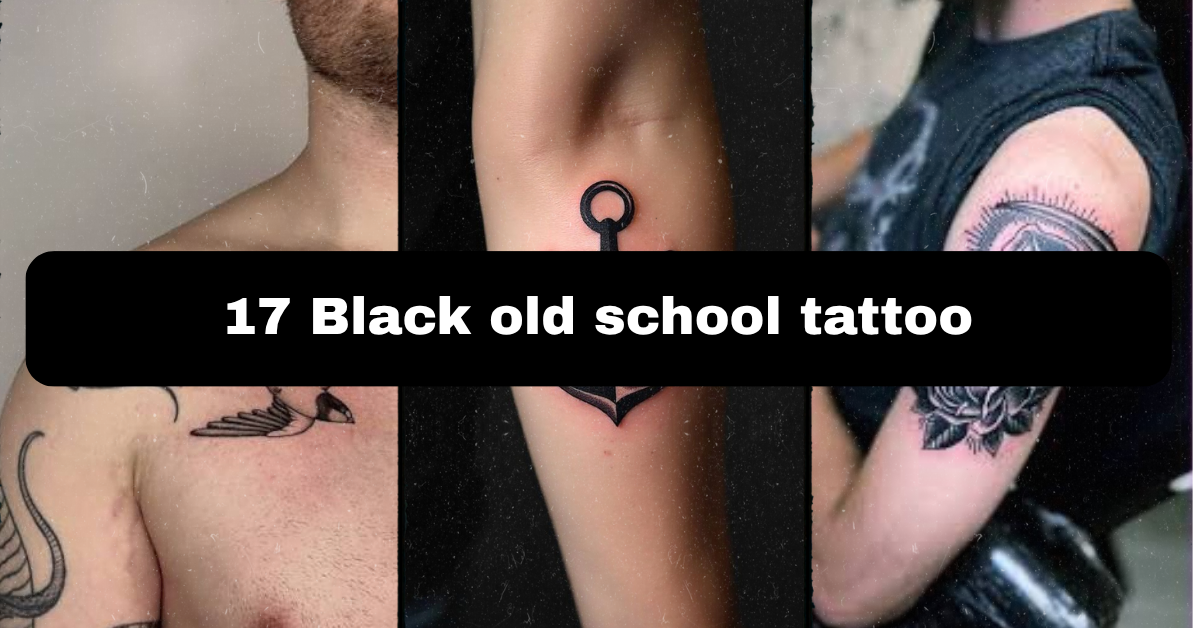
The anchor is the most recognizable old school flash design, and doing it entirely in black gives it a graphic, almost woodcut-print quality. The outline sits thick — around 3mm — with the crossbar and chain rendered in solid black fill rather than shaded gradients. Best placed on the forearm or calf where the elongated shape has room to breathe, ideally 4–5 inches tall so the rope detail doesn’t muddy together as it heals. Forearms and calves are relatively low on the pain scale compared to bony spots. Bring a flash reference but ask your artist to adjust the rope thickness slightly — a common mistake is keeping lines too thin, which blurs first. This one transitions naturally into other nautical black work, like the swallow pair below.
2. Black Swallow Pair on the Collarbones
Swallows were originally a sailor’s badge of experience, and in solid black they read as clean, symmetrical silhouettes rather than busy line drawings. Each bird uses a single bold outline with a solid black body and negative space (bare skin) forming the wing feathers instead of individual shaded lines. Collarbones or the upper chest are classic spots, sized around 2–3 inches per bird. This placement stings more since it’s close to bone, so expect a sharper sensation than fleshier areas. Ask your artist about mirroring the design for perfect left-right symmetry — freehand mirroring is harder than it looks. This design works well for matching tattoos between siblings or close friends.
3. Bold Black Skull With Rose Accents
Skull-and-rose combos are old school staples, and rendering the skull in solid blackwork while keeping the rose as an outlined negative-space bloom creates visual contrast within one piece. The skull typically gets heavy black shading across the eye sockets and jaw, while the rose petals stay lighter, defined mostly by outline. Upper arm or thigh placement works best, giving 5–6 inches of space so the rose doesn’t collapse into the skull’s shading. Fleshier areas like the outer thigh tend to be more tolerable than sharper bony spots. When briefing your artist, specify how much shading you want in the rose — full black or lighter outline — since that changes the whole balance of the piece.
4. Traditional Black Dagger Through a Heart
This one’s a classic symbol of heartbreak or resilience, and going monochrome makes the dagger’s blade pop through sharp negative space instead of a shiny colored highlight. The heart is usually solid black with a thin unshaded outline separating it from the blade. Ribs or upper arm both work, though ribs are consistently rated among the more painful spots due to thin skin over bone. Sizing around 4 inches keeps the banner text (if you add one) legible. A practical tip: ask about a banner with your own short phrase instead of a stock one — it personalizes a very common flash design without changing the composition.
5. Black Panther Head in Heavy Shadow
Panther heads are a favorite in old school flash because the black coat gives artists an excuse to go full blackwork without losing detail — the face features get carved out using negative space rather than added lines. This is a shading-heavy piece, often using dotwork texture in the fur transitions for a slightly grainy depth. Best on the upper arm, shoulder, or upper back where there’s enough flat space for the head to sit proportionally, ideally 5+ inches. Larger flat muscle groups like the shoulder tend to be gentler on pain tolerance than ribs or feet. This design ages remarkably well since it’s almost entirely black saturation with few thin details to blur.
6. Bold Black Eagle With Spread Wings
The eagle is practically the mascot of American traditional tattooing, and stripped of color, it becomes a study in linework hierarchy — thick outer wing outlines, medium lines for feather separation, and solid black fill on the body. This design needs real space to keep the feather linework from crowding, so upper back or chest placement at 6+ inches works best. Chest placement carries moderate pain due to thinner skin, and healing takes the standard two to three weeks before the design settles. If you want this visible for work, consider the outer forearm instead, sized down to 4 inches with slightly less wing detail. Next, let’s look at a smaller, easier first-tattoo option.
7. Solid Black Lightning Bolt Flash
Not every old school design needs to be complex. A lightning bolt in bold black linework, maybe 2–3 inches, is a genuinely good first-tattoo choice because it’s fast to complete, low-detail, and forgiving if you’re nervous about the whole process. Wrist, ankle, or behind the ear are common spots, though bony areas like the wrist and ankle tend to be more sensitive than fleshier placements. A single sitting is usually enough. Ask your artist for a slightly thicker line than a typical flash sheet default — thin lightning bolts are one of the first designs to blur into a faint gray line after several years.
8. Black Wolf Head With Sharp Negative Space
Wolves in old school style lean into aggressive, angular shading with the eyes and snout often left as negative space against a heavily inked black background. This creates strong visual contrast and reads well from a distance, which matters for larger back or thigh placements. Sizing around 6 inches lets the angular jawline stay crisp. This is a longer sitting, often two to three hours depending on shading density, so ask about numbing options and realistic session length during your consultation. Thigh and upper arm placements are generally more comfortable than spine or rib cage for a piece this size.
9. Black Rose With Thorn Detail and Deep Shading
Roses are endlessly customizable, and an all-black version relies entirely on shading gradients to suggest petal depth instead of color transitions. Expect layered black shading from light gray-black at the petal tips to near-solid black at the base, done with a shading needle configuration rather than a liner. Forearm, ankle, or shoulder blade all work depending on size — 2 inches for a minimalist version, 5+ inches for full shading detail. Smaller versions on the ankle heal a bit slower due to friction from socks and shoes, so factor that into your aftercare routine. This design pairs naturally with the dagger-and-heart idea above for a combined piece.
10. Old School Black Ship on Rolling Waves
A ship tattoo tells a story of movement and journey, and in black old school style, the waves get rendered in bold curved linework with alternating solid and negative space sections to suggest motion without any blue ink. This is a wider composition, best suited to the forearm, calf, or upper back where the horizontal layout has room, typically 4–6 inches wide. Calves handle this kind of linework well since the muscle provides a relatively stable, low-pain canvas. Bring reference images showing wave direction you like — artists can adjust the wave rhythm significantly depending on your preference.
11. Bold Black Tiger Face, Front-Facing
A front-facing tiger head uses symmetrical bold linework for the face outline with heavy black shading in the fur striping, often incorporating dotwork texture around the whisker area for a softer transition. Chest or upper back placement gives it the symmetry it needs, sized 5+ inches to keep stripe detail from merging as it heals. This is a longer, more painful sitting given the shading density, particularly over the sternum. It’s not the best pick as a first tattoo given the time commitment, but it’s a strong statement piece for someone already comfortable with the process.
12. Black Snake Wrapping a Dagger or Rose
Snakes wrapping around another object are a foundational old school composition, and in solid black the scales get suggested through repeating small linework patterns rather than individual scale shading. This works well on the forearm or calf where the wrap-around shape follows the limb naturally, typically 4–6 inches long. Forearm placement is one of the more tolerable pain zones, making it approachable even for a first larger tattoo. Ask your artist about scale density — too many fine lines packed closely will blur together faster than a moderate, evenly spaced pattern.
13. Black Pin-Up Silhouette in Bold Outline
Instead of the fully shaded, colored pin-up style, a black silhouette version uses one bold outline with minimal interior detail, letting negative space do most of the visual work. This is a striking, graphic approach best suited to the thigh or upper arm at 4–5 inches. Because there’s less shading involved, healing tends to be quicker and the sitting shorter than heavily shaded designs. This is a solid option if you like old school aesthetics but want something that reads more modern and minimal.
14. Black Sun With Dagger Center Flash

Combining a sun motif with a central dagger is a classic flash mashup, using radiating bold black rays around a smaller solid black dagger. Chest, sternum, or upper back placements suit the radial symmetry, sized around 4 inches across. Sternum placement is consistently reported as one of the more sensitive spots, so pace expectations accordingly. This design is easy to personalize by adjusting ray count and dagger angle, which helps it avoid looking like a direct stencil copy of someone else’s tattoo.
15. Solid Black Heart With Banner Script
A heart with a banner is one of the most requested old school flash designs, and doing it in solid black with negative space lettering (leaving the banner text as bare skin against black fill) gives it a cleaner, more legible finish than colored banners often achieve. Forearm or upper arm placement at 3 inches keeps text readable. Ask your artist to test the lettering size on paper first — banner text that’s too small is a common regret once the tattoo settles and the linework softens slightly.
16. Black Panther and Rose Combination Piece
Combining the panther head from earlier with a rose creates a two-part composition that plays heavy black shading against lighter negative-space petals. This needs real canvas space — upper arm sleeve sections or the upper back work best, at 6+ inches to give both elements room without crowding. This is a multi-session piece for most people, so budget for at least two appointments and factor healing time between them into your schedule.
17. Old School Black Skull With Full Rose Wreath
The most detailed design on this list, this combines a solid black shaded skull with a full wreath of black roses circling it, using varied shading depth to separate the two elements visually. This is a large-scale piece, generally 7+ inches, best suited to the upper back, thigh, or full sleeve section. Given the size and shading density, expect multiple sessions and a longer overall healing timeline. This works best for someone who already has a few tattoos and understands the time and cost commitment involved, rather than as a first tattoo.
Best Placement Ideas
- Forearm — high visibility, moderate pain, easy to keep clean during healing
- Calf — good for wider compositions, low-to-moderate pain, minimal clothing friction
- Upper arm/shoulder — flat canvas for larger pieces, generally well-tolerated pain level
- Ribs — higher pain due to thin skin over bone, harder to keep sanitary during healing, but great for larger side pieces
- Ankle/wrist — good for small flash designs, more sensitive due to bone proximity, higher friction from clothing and shoes
- Behind the ear — very small designs only, moderate sensitivity, easy to conceal for workplace settings
- Chest/sternum — dramatic placement for symmetrical designs, consistently rated as more painful
Tips for Success
Look for an artist whose portfolio shows multiple black old school pieces that have actually healed — not just fresh photos taken right after the session. Fresh ink always looks sharp; healed work tells you how their linework holds up. Ask specifically about their experience with bold traditional style, since it requires different needle technique than fine line or realism work. Bring reference photos, but also bring a clear idea of your intended size and placement, since a design that looks great at 3 inches on paper can fall apart at 6 inches on skin, or vice versa. A good consultation includes a conversation about stencil placement, sizing on your actual body, and a rough cost estimate before you book.
Common Mistakes and How to Avoid Them
- Sizing too small for the detail level — heavy shading and multiple elements need real space; shrinking a complex design below 3–4 inches often causes blurring within a few years
- Choosing a placement that fights the design’s shape — a wide ship design crammed onto a narrow wrist rarely looks right
- Skipping personalization — copying a flash sheet design exactly, down to every line, is common, but small tweaks (banner text, added elements, adjusted proportions) keep it yours
- Ignoring aftercare instructions — not following the specific sheet your artist gives you can affect how the final result looks once healed
- Booking a walk-in slot for a large custom piece — bigger blackwork pieces usually need a proper consultation and scheduled session, not a same-day walk-in
Similar Variations
Nearly every design above can be resized. A large panther head can shrink down to a 2-inch minimalist version with less internal shading for a subtler look. Combination pieces like the panther-and-rose or skull-and-wreath can be split into two smaller separate tattoos if you’re not ready for a large single session. You can also reintroduce limited color — a single red rose against an otherwise all-black composition — if you want a nod to traditional color palettes without going fully colored.
Aftercare Basics
General dermatological guidance for any fresh tattoo typically includes keeping the area clean, avoiding direct sun exposure, avoiding soaking in pools or baths during initial healing, and applying a thin layer of the specific aftercare product your artist recommends. Healing time varies by individual and by design size, but most black old school pieces settle within two to four weeks, with the deeper layers of skin fully finishing over the following months. Always follow the exact aftercare sheet your artist provides, and consult a licensed professional or dermatologist if you notice anything that seems abnormal during healing.
Quick FAQ
How much does a black old school tattoo cost?
Pricing varies widely by studio, location, and artist experience, but small flash pieces (2–3 inches) often start in the range most shops charge as a minimum, while larger custom blackwork pieces are usually priced hourly. Always get a specific quote during your consultation.
Does black old school tattooing hurt more than colored traditional work?
Pain is largely tied to placement and shading density rather than ink color itself. Bony areas and heavily shaded pieces tend to feel more intense, according to general consensus among tattoo professionals, but pain tolerance varies by individual.
How long does healing take?
Most people see surface healing within two to three weeks, though full settling underneath the skin can take a couple of months. This varies based on placement, size, and individual healing response.
Will a black old school tattoo fade over time?
All tattoos fade gradually with age and sun exposure, but bold, solid black linework tends to hold its shape and contrast longer than thin or lightly shaded designs, since there’s more ink saturation to begin with.
Final Thoughts
A black old school tattoo works because it leans on decades-old technique — bold lines, heavy black saturation, and smart negative space — rather than trends that fade in a few years. Whether you go with a small flash piece like the lightning bolt or commit to a larger multi-session design like the skull-and-wreath, the same fundamentals apply: size it right, place it where the linework can breathe, and work with an artist who actually specializes in this style. Take your time picking both the design and the person doing the tattooing, and a black old school tattoo can genuinely stay sharp and meaningful for decades to come.