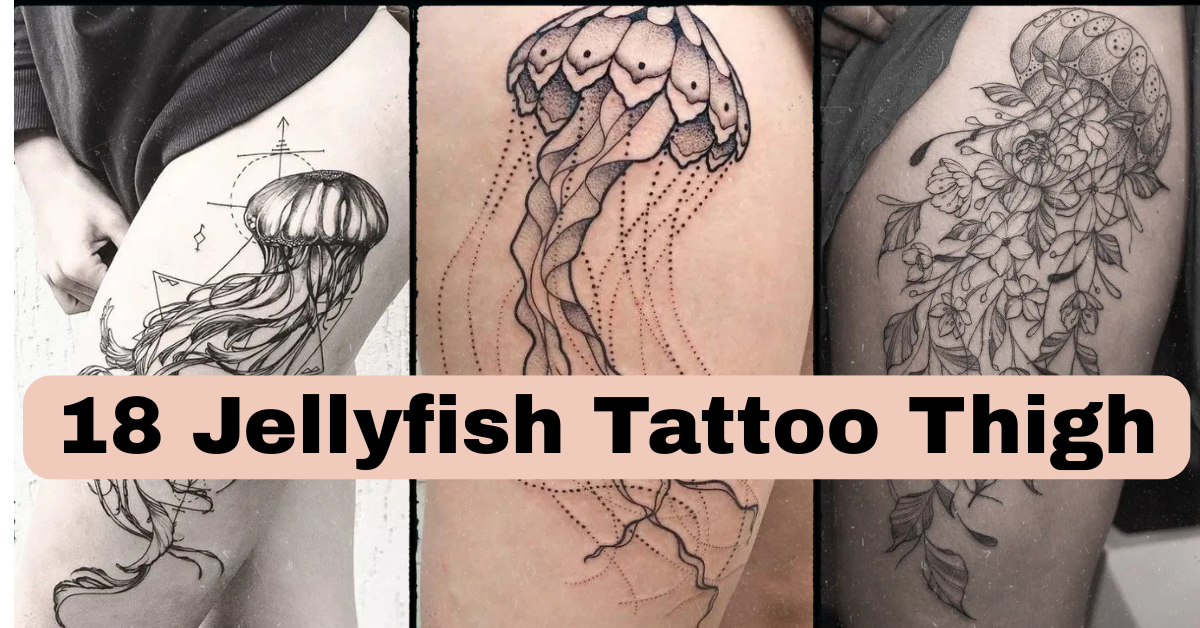
18 Jellyfish Tattoo Thigh Designs Worth Considering Before You Book
Thinking about a jellyfish tattoo on your thigh but not sure which style actually works on that part of your body? I’ve spent enough time talking to tattoo artists and watching sessions to know that jellyfish designs are trickier than they look — the flowing tentacles need the right technique, or they blur into a smudge after a few years.
So what are the best jellyfish tattoo thigh ideas? Fine-line single jellyfish outlines, dotwork jellyfish with stippled tentacles, and blackwork silhouettes work best on the thigh because the flat, spacious skin holds detailed linework and shading without much distortion. Bold traditional designs also age well here due to the muscle coverage.
Stick around, because I’m covering placement tradeoffs, real pain expectations, healing timelines, how to brief your artist so you don’t end up with a generic flash piece, and the mistakes that ruin good jellyfish designs before they even heal.
Why Jellyfish Designs Work So Well on the Thigh
The thigh is honestly one of the most forgiving canvases on the body. It’s got a big, mostly flat surface area, which means an artist can actually draw out those long, trailing tentacles without cramming them into a weird shape. Jellyfish designs live and die by their flow — the way the tentacles drape and curve — and the thigh gives them room to breathe. It’s also a spot with decent fat and muscle coverage, so linework tends to hold up better over time compared to thinner-skinned areas like the wrist or ankle. Plus, you can choose how visible you want it. Outer thigh placements show in shorts or swimsuits; inner or upper thigh placements stay private. That flexibility is a big reason jellyfish tattoos land here so often.
Fine-Line Single Jellyfish Outline
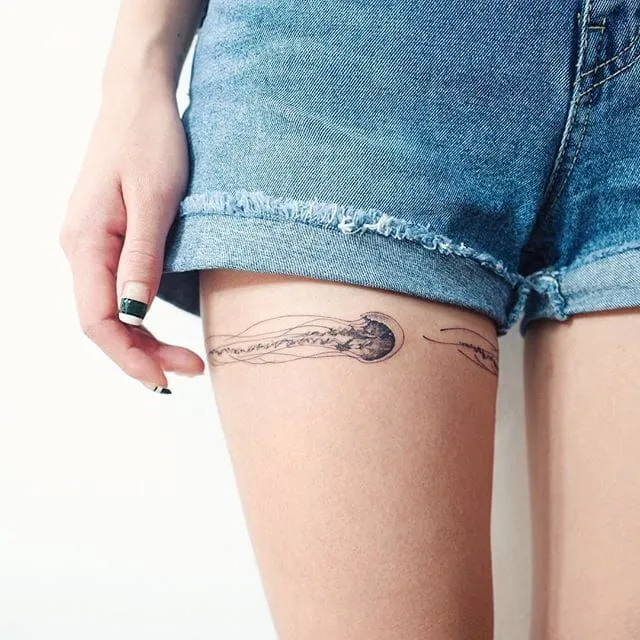
This is the quiet, understated option. A fine-line jellyfish uses thin, consistent needle strokes — usually a single needle or a small liner — to create delicate outlines without heavy shading. The bell (the rounded top part) is often left mostly empty, with just a few subtle strokes to suggest form, while the tentacles trail down in soft, wavy lines. It reads as elegant rather than bold.
Best placed on the outer thigh or just above the knee where the skin is smooth and there’s minimal movement to distort the lines. Keep it at least 4 inches tall so the tentacle details don’t merge together as it settles. Healing typically runs 2 to 3 weeks. Bring a clean vector-style reference image to your consultation — fine line work depends heavily on a crisp stencil. Pain here tends to be moderate since fatty tissue on the thigh softens the sting. Great first-tattoo option.
Blackwork Jellyfish Silhouette
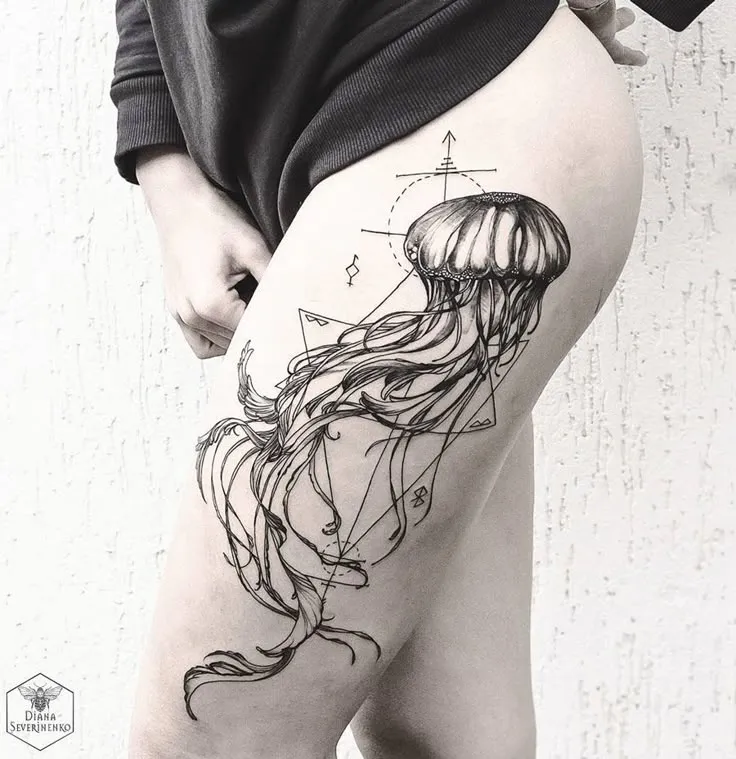
Blackwork means solid, saturated black ink filling in the design rather than relying on outlines alone. A blackwork jellyfish typically shows the bell as a dense, inky dome with tentacles rendered as thick, tapering strokes that fade toward the tips. The contrast is dramatic — this style reads clearly from a distance and doesn’t rely on fine detail to look intentional.
This works especially well on the front or side of the thigh, where a bigger canvas lets the artist balance negative space (the untouched skin used deliberately as part of the design) against the solid black areas. Aim for at least 6 inches for the piece to have real presence. Healing runs 2 to 4 weeks, and saturated black areas may need a touch-up appointment if any ink fades unevenly. Ask your artist about their shading consistency on solid black fills before booking. Pain is generally manageable on the thigh’s fleshier zones.
Dotwork Jellyfish With Stippled Tentacles
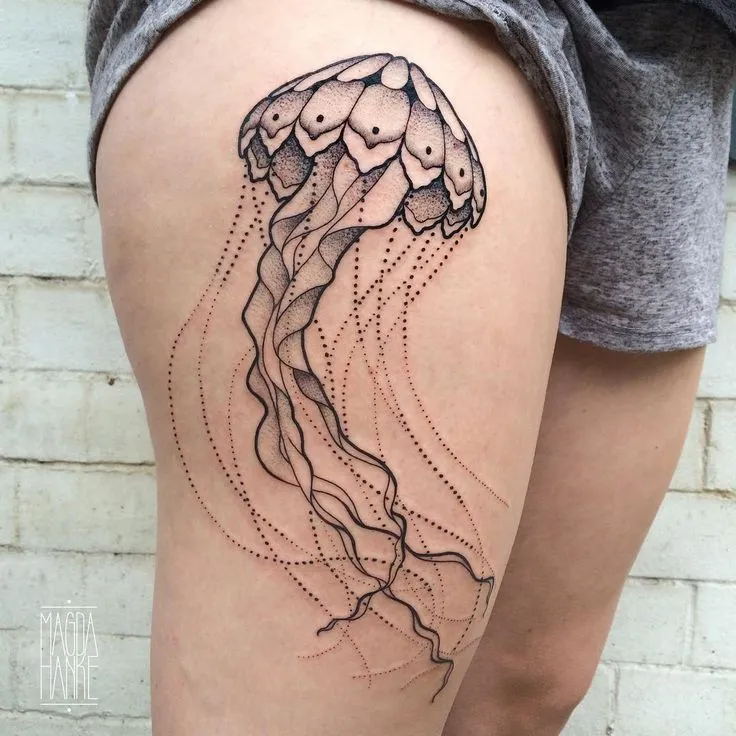
Dotwork builds an image entirely from tiny dots instead of continuous lines, creating a soft, textured gradient effect. For a jellyfish, this technique shines on the tentacles — instead of solid lines, you get a hazy, almost photographic trailing effect that mimics how jellyfish actually look drifting through water.
This design needs patience from both you and the artist since stippling takes longer per square inch than linework. Mid-thigh or the side of the thigh gives enough flat space for the dot gradients to transition smoothly. Size should be 5 inches or larger — dotwork shrinks poorly and can look muddy if too small. Healing takes about 3 weeks, and you’ll want to avoid tight clothing rubbing against the area early on. Tell your artist you want a “gradient stipple effect,” not solid shading, so expectations match technique.
Geometric Jellyfish With Negative Space

This style combines a jellyfish’s natural shape with hard geometric lines — think triangles, hexagons, or dot-grid patterns layered into the bell or tentacles. Negative space (parts of the design left as bare skin) plays a huge role here, often used to create the illusion of light passing through the jellyfish’s translucent body.
The thigh’s broad, even surface is ideal for this because geometric linework needs a flat plane to stay symmetrical. Place it on the front thigh where the shapes won’t warp around curves. Go no smaller than 5 inches so the geometric lines don’t collapse into each other. Healing is typically 2 to 3 weeks. Ask to see the stencil applied to your actual skin before the artist starts — geometric symmetry is easy to get wrong on a curved surface if not checked first.
Bioluminescent Jellyfish With Dot Highlights

Real jellyfish often glow faintly in dark water, and this design translates that idea using small clusters of dots or fine white-ink highlights against darker shading to suggest a soft internal glow. It’s a more advanced technique combining dotwork shading with careful placement of lighter accents.
This design looks best on the outer thigh with enough space to let the darker background shading contrast against the lighter “glow” points. A minimum of 6 inches keeps the light and dark areas distinct instead of blending into gray mush as it heals. Healing runs 3 to 4 weeks since shaded areas take slightly longer to settle. Bring reference photos of actual bioluminescent jellyfish, not just tattoo flash art, so your artist understands the lighting effect you’re after. Pain is moderate to noticeable in heavily shaded zones.
Bold Traditional Jellyfish
Traditional American tattoo style uses thick black outlines, limited color palettes (usually red, yellow, and green), and minimal shading. A traditional jellyfish looks almost cartoonish in the best way — simplified, bold, and built to last decades without losing clarity.
This is one of the most durable styles for the thigh specifically because thick lines and solid color blocks resist the blurring that fine detail suffers from over time. Place it on the front or outer thigh at 5 to 7 inches. Healing takes 2 to 3 weeks. Because color saturation matters here, ask your artist how many passes they typically do on colored traditional work — thin, single-pass color often fades faster. This is a solid pick if you want something that still looks sharp in fifteen years.
Minimalist Single-Needle Jellyfish
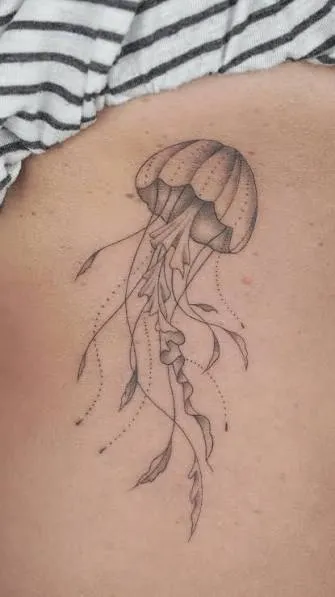
Single-needle work is about as delicate as tattooing gets — one fine needle point creates thread-thin lines with almost no shading. A minimalist jellyfish rendered this way looks more like a pencil sketch than a traditional tattoo, often reduced to just the essential curve of the bell and a few tentacle lines.
Because the lines are so thin, this design ages differently than bolder styles — expect some softening after 8 to 10 years, which is worth knowing upfront. Best placed on the upper thigh or inner thigh where subtlety matters more than boldness. Keep it small, 2 to 4 inches, since that’s the whole appeal. Healing is quick, around 10 to 14 days. This is a strong low-commitment option for a first tattoo or a discreet placement.
Realistic Shaded Jellyfish
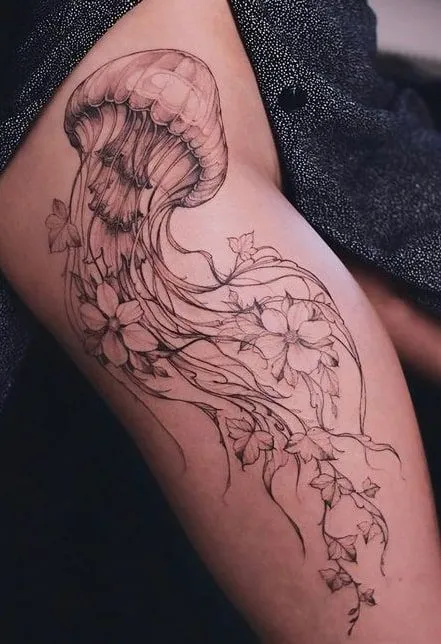
Realism relies on smooth shading gradients, built up through layered passes of gray-toned ink, to mimic the actual translucent, almost glassy texture of a jellyfish. This is technically demanding work — it requires an artist experienced specifically in realism, not just general tattooing.
The thigh’s size advantage really matters here. You need at least 7 inches of space for shading gradients to transition believably instead of looking flat or patchy. Front or side thigh placement works best. Healing runs 3 to 4 weeks, and shaded realism pieces are more prone to needing a touch-up within the first year as ink settles unevenly in some spots. Bring high-resolution reference photos, ideally multiple angles, so the artist can study how light hits a real jellyfish’s form.
Jellyfish and Moon Composition
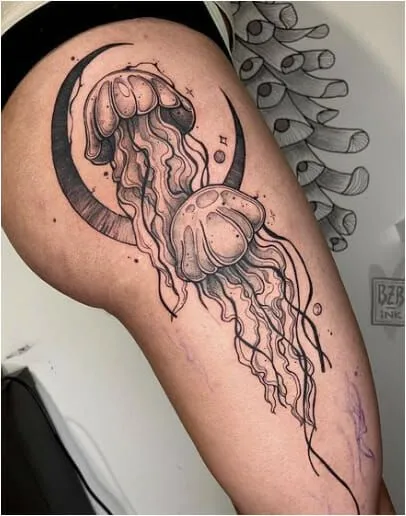
Pairing a jellyfish with a crescent or full moon creates a composition with built-in visual balance — the round or curved moon shape echoes the dome of the jellyfish’s bell, while the tentacles trail downward to fill the remaining space. It’s a popular combination because it gives the tattoo a sense of narrative, like a small scene rather than an isolated object.
This layout benefits from the thigh’s vertical length, letting the moon sit higher near the hip and the tentacles flow toward the knee. Aim for 6 to 8 inches total. Healing takes 2 to 3 weeks. When briefing your artist, specify whether you want the moon in linework, dotwork, or solid blackwork, since mismatched techniques between the two elements can make the piece feel disjointed.
Jellyfish Swarm Cluster Design
Instead of one large jellyfish, this approach scatters three to five smaller ones across the thigh at varying sizes and angles, mimicking how jellyfish drift in groups. It works particularly well as a wraparound piece that follows the natural curve of the leg.
Because this design covers more surface area, it usually requires multiple sessions and a higher budget. Placement should span the outer thigh down toward the knee for the most natural drifting effect. Each jellyfish in the cluster should be at least 2.5 inches to keep tentacle details from disappearing. Healing takes 3 to 4 weeks total since you’re covering more skin. This works well if you want something that feels custom rather than like a stock flash design.
Mandala-Style Jellyfish
This design fuses the jellyfish’s bell shape with radial mandala patterning — symmetrical linework radiating outward in repeating shapes. The tentacles often get reimagined as flowing decorative lines rather than literal jellyfish limbs, blending symbolic pattern work with the sea creature’s silhouette.
Mandala work demands precise symmetry, so the thigh’s flat plane is almost a requirement rather than a preference. Front thigh placement, sized 6 inches or larger, allows the radial pattern to stay balanced. Healing takes about 3 weeks. Ask to see your artist’s freehand symmetry skills in their portfolio specifically, since mandala patterns drawn without a stencil grid often drift off-center. This design suits people drawn to spiritual or symbolic meaning alongside the ocean imagery.
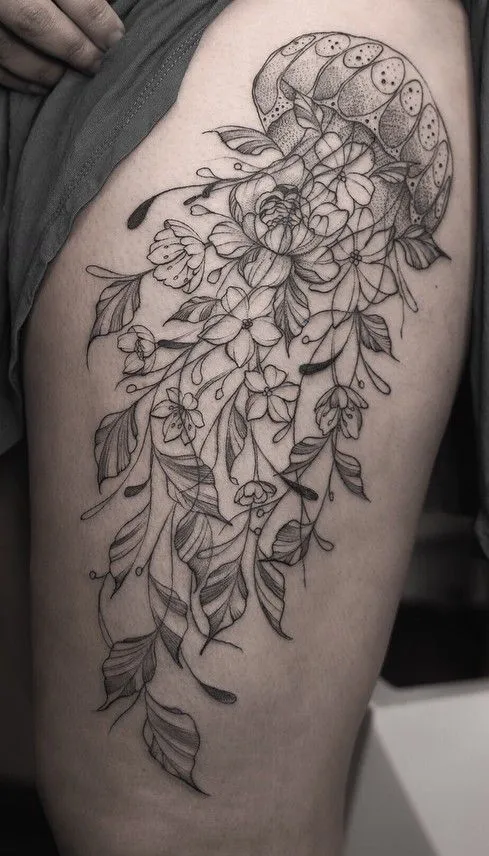
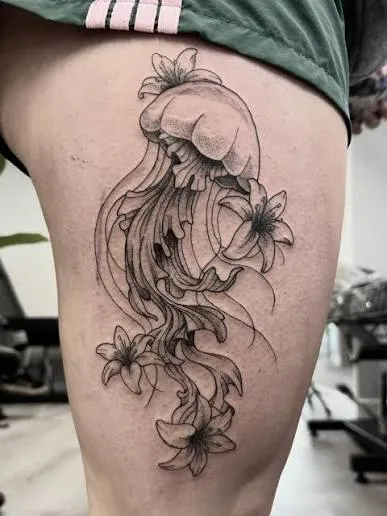
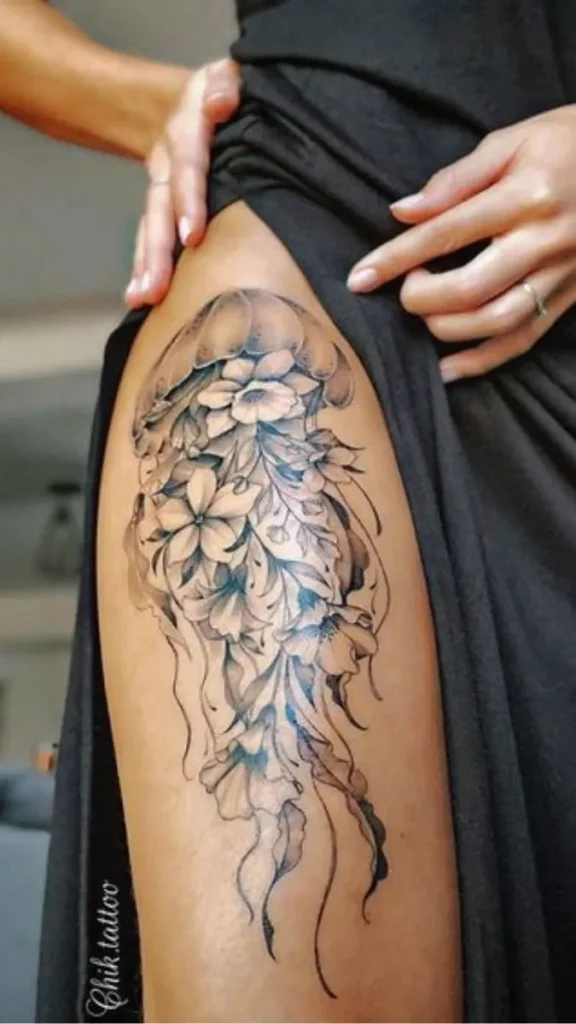
Jellyfish With Floral Accents

Small botanical elements — a few line-drawn flowers or leaves — woven around the jellyfish’s tentacles soften the overall look and add a personal, decorative touch. This composition usually blends fine-line botanical work with whatever core technique the jellyfish itself uses, whether that’s dotwork or solid blackwork.
Place this on the inner or upper thigh where the added detail reads as intimate rather than bold. Size should stay around 5 to 6 inches so both the jellyfish and floral details stay legible. Healing runs 2 to 3 weeks. A useful tip: choose flowers with personal meaning rather than generic filler blooms — it gives the piece a story instead of just decoration. This combination works nicely for anniversary or memorial-inspired tattoos.
Sketch-Style Jellyfish
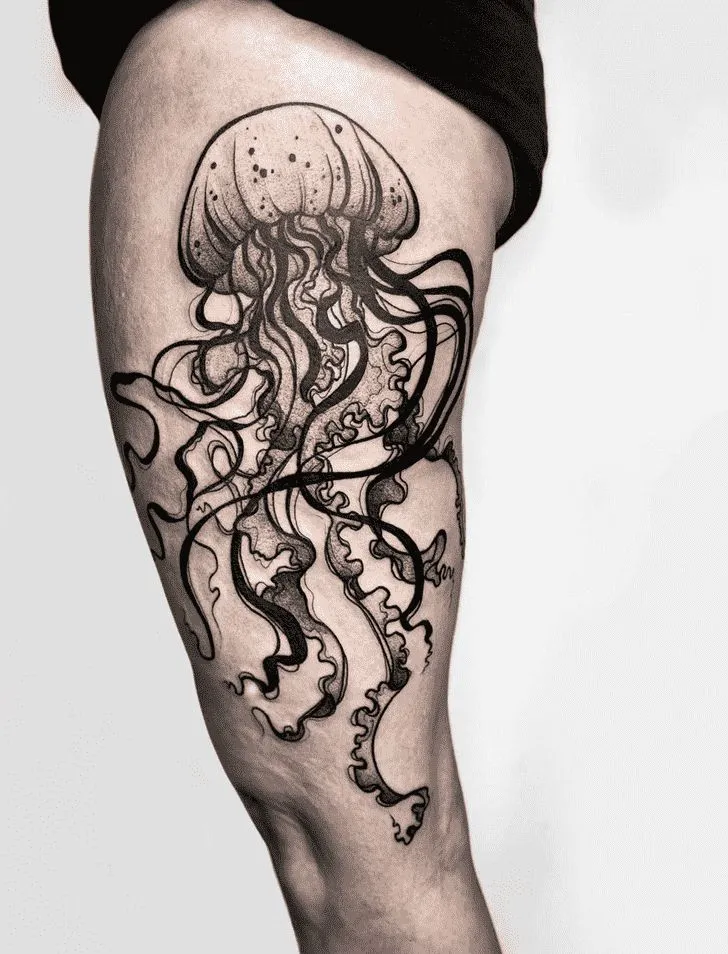
Sketch-style tattoos intentionally look unfinished — think loose, slightly uneven lines, cross-hatching, and visible “construction lines” that mimic a hand-drawn sketchbook page. It’s a deliberate technique, not sloppy work, and it takes a skilled linework artist to pull off convincingly.
This style photographs beautifully on the thigh because the looser lines contrast nicely against smooth skin. Keep it 4 to 6 inches for the sketch marks to stay visible without crowding. Healing takes 2 to 3 weeks. When briefing your artist, bring examples of actual sketch-style tattoo work, not pencil drawings — the translation from paper to skin changes how “loose” lines should be weighted.
Ornamental Jellyfish With Linework Patterns
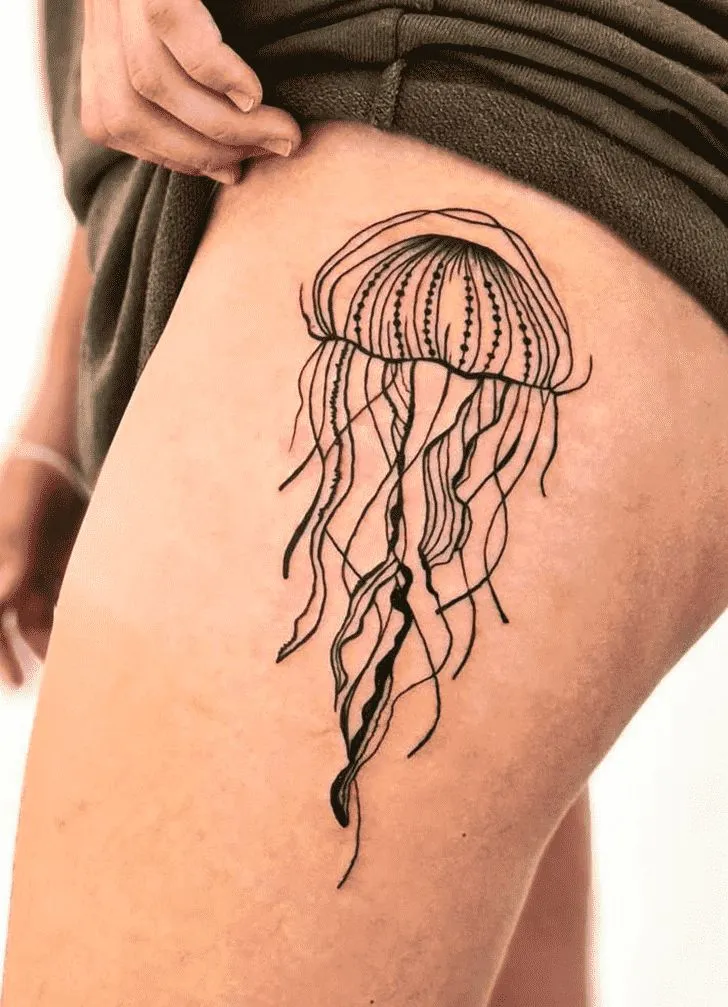
This design treats the jellyfish’s tentacles as a canvas for decorative patterning — small repeating shapes, dot chains, or filigree-style lines running along each tentacle’s length. It’s more about pattern than realism, turning the creature into something closer to jewelry design.
Because the detail is dense, this needs a larger space to avoid looking cluttered. Outer thigh, 6 to 8 inches, works well. Healing takes 3 weeks. This is a good design to personalize — ask your artist to swap generic filigree for a pattern style that matches jewelry or art you already love, so it doesn’t look identical to someone else’s tattoo.
Large Wraparound Thigh Jellyfish
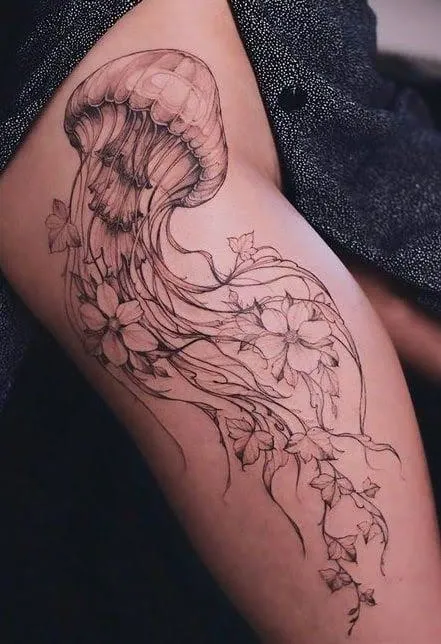
This is the boldest option on the list — a single jellyfish scaled up to cover most of the outer or front thigh, tentacles wrapping partially around the leg. It’s a serious commitment requiring multiple sessions and a higher budget, but the visual impact is hard to match.
Expect 3 to 5 hour-long sessions depending on detail level. Healing for a piece this size runs closer to 4 weeks, with some scabbing and peeling along the way that’s completely normal. This size works best with either blackwork or bold traditional technique, since fine detail gets harder to maintain at that scale. Only book this after seeing an artist’s portfolio of similarly large-scale work.
Small Jellyfish Trio, Scattered Placement
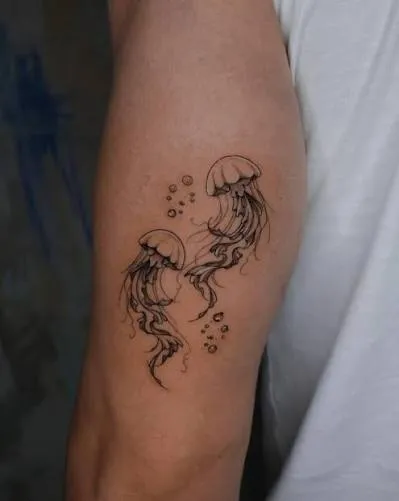
Rather than one focal design, three small jellyfish — each under 2 inches — are placed with intentional gaps across the thigh, almost like a constellation. This suits people who want something delicate and asymmetrical rather than a single centered piece.
Upper thigh or the side near the hip works well for this scattered approach. Healing is quick, around 10 to 14 days per session if done separately. Because the pieces are small, stick to simple fine-line or single-needle technique — detailed shading won’t hold up at this size. This is a low-commitment option and a popular choice for matching tattoos among friends who each get one jellyfish from the trio.
Neo-Traditional Color Jellyfish
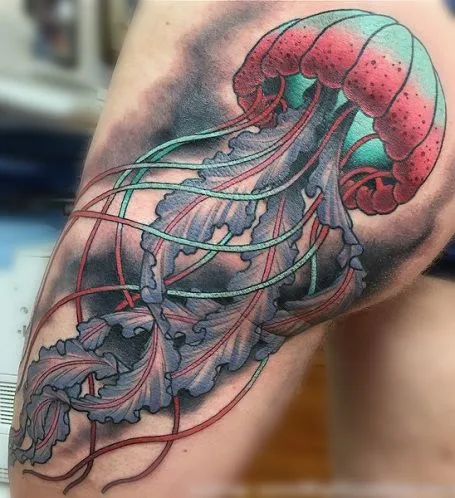
Neo-traditional style takes the bold lines of classic traditional tattooing and adds richer color palettes, more shading depth, and slightly more illustrative detail. A neo-traditional jellyfish might include gradient blues, purples, or teals through the bell, with tentacles rendered in flowing, slightly exaggerated curves.
This style needs real space to let the color transitions read clearly, so aim for 6 inches minimum on the front or outer thigh. Healing runs 3 to 4 weeks, and colored ink can take a bit longer to fully settle than black-only work. Ask your artist specifically about their color saturation technique and how many sessions they recommend for full color depth. This is a strong choice if you want boldness and color without going fully into realism.
Best Placement Ideas for Thigh Jellyfish Tattoos
- Outer thigh — high visibility in shorts and swimwear, moderate pain, easiest for the artist to work on due to flat positioning
- Inner thigh — private placement, generally more sensitive skin, better for smaller or simpler designs
- Front thigh — great for symmetrical designs like mandalas or geometric work, moderate visibility
- Upper thigh near hip — easy to conceal, good for scattered or trio designs, slightly more discreet
- Full wraparound thigh — maximum visual impact, longest healing time, best suited to bold or blackwork styles
Tips for Success
Look for an artist whose portfolio shows multiple examples of the specific technique you want — not just jellyfish tattoos in general, but actual dotwork, blackwork, or fine-line pieces they’ve done recently. Healed photos matter more than fresh ones, since fresh tattoos always look sharper than they will in a year. Bring 2 to 3 reference images instead of one, and be upfront about your pain tolerance and budget during the consultation. A good artist will talk you through placement, sizing, and technique tradeoffs rather than just tracing whatever image you bring in.
Common Mistakes and How to Avoid Them
- Going too small for the detail level — dotwork and shaded realism need space; shrinking them below 4-5 inches often causes the design to blur together within a few years
- Choosing a placement that fights the design’s flow — long trailing tentacles need a placement that lets them stretch naturally, like the thigh, rather than a cramped area
- Skipping aftercare instructions — every artist gives a slightly different aftercare sheet; follow theirs specifically rather than generic advice found online
- Copying a design exactly from Pinterest or Instagram — personalizing even small details (color choice, one added element) prevents your tattoo from looking identical to hundreds of others
Similar Variations Worth Considering
Nearly every design above can shift dramatically with small changes. A fine-line jellyfish can gain subtle color washes for a softer, less stark look. A blackwork silhouette can shrink into a small trio for a more delicate feel. Dotwork tentacles can extend into a full sleeve-style leg piece if you eventually want to expand. Even the traditional bold jellyfish can drop the color entirely for a black-and-gray version that ages a bit differently. Talk to your artist about which adjustments fit the technique you’ve chosen before committing to a final size.
Aftercare Basics
General aftercare guidance includes keeping the tattoo clean, avoiding direct sun exposure while healing, not picking at any scabbing or peeling, and wearing loose clothing over the area for the first couple of weeks to reduce friction. Every studio provides its own aftercare sheet, and you should follow that specific guidance over generic internet advice. If you notice unusual redness, swelling, or discharge beyond normal healing, consult a licensed dermatologist or your tattoo artist promptly. Healing time and skin reaction vary from person to person, so don’t panic if your healing timeline looks slightly different from someone else’s.
Quick FAQ
How much does a jellyfish thigh tattoo cost?
Pricing depends heavily on size, technique, and your artist’s hourly rate, but most jellyfish thigh designs range from $150 for small, simple pieces to $600 or more for large, detailed color or dotwork designs spanning multiple sessions.
Does a thigh tattoo hurt a lot?
The thigh is generally considered one of the more tolerable placements since it has more muscle and fat coverage than bony areas like the ankle or ribs, though pain tolerance varies quite a bit from person to person.
How long does a jellyfish tattoo take to heal?
Most jellyfish thigh tattoos heal within 2 to 4 weeks depending on size and technique, with larger or heavily shaded pieces sometimes taking closer to a month for the surface to fully settle.
Will the design still look good in ten years?
Bold traditional and blackwork styles tend to hold their shape longest, while fine-line and single-needle designs may soften slightly over a decade — regular sun protection and following your artist’s touch-up recommendations both help maintain clarity over time.
Choosing a jellyfish tattoo thigh design really comes down to matching the technique to how you actually want it to look years from now, not just today. Whether you land on a soft fine-line outline or a bold wraparound blackwork piece, the thigh gives you enough room to do the design justice — you just need to be honest with your artist about size, placement, and long-term expectations. Take your time picking a licensed professional whose portfolio actually matches the style you want, and don’t rush the decision just to get it done. A well-planned jellyfish tattoo thigh piece is one you’ll still be glad you chose a decade from now.